

512
A. Karabchevsky et al.
F p =
3π c
4ω 2 μ 0
Re
kl
ˆ
e p,k ˆ
e
∗
p,l K kl ˆ
P kl ,
(18.64)
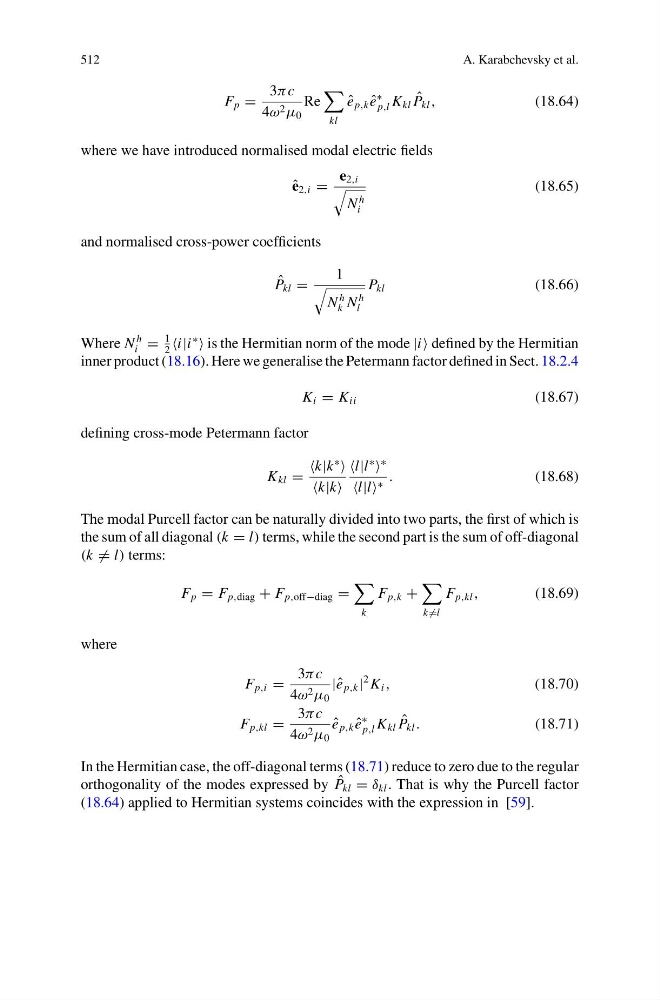
where we have introduced normalised modal electric fields
ˆ
e 2,i =
e 2,i
N
h
i
(18.65)
and normalised cross-power coefficients
ˆ
P kl =
1
N
h
k N
h
l
P kl
(18.66)
Where N
h
i =
1
2
i|i
∗
is the Hermitian norm of the mode |i defined by the Hermitian
inner product (18.16). Here we generalise the Petermann factor defined in Sect. 18.2.4
K i = K ii
(18.67)
defining cross-mode Petermann factor
K kl =
k|k
∗
k|k
l|l
∗
∗
l|l ∗ .
(18.68)
The modal Purcell factor can be naturally divided into two parts, the first of which is
the sum of all diagonal (k = l) terms, while the second part is the sum of off-diagonal
(k = l) terms:
F p = F p,diag + F p,off−diag =
k
F p,k +
k =l
F p,kl ,
(18.69)
where
F p,i =
3π c
4ω 2 μ 0
|ˆ e p,k |
2 K i ,
(18.70)
F p,kl =
3π c
4ω 2 μ 0
ˆ
e p,k ˆ
e
∗
p,l K kl ˆ
P kl .
(18.71)
In the Hermitian case, the off-diagonal terms (18.71) reduce to zero due to the regular
orthogonality of the modes expressed by ˆ
P kl = δ kl . That is why the Purcell factor
(18.64) applied to Hermitian systems coincides with the expression in [59].
A. Karabchevsky et al.
F p =
3π c
4ω 2 μ 0
Re
kl
ˆ
e p,k ˆ
e
∗
p,l K kl ˆ
P kl ,
(18.64)
where we have introduced normalised modal electric fields
ˆ
e 2,i =
e 2,i
N
h
i
(18.65)
and normalised cross-power coefficients
ˆ
P kl =
1
N
h
k N
h
l
P kl
(18.66)
Where N
h
i =
1
2
i|i
∗
is the Hermitian norm of the mode |i defined by the Hermitian
inner product (18.16). Here we generalise the Petermann factor defined in Sect. 18.2.4
K i = K ii
(18.67)
defining cross-mode Petermann factor
K kl =
k|k
∗
k|k
l|l
∗
∗
l|l ∗ .
(18.68)
The modal Purcell factor can be naturally divided into two parts, the first of which is
the sum of all diagonal (k = l) terms, while the second part is the sum of off-diagonal
(k = l) terms:
F p = F p,diag + F p,off−diag =
k
F p,k +
k =l
F p,kl ,
(18.69)
where
F p,i =
3π c
4ω 2 μ 0
|ˆ e p,k |
2 K i ,
(18.70)
F p,kl =
3π c
4ω 2 μ 0
ˆ
e p,k ˆ
e
∗
p,l K kl ˆ
P kl .
(18.71)
In the Hermitian case, the off-diagonal terms (18.71) reduce to zero due to the regular
orthogonality of the modes expressed by ˆ
P kl = δ kl . That is why the Purcell factor
(18.64) applied to Hermitian systems coincides with the expression in [59].