

510
A. Karabchevsky et al.
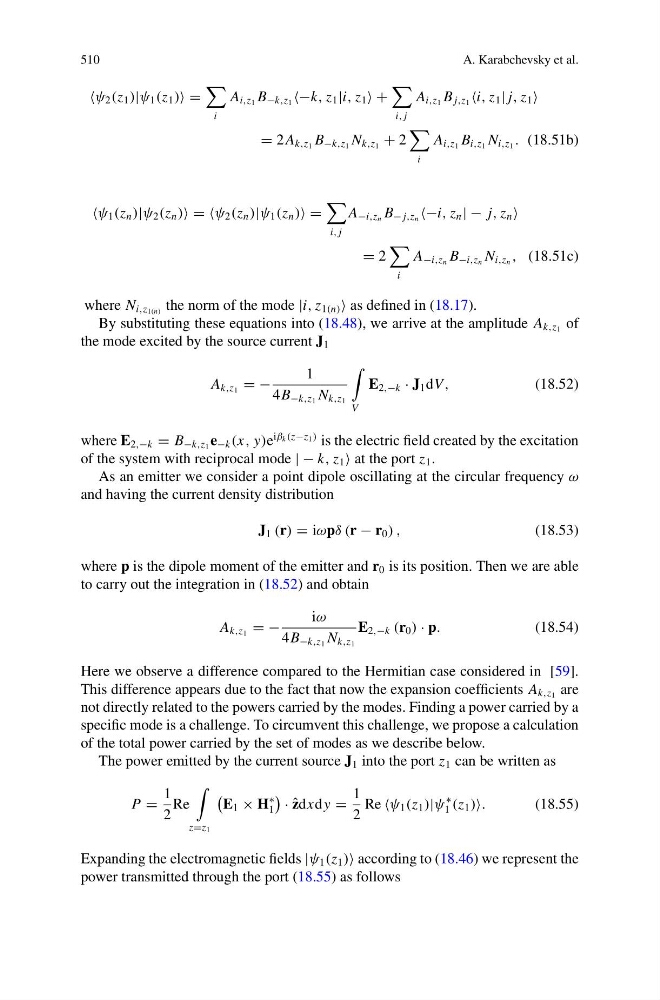
ψ 2 (z 1 )|ψ 1 (z 1 ) =
i
A i,z 1 B −k,z 1 −k, z 1 |i, z 1 +
i, j
A i,z 1 B j,z 1 i, z 1 | j, z 1
= 2 A k,z 1 B −k,z 1 N k,z 1 + 2
i
A i,z 1 B i,z 1 N i,z 1 . (18.51b)
ψ 1 (z n )|ψ 2 (z n ) = =ψ 2 (z n )|ψ 1 (z n ) =
i, j
A −i,z n B − j,z n −i, z n | − j, z n
= 2
i
A −i,z n B −i,z n N i,z n , (18.51c)
where N i,z 1(n) the norm of the mode |i, z 1(n) as defined in (18.17).
By substituting these equations into (18.48), we arrive at the amplitude A k,z 1 of
the mode excited by the source current J 1
A k,z 1 = −
1
4B −k,z 1 N k,z 1
V
E 2,−k · J 1 dV,
(18.52)
where E 2,−k = B −k,z 1 e −k (x, y)e
iβ k (z−z 1 ) is the electric field created by the excitation
of the system with reciprocal mode | − k, z 1 at the port z 1 .
As an emitter we consider a point dipole oscillating at the circular frequency ω
and having the current density distribution
J 1 (r) = iωpδ (r − r 0 ) ,
(18.53)
where p is the dipole moment of the emitter and r 0 is its position. Then we are able
to carry out the integration in (18.52) and obtain
A k,z 1 = −
iω
4B −k,z 1 N k,z 1
E 2,−k (r 0 ) · p.
(18.54)
Here we observe a difference compared to the Hermitian case considered in [59].
This difference appears due to the fact that now the expansion coefficients A k,z 1 are
not directly related to the powers carried by the modes. Finding a power carried by a
specific mode is a challenge. To circumvent this challenge, we propose a calculation
of the total power carried by the set of modes as we describe below.
The power emitted by the current source J 1 into the port z 1 can be written as
P =
1
2
Re
z=z 1
E 1 × H
∗
1
· ˆ
zdxdy =
1
2
Re ψ 1 (z 1 )|ψ
∗
1 (z 1 ).
(18.55)
Expanding the electromagnetic fields |ψ 1 (z 1 ) according to (18.46) we represent the
power transmitted through the port (18.55) as follows
A. Karabchevsky et al.
ψ 2 (z 1 )|ψ 1 (z 1 ) =
i
A i,z 1 B −k,z 1 −k, z 1 |i, z 1 +
i, j
A i,z 1 B j,z 1 i, z 1 | j, z 1
= 2 A k,z 1 B −k,z 1 N k,z 1 + 2
i
A i,z 1 B i,z 1 N i,z 1 . (18.51b)
ψ 1 (z n )|ψ 2 (z n ) = =ψ 2 (z n )|ψ 1 (z n ) =
i, j
A −i,z n B − j,z n −i, z n | − j, z n
= 2
i
A −i,z n B −i,z n N i,z n , (18.51c)
where N i,z 1(n) the norm of the mode |i, z 1(n) as defined in (18.17).
By substituting these equations into (18.48), we arrive at the amplitude A k,z 1 of
the mode excited by the source current J 1
A k,z 1 = −
1
4B −k,z 1 N k,z 1
V
E 2,−k · J 1 dV,
(18.52)
where E 2,−k = B −k,z 1 e −k (x, y)e
iβ k (z−z 1 ) is the electric field created by the excitation
of the system with reciprocal mode | − k, z 1 at the port z 1 .
As an emitter we consider a point dipole oscillating at the circular frequency ω
and having the current density distribution
J 1 (r) = iωpδ (r − r 0 ) ,
(18.53)
where p is the dipole moment of the emitter and r 0 is its position. Then we are able
to carry out the integration in (18.52) and obtain
A k,z 1 = −
iω
4B −k,z 1 N k,z 1
E 2,−k (r 0 ) · p.
(18.54)
Here we observe a difference compared to the Hermitian case considered in [59].
This difference appears due to the fact that now the expansion coefficients A k,z 1 are
not directly related to the powers carried by the modes. Finding a power carried by a
specific mode is a challenge. To circumvent this challenge, we propose a calculation
of the total power carried by the set of modes as we describe below.
The power emitted by the current source J 1 into the port z 1 can be written as
P =
1
2
Re
z=z 1
E 1 × H
∗
1
· ˆ
zdxdy =
1
2
Re ψ 1 (z 1 )|ψ
∗
1 (z 1 ).
(18.55)
Expanding the electromagnetic fields |ψ 1 (z 1 ) according to (18.46) we represent the
power transmitted through the port (18.55) as follows