

18 Purcell Effect in PT-Symmetric Waveguides
499
18.2.5 Eigenmodes of PT-Symmetric Optical Systems
To get some insight on the eigenstates of photonic PT-symmetric systems, let us analyse the system of two coupled waveguides using the coupled mode theory. Coupled
waveguides are the simplest systems proposed at the beginning of the era of optical
PT symmetry [16]. As schematically shown in Fig. 18.5a, they consist of gain and
lossy waveguides having identical geometrical parameters at a distance g one from
another. The waveguide can be either slab, rectangular, circular or gradient one, yet
the physics behind the coupling mechanism is the same.
We express the total field in the coupled system in terms of the modes |g =
(e g,t , h g,t )
T and |l = (e l,t , h l,t )
T of isolated gain and loss waveguides with corresponding z-dependent amplitudes g and l as
|ψ = g(z)|g + l(z)|l.
(18.22)
We assume that the overlap between the modes of isolated waveguides is negligible
(weak coupling condition), therefore, the modes are orthogonal and normalised as
follows
g|l = =g|l
∗
= 0,
(18.23)
g|g = =l|l = 1.
(18.24)
ˆ
P ˆ
T operator converts the mode of isolated lossy waveguide to the mode of the
isolated gain waveguide and vice versa, and so
ˆ
P ˆ
T |g = |l,
(18.25a)
ˆ
P ˆ
T |l = |g.
(18.25b)
Coupled mode theory for optical PT-symmetric systems can be formulated on the
basis of Lagrangian formalism [17] or by using Lorentz reciprocity theorem [18].
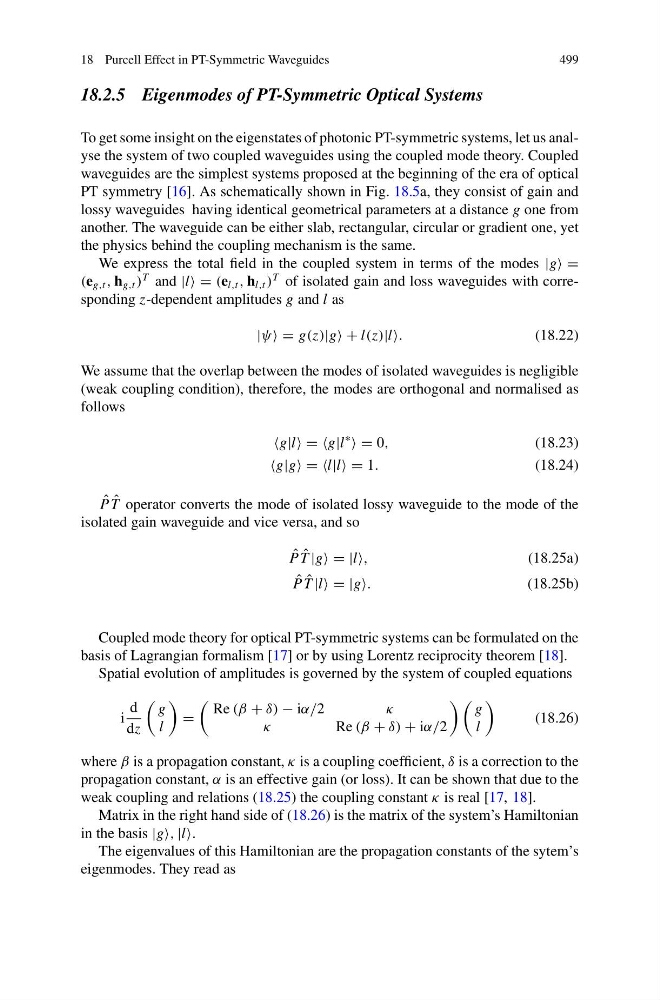
Spatial evolution of amplitudes is governed by the system of coupled equations
i
d
dz
g
l
=
Re (β + δ) − iα/2
κ
κ
Re (β + δ) + iα/2
g
l
(18.26)
where β is a propagation constant, κ is a coupling coefficient, δ is a correction to the
propagation constant, α is an effective gain (or loss). It can be shown that due to the
weak coupling and relations (18.25) the coupling constant κ is real [17, 18].
Matrix in the right hand side of (18.26) is the matrix of the system’s Hamiltonian
in the basis |g, |l.
The eigenvalues of this Hamiltonian are the propagation constants of the sytem’s
eigenmodes. They read as
499
18.2.5 Eigenmodes of PT-Symmetric Optical Systems
To get some insight on the eigenstates of photonic PT-symmetric systems, let us analyse the system of two coupled waveguides using the coupled mode theory. Coupled
waveguides are the simplest systems proposed at the beginning of the era of optical
PT symmetry [16]. As schematically shown in Fig. 18.5a, they consist of gain and
lossy waveguides having identical geometrical parameters at a distance g one from
another. The waveguide can be either slab, rectangular, circular or gradient one, yet
the physics behind the coupling mechanism is the same.
We express the total field in the coupled system in terms of the modes |g =
(e g,t , h g,t )
T and |l = (e l,t , h l,t )
T of isolated gain and loss waveguides with corresponding z-dependent amplitudes g and l as
|ψ = g(z)|g + l(z)|l.
(18.22)
We assume that the overlap between the modes of isolated waveguides is negligible
(weak coupling condition), therefore, the modes are orthogonal and normalised as
follows
g|l = =g|l
∗
= 0,
(18.23)
g|g = =l|l = 1.
(18.24)
ˆ
P ˆ
T operator converts the mode of isolated lossy waveguide to the mode of the
isolated gain waveguide and vice versa, and so
ˆ
P ˆ
T |g = |l,
(18.25a)
ˆ
P ˆ
T |l = |g.
(18.25b)
Coupled mode theory for optical PT-symmetric systems can be formulated on the
basis of Lagrangian formalism [17] or by using Lorentz reciprocity theorem [18].
Spatial evolution of amplitudes is governed by the system of coupled equations
i
d
dz
g
l
=
Re (β + δ) − iα/2
κ
κ
Re (β + δ) + iα/2
g
l
(18.26)
where β is a propagation constant, κ is a coupling coefficient, δ is a correction to the
propagation constant, α is an effective gain (or loss). It can be shown that due to the
weak coupling and relations (18.25) the coupling constant κ is real [17, 18].
Matrix in the right hand side of (18.26) is the matrix of the system’s Hamiltonian
in the basis |g, |l.
The eigenvalues of this Hamiltonian are the propagation constants of the sytem’s
eigenmodes. They read as