

498
A. Karabchevsky et al.
i| j
∗
=
e i × h
∗
j
· ˆ
zdxdy ∼ δ i j ,
(18.16)
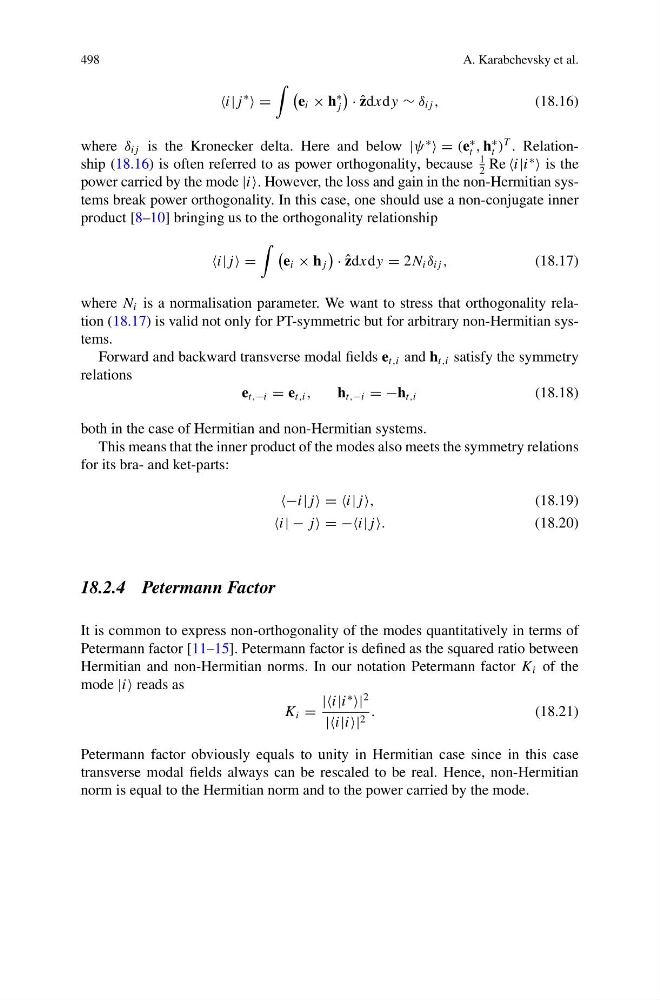
where δ i j is the Kronecker delta. Here and below |ψ
∗
= (e
∗
t , h
∗
t )
T . Relationship (18.16) is often referred to as power orthogonality, because
1
2
Re i|i
∗
is the
power carried by the mode |i. However, the loss and gain in the non-Hermitian systems break power orthogonality. In this case, one should use a non-conjugate inner
product [8–10] bringing us to the orthogonality relationship
i| j =
e i × h j
· ˆ
zdxdy = 2N i δ i j ,
(18.17)
where N i is a normalisation parameter. We want to stress that orthogonality relation (18.17) is valid not only for PT-symmetric but for arbitrary non-Hermitian systems.
Forward and backward transverse modal fields e t,i and h t,i satisfy the symmetry
relations
e t,−i = e t,i ,
h t,−i = −h t,i
(18.18)
both in the case of Hermitian and non-Hermitian systems.
This means that the inner product of the modes also meets the symmetry relations
for its bra- and ket-parts:
−i| j = =i| j,
(18.19)
i| − j = −−i| j.
(18.20)
18.2.4 Petermann Factor
It is common to express non-orthogonality of the modes quantitatively in terms of
Petermann factor [11–15]. Petermann factor is defined as the squared ratio between
Hermitian and non-Hermitian norms. In our notation Petermann factor K i of the
mode |i reads as
K i =
||i|i
∗
|
2
||i|i| 2 .
(18.21)
Petermann factor obviously equals to unity in Hermitian case since in this case
transverse modal fields always can be rescaled to be real. Hence, non-Hermitian
norm is equal to the Hermitian norm and to the power carried by the mode.
A. Karabchevsky et al.
i| j
∗
=
e i × h
∗
j
· ˆ
zdxdy ∼ δ i j ,
(18.16)
where δ i j is the Kronecker delta. Here and below |ψ
∗
= (e
∗
t , h
∗
t )
T . Relationship (18.16) is often referred to as power orthogonality, because
1
2
Re i|i
∗
is the
power carried by the mode |i. However, the loss and gain in the non-Hermitian systems break power orthogonality. In this case, one should use a non-conjugate inner
product [8–10] bringing us to the orthogonality relationship
i| j =
e i × h j
· ˆ
zdxdy = 2N i δ i j ,
(18.17)
where N i is a normalisation parameter. We want to stress that orthogonality relation (18.17) is valid not only for PT-symmetric but for arbitrary non-Hermitian systems.
Forward and backward transverse modal fields e t,i and h t,i satisfy the symmetry
relations
e t,−i = e t,i ,
h t,−i = −h t,i
(18.18)
both in the case of Hermitian and non-Hermitian systems.
This means that the inner product of the modes also meets the symmetry relations
for its bra- and ket-parts:
−i| j = =i| j,
(18.19)
i| − j = −−i| j.
(18.20)
18.2.4 Petermann Factor
It is common to express non-orthogonality of the modes quantitatively in terms of
Petermann factor [11–15]. Petermann factor is defined as the squared ratio between
Hermitian and non-Hermitian norms. In our notation Petermann factor K i of the
mode |i reads as
K i =
||i|i
∗
|
2
||i|i| 2 .
(18.21)
Petermann factor obviously equals to unity in Hermitian case since in this case
transverse modal fields always can be rescaled to be real. Hence, non-Hermitian
norm is equal to the Hermitian norm and to the power carried by the mode.