

17 Axion Electrodynamics in Magnetoelectric Media
483
Let us consider a topological Weyl semimetal with a pair of nodes separated along
the k z -direction in the bulk BZ occupying the half-space z < 0. The region z > 0
is occupied by a dielectric fluid. An electric charge is brought near the surface that
does not support Fermi-arc electronic states, in this case the x y-plane for b = bˆ e z .
Neglecting all frequency dependence on the conductivities (since we deal with a static
problem), the electromagnetic response of the WSM is fully captured by (17.66) and
(17.67), with b 0 = μ 5 and μ = 0. Since θ(z = 0) = 0, there are no surface currents,
and the resulting material is just a bulk Hall medium with current responses given
by the transverse Hall conductivity
σ xy =
e
2 b
2π 2
.
(17.69)
Due to the gauge invariance of the theory, we can introduce the electromagnetic
potentials as usual: E = −∇ and B = ∇ × A. In the Coulomb gauge ∇ · A = 0,
for a pointlike electric charge of strength q at r
= z
ˆ
e z with z
> 0 (that is the
charge lies in the dielectric fluid), the electromagnetic potentials satisfy the coupled
equations of motion
−∇ · [(z)∇] +
4π
c
σ xy (z) ˆ
e z · ∇ × A = 4πqδ(z − z
),
(17.70)
−∇
2 A +
4π
c
σ xy (z) ˆ
e z × ∇ = 0,
(17.71)
where σ xy (z) = σ xy H (−z) is the bulk Hall conductivity and (z) = 1 H (−z) +
2 H (z) is the static permittivity of the system. The differential equations (17.70) and
(17.71), along with the appropriate boundary conditions at the interface z = 0 and at
the singular point z = z
, constitute a complete boundary value problem, which can
be solved with standard techniques of electromagnetism [42]. The solution is simple,
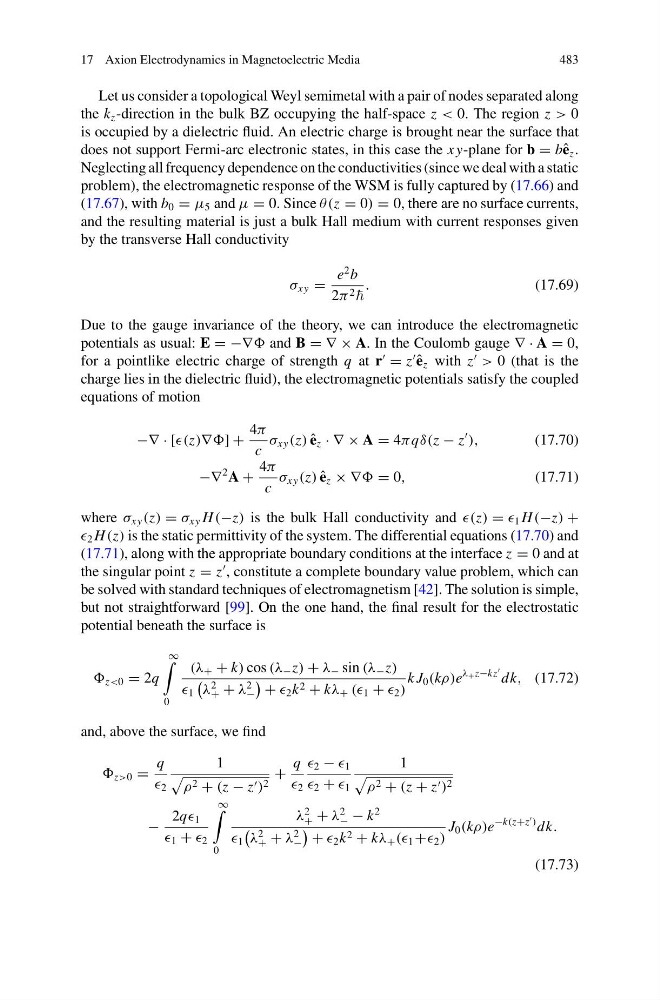
but not straightforward [99]. On the one hand, the final result for the electrostatic
potential beneath the surface is
z<0 = 2q
∞
0
(λ + + k) cos (λ − z) + λ − sin (λ − z)
1
λ
2
+ + λ
2
−
+ 2 k 2 + kλ + ( 1 + 2 )
k J 0 (kρ)e
λ + z−kz
dk, (17.72)
and, above the surface, we find
z>0 =
q
2
1
ρ 2 + (z − z ) 2
+
q
2
2 − 1
2 + 1
1
ρ 2 + (z + z ) 2
−
2q 1
1 + 2
∞
0
λ
2
+ + λ
2
− − k
2
1
λ
2
+ + λ
2
−
+ 2 k 2 + kλ + ( 1 + 2 )
J 0 (kρ)e
−k(z+z
) dk.
(17.73)
483
Let us consider a topological Weyl semimetal with a pair of nodes separated along
the k z -direction in the bulk BZ occupying the half-space z < 0. The region z > 0
is occupied by a dielectric fluid. An electric charge is brought near the surface that
does not support Fermi-arc electronic states, in this case the x y-plane for b = bˆ e z .
Neglecting all frequency dependence on the conductivities (since we deal with a static
problem), the electromagnetic response of the WSM is fully captured by (17.66) and
(17.67), with b 0 = μ 5 and μ = 0. Since θ(z = 0) = 0, there are no surface currents,
and the resulting material is just a bulk Hall medium with current responses given
by the transverse Hall conductivity
σ xy =
e
2 b
2π 2
.
(17.69)
Due to the gauge invariance of the theory, we can introduce the electromagnetic
potentials as usual: E = −∇ and B = ∇ × A. In the Coulomb gauge ∇ · A = 0,
for a pointlike electric charge of strength q at r
= z
ˆ
e z with z
> 0 (that is the
charge lies in the dielectric fluid), the electromagnetic potentials satisfy the coupled
equations of motion
−∇ · [(z)∇] +
4π
c
σ xy (z) ˆ
e z · ∇ × A = 4πqδ(z − z
),
(17.70)
−∇
2 A +
4π
c
σ xy (z) ˆ
e z × ∇ = 0,
(17.71)
where σ xy (z) = σ xy H (−z) is the bulk Hall conductivity and (z) = 1 H (−z) +
2 H (z) is the static permittivity of the system. The differential equations (17.70) and
(17.71), along with the appropriate boundary conditions at the interface z = 0 and at
the singular point z = z
, constitute a complete boundary value problem, which can
be solved with standard techniques of electromagnetism [42]. The solution is simple,
but not straightforward [99]. On the one hand, the final result for the electrostatic
potential beneath the surface is
z<0 = 2q
∞
0
(λ + + k) cos (λ − z) + λ − sin (λ − z)
1
λ
2
+ + λ
2
−
+ 2 k 2 + kλ + ( 1 + 2 )
k J 0 (kρ)e
λ + z−kz
dk, (17.72)
and, above the surface, we find
z>0 =
q
2
1
ρ 2 + (z − z ) 2
+
q
2
2 − 1
2 + 1
1
ρ 2 + (z + z ) 2
−
2q 1
1 + 2
∞
0
λ
2
+ + λ
2
− − k
2
1
λ
2
+ + λ
2
−
+ 2 k 2 + kλ + ( 1 + 2 )
J 0 (kρ)e
−k(z+z
) dk.
(17.73)