

482
A. Martín-Ruiz et al.
where D = ε E and B = ˜
μ H. Faraday’s law, ∇ × E = −c
−1
∂B/∂t, and the equation
stating the absence of magnetic monopoles, ∇ · B = 0, remain unaltered. Here, as in
ordinary metals, ε = + iσ xx (ω)/ω and ˜
μ = 1 + χ m , where is the static permittivity, σ xx (ω) is the longitudinal conductivity and χ m is the magnetic susceptibility
that we assume is negligible for the WSM. Again, we will treat the WSM material as
linear and isotropic, but the extension to the linear and anisotropic case is possible.
There are other distinguishing effects of Weyl semimetals not fully captured by
axion electrodynamics, such as the chiral magnetic effect and the chiral separation
effect. These can be derived by using, for example, the semiclassical Boltzmann
transport theory. In short, if we have chiral fermions in a magnetic field with chemical
potentials μ L and μ R for left- and right-handed fermions, respectively, there are two
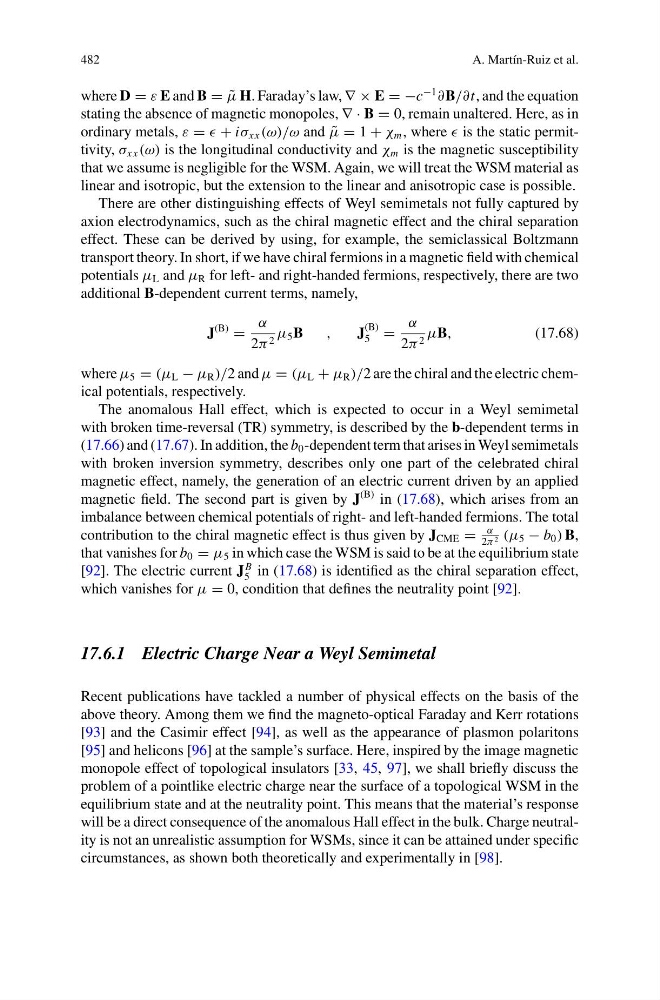
additional B-dependent current terms, namely,
J
(B)
=
α
2π 2 μ 5 B
,
J
(B)
5 =
α
2π 2 μB,
(17.68)
where μ 5 = (μ L − μ R )/2 and μ = (μ L + μ R )/2 are the chiral and the electric chemical potentials, respectively.
The anomalous Hall effect, which is expected to occur in a Weyl semimetal
with broken time-reversal (TR) symmetry, is described by the b-dependent terms in
(17.66) and (17.67). In addition, the b 0 -dependent term that arises in Weyl semimetals
with broken inversion symmetry, describes only one part of the celebrated chiral
magnetic effect, namely, the generation of an electric current driven by an applied
magnetic field. The second part is given by J
(B) in (17.68), which arises from an
imbalance between chemical potentials of right- and left-handed fermions. The total
contribution to the chiral magnetic effect is thus given by J CME =
α
2π 2 (μ 5 − b 0 ) B,
that vanishes for b 0 = μ 5 in which case the WSM is said to be at the equilibrium state
[92]. The electric current J
B
5 in (17.68) is identified as the chiral separation effect,
which vanishes for μ = 0, condition that defines the neutrality point [92].
17.6.1 Electric Charge Near a Weyl Semimetal
Recent publications have tackled a number of physical effects on the basis of the
above theory. Among them we find the magneto-optical Faraday and Kerr rotations
[93] and the Casimir effect [94], as well as the appearance of plasmon polaritons
[95] and helicons [96] at the sample’s surface. Here, inspired by the image magnetic
monopole effect of topological insulators [33, 45, 97], we shall briefly discuss the
problem of a pointlike electric charge near the surface of a topological WSM in the
equilibrium state and at the neutrality point. This means that the material’s response
will be a direct consequence of the anomalous Hall effect in the bulk. Charge neutrality is not an unrealistic assumption for WSMs, since it can be attained under specific
circumstances, as shown both theoretically and experimentally in [98].
A. Martín-Ruiz et al.
where D = ε E and B = ˜
μ H. Faraday’s law, ∇ × E = −c
−1
∂B/∂t, and the equation
stating the absence of magnetic monopoles, ∇ · B = 0, remain unaltered. Here, as in
ordinary metals, ε = + iσ xx (ω)/ω and ˜
μ = 1 + χ m , where is the static permittivity, σ xx (ω) is the longitudinal conductivity and χ m is the magnetic susceptibility
that we assume is negligible for the WSM. Again, we will treat the WSM material as
linear and isotropic, but the extension to the linear and anisotropic case is possible.
There are other distinguishing effects of Weyl semimetals not fully captured by
axion electrodynamics, such as the chiral magnetic effect and the chiral separation
effect. These can be derived by using, for example, the semiclassical Boltzmann
transport theory. In short, if we have chiral fermions in a magnetic field with chemical
potentials μ L and μ R for left- and right-handed fermions, respectively, there are two
additional B-dependent current terms, namely,
J
(B)
=
α
2π 2 μ 5 B
,
J
(B)
5 =
α
2π 2 μB,
(17.68)
where μ 5 = (μ L − μ R )/2 and μ = (μ L + μ R )/2 are the chiral and the electric chemical potentials, respectively.
The anomalous Hall effect, which is expected to occur in a Weyl semimetal
with broken time-reversal (TR) symmetry, is described by the b-dependent terms in
(17.66) and (17.67). In addition, the b 0 -dependent term that arises in Weyl semimetals
with broken inversion symmetry, describes only one part of the celebrated chiral
magnetic effect, namely, the generation of an electric current driven by an applied
magnetic field. The second part is given by J
(B) in (17.68), which arises from an
imbalance between chemical potentials of right- and left-handed fermions. The total
contribution to the chiral magnetic effect is thus given by J CME =
α
2π 2 (μ 5 − b 0 ) B,
that vanishes for b 0 = μ 5 in which case the WSM is said to be at the equilibrium state
[92]. The electric current J
B
5 in (17.68) is identified as the chiral separation effect,
which vanishes for μ = 0, condition that defines the neutrality point [92].
17.6.1 Electric Charge Near a Weyl Semimetal
Recent publications have tackled a number of physical effects on the basis of the
above theory. Among them we find the magneto-optical Faraday and Kerr rotations
[93] and the Casimir effect [94], as well as the appearance of plasmon polaritons
[95] and helicons [96] at the sample’s surface. Here, inspired by the image magnetic
monopole effect of topological insulators [33, 45, 97], we shall briefly discuss the
problem of a pointlike electric charge near the surface of a topological WSM in the
equilibrium state and at the neutrality point. This means that the material’s response
will be a direct consequence of the anomalous Hall effect in the bulk. Charge neutrality is not an unrealistic assumption for WSMs, since it can be attained under specific
circumstances, as shown both theoretically and experimentally in [98].