

17 Axion Electrodynamics in Magnetoelectric Media
481
in the Cherenkov spectrum and is always accompanied by forward radiation with
the same frequency, (iii) the angular distribution of the RVCR is suppressed with
respect to the forward emission by a factor ˜
θ
2
/8n
2 . The details of this development
are reported in [64].
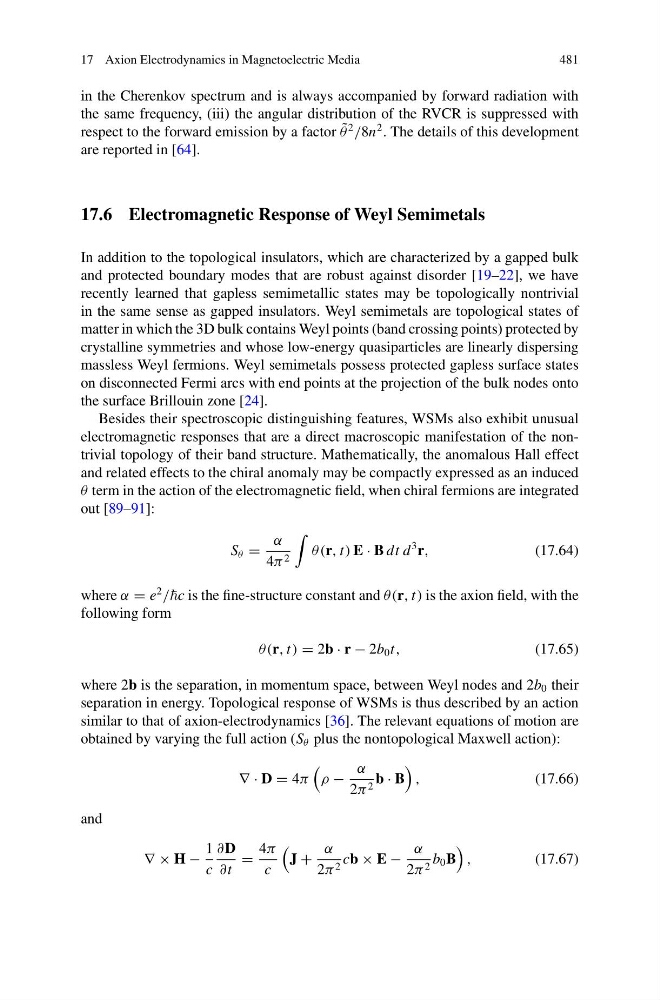
17.6 Electromagnetic Response of Weyl Semimetals
In addition to the topological insulators, which are characterized by a gapped bulk
and protected boundary modes that are robust against disorder [19–22], we have
recently learned that gapless semimetallic states may be topologically nontrivial
in the same sense as gapped insulators. Weyl semimetals are topological states of
matter in which the 3D bulk contains Weyl points (band crossing points) protected by
crystalline symmetries and whose low-energy quasiparticles are linearly dispersing
massless Weyl fermions. Weyl semimetals possess protected gapless surface states
on disconnected Fermi arcs with end points at the projection of the bulk nodes onto
the surface Brillouin zone [24].
Besides their spectroscopic distinguishing features, WSMs also exhibit unusual
electromagnetic responses that are a direct macroscopic manifestation of the nontrivial topology of their band structure. Mathematically, the anomalous Hall effect
and related effects to the chiral anomaly may be compactly expressed as an induced
θ term in the action of the electromagnetic field, when chiral fermions are integrated
out [89–91]:
S θ =
α
4π 2
θ(r, t) E · B dt d
3 r,
(17.64)
where α = e
2
/c is the fine-structure constant and θ(r, t) is the axion field, with the
following form
θ(r, t) = 2b · r − 2b 0 t,
(17.65)
where 2b is the separation, in momentum space, between Weyl nodes and 2b 0 their
separation in energy. Topological response of WSMs is thus described by an action
similar to that of axion-electrodynamics [36]. The relevant equations of motion are
obtained by varying the full action (S θ plus the nontopological Maxwell action):
∇ · D = 4π
ρ −
α
2π 2 b · B
,
(17.66)
and
∇ × H −
1
c
∂D
∂t
=
4π
c
J +
α
2π 2 cb × E −
α
2π 2 b 0 B
,
(17.67)
481
in the Cherenkov spectrum and is always accompanied by forward radiation with
the same frequency, (iii) the angular distribution of the RVCR is suppressed with
respect to the forward emission by a factor ˜
θ
2
/8n
2 . The details of this development
are reported in [64].
17.6 Electromagnetic Response of Weyl Semimetals
In addition to the topological insulators, which are characterized by a gapped bulk
and protected boundary modes that are robust against disorder [19–22], we have
recently learned that gapless semimetallic states may be topologically nontrivial
in the same sense as gapped insulators. Weyl semimetals are topological states of
matter in which the 3D bulk contains Weyl points (band crossing points) protected by
crystalline symmetries and whose low-energy quasiparticles are linearly dispersing
massless Weyl fermions. Weyl semimetals possess protected gapless surface states
on disconnected Fermi arcs with end points at the projection of the bulk nodes onto
the surface Brillouin zone [24].
Besides their spectroscopic distinguishing features, WSMs also exhibit unusual
electromagnetic responses that are a direct macroscopic manifestation of the nontrivial topology of their band structure. Mathematically, the anomalous Hall effect
and related effects to the chiral anomaly may be compactly expressed as an induced
θ term in the action of the electromagnetic field, when chiral fermions are integrated
out [89–91]:
S θ =
α
4π 2
θ(r, t) E · B dt d
3 r,
(17.64)
where α = e
2
/c is the fine-structure constant and θ(r, t) is the axion field, with the
following form
θ(r, t) = 2b · r − 2b 0 t,
(17.65)
where 2b is the separation, in momentum space, between Weyl nodes and 2b 0 their
separation in energy. Topological response of WSMs is thus described by an action
similar to that of axion-electrodynamics [36]. The relevant equations of motion are
obtained by varying the full action (S θ plus the nontopological Maxwell action):
∇ · D = 4π
ρ −
α
2π 2 b · B
,
(17.66)
and
∇ × H −
1
c
∂D
∂t
=
4π
c
J +
α
2π 2 cb × E −
α
2π 2 b 0 B
,
(17.67)