

480
A. Martín-Ruiz et al.
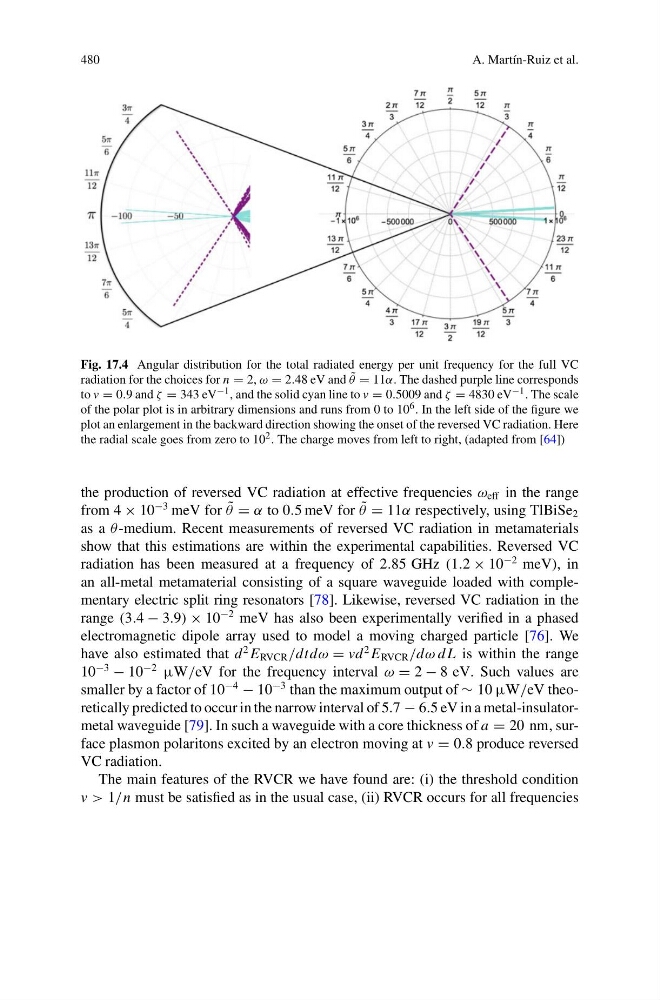
Fig. 17.4 Angular distribution for the total radiated energy per unit frequency for the full VC
radiation for the choices for n = 2, ω = 2.48 eV and ˜
θ = 11α. The dashed purple line corresponds
to v = 0.9 and ζ = 343 eV −1 , and the solid cyan line to v = 0.5009 and ζ = 4830 eV −1 . The scale
of the polar plot is in arbitrary dimensions and runs from 0 to 10 6 . In the left side of the figure we
plot an enlargement in the backward direction showing the onset of the reversed VC radiation. Here
the radial scale goes from zero to 10 2 . The charge moves from left to right, (adapted from [64])
the production of reversed VC radiation at effective frequencies ω eff in the range
from 4 × 10
−3 meV for ˜
θ = α to 0.5 meV for ˜
θ = 11α respectively, using TlBiSe 2
as a θ -medium. Recent measurements of reversed VC radiation in metamaterials
show that this estimations are within the experimental capabilities. Reversed VC
radiation has been measured at a frequency of 2.85 GHz (1.2 × 10
−2 meV), in
an all-metal metamaterial consisting of a square waveguide loaded with complementary electric split ring resonators [78]. Likewise, reversed VC radiation in the
range (3.4 − 3.9) × 10
−2 meV has also been experimentally verified in a phased
electromagnetic dipole array used to model a moving charged particle [76]. We
have also estimated that d
2 E RVCR /dtdω = vd
2 E RVCR /dω d L is within the range
10
−3
− 10
−2
µW/eV for the frequency interval ω = 2 − 8 eV. Such values are
smaller by a factor of 10
−4
− 10
−3 than the maximum output of ∼ 10 µW/eV theoretically predicted to occur in the narrow interval of 5.7 − 6.5 eV in a metal-insulatormetal waveguide [79]. In such a waveguide with a core thickness of a = 20 nm, surface plasmon polaritons excited by an electron moving at v = 0.8 produce reversed
VC radiation.
The main features of the RVCR we have found are: (i) the threshold condition
v > 1/n must be satisfied as in the usual case, (ii) RVCR occurs for all frequencies
A. Martín-Ruiz et al.
Fig. 17.4 Angular distribution for the total radiated energy per unit frequency for the full VC
radiation for the choices for n = 2, ω = 2.48 eV and ˜
θ = 11α. The dashed purple line corresponds
to v = 0.9 and ζ = 343 eV −1 , and the solid cyan line to v = 0.5009 and ζ = 4830 eV −1 . The scale
of the polar plot is in arbitrary dimensions and runs from 0 to 10 6 . In the left side of the figure we
plot an enlargement in the backward direction showing the onset of the reversed VC radiation. Here
the radial scale goes from zero to 10 2 . The charge moves from left to right, (adapted from [64])
the production of reversed VC radiation at effective frequencies ω eff in the range
from 4 × 10
−3 meV for ˜
θ = α to 0.5 meV for ˜
θ = 11α respectively, using TlBiSe 2
as a θ -medium. Recent measurements of reversed VC radiation in metamaterials
show that this estimations are within the experimental capabilities. Reversed VC
radiation has been measured at a frequency of 2.85 GHz (1.2 × 10
−2 meV), in
an all-metal metamaterial consisting of a square waveguide loaded with complementary electric split ring resonators [78]. Likewise, reversed VC radiation in the
range (3.4 − 3.9) × 10
−2 meV has also been experimentally verified in a phased
electromagnetic dipole array used to model a moving charged particle [76]. We
have also estimated that d
2 E RVCR /dtdω = vd
2 E RVCR /dω d L is within the range
10
−3
− 10
−2
µW/eV for the frequency interval ω = 2 − 8 eV. Such values are
smaller by a factor of 10
−4
− 10
−3 than the maximum output of ∼ 10 µW/eV theoretically predicted to occur in the narrow interval of 5.7 − 6.5 eV in a metal-insulatormetal waveguide [79]. In such a waveguide with a core thickness of a = 20 nm, surface plasmon polaritons excited by an electron moving at v = 0.8 produce reversed
VC radiation.
The main features of the RVCR we have found are: (i) the threshold condition
v > 1/n must be satisfied as in the usual case, (ii) RVCR occurs for all frequencies