

17 Axion Electrodynamics in Magnetoelectric Media
479
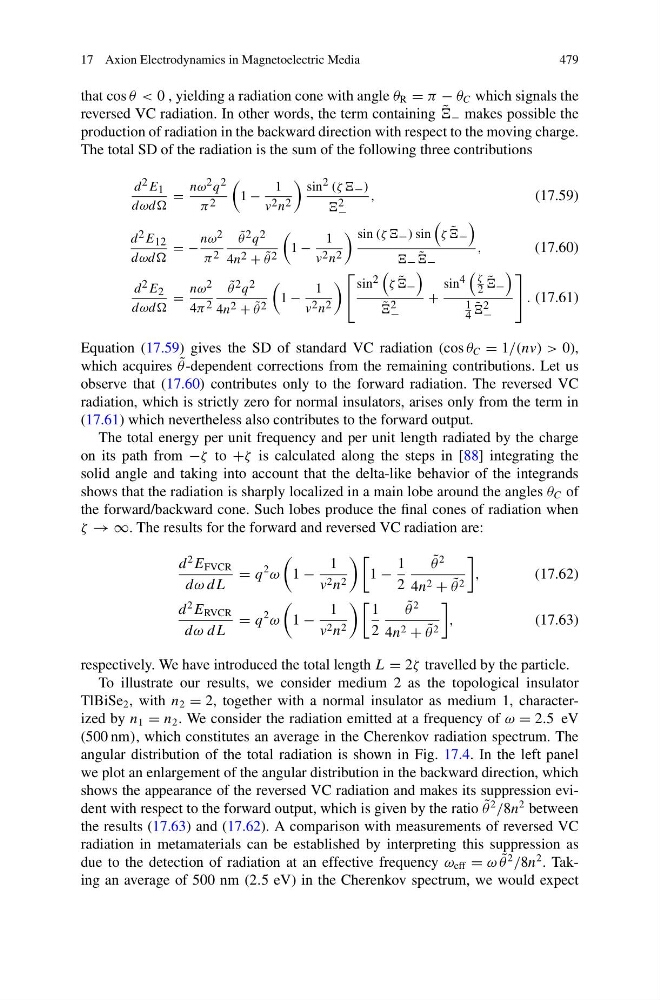
that cos θ < 0 , yielding a radiation cone with angle θ R = π − θ C which signals the
reversed VC radiation. In other words, the term containing ˜
− makes possible the
production of radiation in the backward direction with respect to the moving charge.
The total SD of the radiation is the sum of the following three contributions
d 2 E 1
dωd
=
nω 2 q 2
π 2
1 −
1
v 2 n 2
sin 2 (ζ ζ − )
2
−
,
(17.59)
d 2 E 12
dωd
= −
nω 2
π 2
˜
θ 2 q 2
4n 2 + ˜
θ 2
1 −
1
v 2 n 2
sin (ζ ζ − ) sin
ζ ˜
−
− ˜
−
,
(17.60)
d 2 E 2
dωd
=
nω 2
4π 2
˜
θ 2 q 2
4n 2 + ˜
θ 2
1 −
1
v 2 n 2
⎡
⎣
sin 2
ζ ˜
−
˜
2
−
+
sin 4
ζ
2
˜
−
1
4
˜
2
−
⎤
⎦ . (17.61)
Equation (17.59) gives the SD of standard VC radiation (cos θ C = 1/(nv) > 0),
which acquires ˜
θ -dependent corrections from the remaining contributions. Let us
observe that (17.60) contributes only to the forward radiation. The reversed VC
radiation, which is strictly zero for normal insulators, arises only from the term in
(17.61) which nevertheless also contributes to the forward output.
The total energy per unit frequency and per unit length radiated by the charge
on its path from −ζ to +ζ is calculated along the steps in [88] integrating the
solid angle and taking into account that the delta-like behavior of the integrands
shows that the radiation is sharply localized in a main lobe around the angles θ C of
the forward/backward cone. Such lobes produce the final cones of radiation when
ζ → ∞. The results for the forward and reversed VC radiation are:
d
2 E FVCR
dω d L
= q
2
ω
1 −
1
v 2 n 2
1 −
1
2
˜
θ
2
4n 2 + ˜
θ 2
,
(17.62)
d
2 E RVCR
dω d L
= q
2
ω
1 −
1
v 2 n 2
1
2
˜
θ
2
4n 2 + ˜
θ 2
,
(17.63)
respectively. We have introduced the total length L = 2ζ travelled by the particle.
To illustrate our results, we consider medium 2 as the topological insulator
TlBiSe 2 , with n 2 = 2, together with a normal insulator as medium 1, characterized by n 1 = n 2 . We consider the radiation emitted at a frequency of ω = 2.5 eV
(500 nm), which constitutes an average in the Cherenkov radiation spectrum. The
angular distribution of the total radiation is shown in Fig. 17.4. In the left panel
we plot an enlargement of the angular distribution in the backward direction, which
shows the appearance of the reversed VC radiation and makes its suppression evident with respect to the forward output, which is given by the ratio ˜
θ
2
/8n
2 between
the results (17.63) and (17.62). A comparison with measurements of reversed VC
radiation in metamaterials can be established by interpreting this suppression as
due to the detection of radiation at an effective frequency ω eff = ω ˜
θ
2
/8n
2 . Taking an average of 500 nm (2.5 eV) in the Cherenkov spectrum, we would expect
479
that cos θ < 0 , yielding a radiation cone with angle θ R = π − θ C which signals the
reversed VC radiation. In other words, the term containing ˜
− makes possible the
production of radiation in the backward direction with respect to the moving charge.
The total SD of the radiation is the sum of the following three contributions
d 2 E 1
dωd
=
nω 2 q 2
π 2
1 −
1
v 2 n 2
sin 2 (ζ ζ − )
2
−
,
(17.59)
d 2 E 12
dωd
= −
nω 2
π 2
˜
θ 2 q 2
4n 2 + ˜
θ 2
1 −
1
v 2 n 2
sin (ζ ζ − ) sin
ζ ˜
−
− ˜
−
,
(17.60)
d 2 E 2
dωd
=
nω 2
4π 2
˜
θ 2 q 2
4n 2 + ˜
θ 2
1 −
1
v 2 n 2
⎡
⎣
sin 2
ζ ˜
−
˜
2
−
+
sin 4
ζ
2
˜
−
1
4
˜
2
−
⎤
⎦ . (17.61)
Equation (17.59) gives the SD of standard VC radiation (cos θ C = 1/(nv) > 0),
which acquires ˜
θ -dependent corrections from the remaining contributions. Let us
observe that (17.60) contributes only to the forward radiation. The reversed VC
radiation, which is strictly zero for normal insulators, arises only from the term in
(17.61) which nevertheless also contributes to the forward output.
The total energy per unit frequency and per unit length radiated by the charge
on its path from −ζ to +ζ is calculated along the steps in [88] integrating the
solid angle and taking into account that the delta-like behavior of the integrands
shows that the radiation is sharply localized in a main lobe around the angles θ C of
the forward/backward cone. Such lobes produce the final cones of radiation when
ζ → ∞. The results for the forward and reversed VC radiation are:
d
2 E FVCR
dω d L
= q
2
ω
1 −
1
v 2 n 2
1 −
1
2
˜
θ
2
4n 2 + ˜
θ 2
,
(17.62)
d
2 E RVCR
dω d L
= q
2
ω
1 −
1
v 2 n 2
1
2
˜
θ
2
4n 2 + ˜
θ 2
,
(17.63)
respectively. We have introduced the total length L = 2ζ travelled by the particle.
To illustrate our results, we consider medium 2 as the topological insulator
TlBiSe 2 , with n 2 = 2, together with a normal insulator as medium 1, characterized by n 1 = n 2 . We consider the radiation emitted at a frequency of ω = 2.5 eV
(500 nm), which constitutes an average in the Cherenkov radiation spectrum. The
angular distribution of the total radiation is shown in Fig. 17.4. In the left panel
we plot an enlargement of the angular distribution in the backward direction, which
shows the appearance of the reversed VC radiation and makes its suppression evident with respect to the forward output, which is given by the ratio ˜
θ
2
/8n
2 between
the results (17.63) and (17.62). A comparison with measurements of reversed VC
radiation in metamaterials can be established by interpreting this suppression as
due to the detection of radiation at an effective frequency ω eff = ω ˜
θ
2
/8n
2 . Taking an average of 500 nm (2.5 eV) in the Cherenkov spectrum, we would expect