

478
A. Martín-Ruiz et al.
¯
G
μ
E D ν (x, x
; ω) = η
μ
ν
e i ˜
k 0 r
r
e
−i ˜
k 0 ˆ
x·x ,
¯
G
μ
˜
θ ν
(x, x
; ω) = ε
μ α3
ν
2 ˜
θ
4n 2 + ˜
θ 2
s α
| cos θ|
e i ˜
k 0 r
r
e
i ˜
k 0
−ˆ x·x
+|z cos θ |
,
¯
G
μ
˜
θ 2 ν
(x, x
; ω) =
˜
θ 2
4n 2 + ˜
θ 2
e i ˜
k 0 r
r cos 2 θ
C
μ
ν (θ, φ, n) × e
i ˜
k 0
−ˆ x·x
+|z cos θ |
, (17.55)
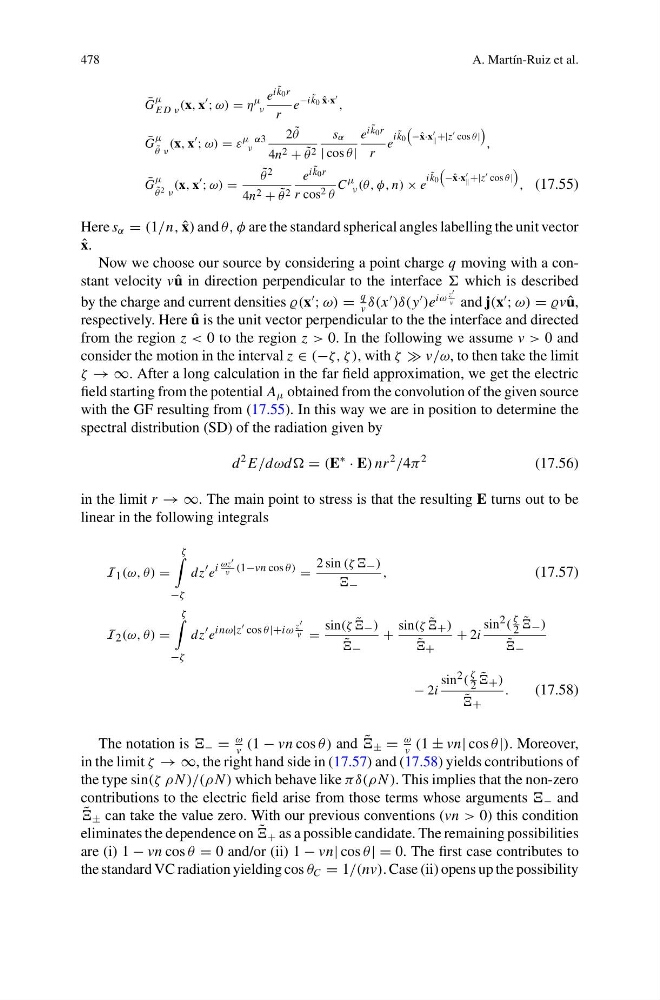
Here s α = (1/n, ˆ
x) and θ, φ are the standard spherical angles labelling the unit vector
ˆ
x.
Now we choose our source by considering a point charge q moving with a constant velocity v ˆ
u in direction perpendicular to the interface which is described
by the charge and current densities (x
; ω) =
q
v
δ(x
)δ(y
)e
iω
z
v and j(x
; ω) = v ˆ
u,
respectively. Here ˆ
u is the unit vector perpendicular to the the interface and directed
from the region z < 0 to the region z > 0. In the following we assume v > 0 and
consider the motion in the interval z ∈ (−ζ, ζ ), with ζ v/ω, to then take the limit
ζ → ∞. After a long calculation in the far field approximation, we get the electric
field starting from the potential A μ obtained from the convolution of the given source
with the GF resulting from (17.55). In this way we are in position to determine the
spectral distribution (SD) of the radiation given by
d
2 E/dωd = (E
∗
· E) nr
2
/4π
2
(17.56)
in the limit r → ∞. The main point to stress is that the resulting E turns out to be
linear in the following integrals
I 1 (ω, θ) =
ζ
−ζ
dz e i
ωz
v (1−vn cos θ) =
2 sin (ζ ζ − )
−
,
(17.57)
I 2 (ω, θ) =
ζ
−ζ
dz e inω|z cos θ|+iω
z
v =
sin(ζ ˜
− )
˜
−
+
sin(ζ ˜
+ )
˜
+
+ 2i
sin 2 (
ζ
2
˜
− )
˜
−
− 2i
sin 2 (
ζ
2
˜
+ )
˜
+
.
(17.58)
The notation is − =
ω
v (1 − vn cos θ ) and ˜
± =
ω
v (1 ± vn| cos θ |). Moreover,
in the limit ζ → ∞, the right hand side in (17.57) and (17.58) yields contributions of
the type sin(ζ ρ N )/(ρ N ) which behave like πδ(ρ N ). This implies that the non-zero
contributions to the electric field arise from those terms whose arguments − and
˜
± can take the value zero. With our previous conventions (vn > 0) this condition
eliminates the dependence on ˜
+ as a possible candidate. The remaining possibilities
are (i) 1 − vn cos θ = 0 and/or (ii) 1 − vn| cos θ | = 0. The first case contributes to
the standard VC radiation yielding cos θ C = 1/(nv). Case (ii) opens up the possibility
A. Martín-Ruiz et al.
¯
G
μ
E D ν (x, x
; ω) = η
μ
ν
e i ˜
k 0 r
r
e
−i ˜
k 0 ˆ
x·x ,
¯
G
μ
˜
θ ν
(x, x
; ω) = ε
μ α3
ν
2 ˜
θ
4n 2 + ˜
θ 2
s α
| cos θ|
e i ˜
k 0 r
r
e
i ˜
k 0
−ˆ x·x
+|z cos θ |
,
¯
G
μ
˜
θ 2 ν
(x, x
; ω) =
˜
θ 2
4n 2 + ˜
θ 2
e i ˜
k 0 r
r cos 2 θ
C
μ
ν (θ, φ, n) × e
i ˜
k 0
−ˆ x·x
+|z cos θ |
, (17.55)
Here s α = (1/n, ˆ
x) and θ, φ are the standard spherical angles labelling the unit vector
ˆ
x.
Now we choose our source by considering a point charge q moving with a constant velocity v ˆ
u in direction perpendicular to the interface which is described
by the charge and current densities (x
; ω) =
q
v
δ(x
)δ(y
)e
iω
z
v and j(x
; ω) = v ˆ
u,
respectively. Here ˆ
u is the unit vector perpendicular to the the interface and directed
from the region z < 0 to the region z > 0. In the following we assume v > 0 and
consider the motion in the interval z ∈ (−ζ, ζ ), with ζ v/ω, to then take the limit
ζ → ∞. After a long calculation in the far field approximation, we get the electric
field starting from the potential A μ obtained from the convolution of the given source
with the GF resulting from (17.55). In this way we are in position to determine the
spectral distribution (SD) of the radiation given by
d
2 E/dωd = (E
∗
· E) nr
2
/4π
2
(17.56)
in the limit r → ∞. The main point to stress is that the resulting E turns out to be
linear in the following integrals
I 1 (ω, θ) =
ζ
−ζ
dz e i
ωz
v (1−vn cos θ) =
2 sin (ζ ζ − )
−
,
(17.57)
I 2 (ω, θ) =
ζ
−ζ
dz e inω|z cos θ|+iω
z
v =
sin(ζ ˜
− )
˜
−
+
sin(ζ ˜
+ )
˜
+
+ 2i
sin 2 (
ζ
2
˜
− )
˜
−
− 2i
sin 2 (
ζ
2
˜
+ )
˜
+
.
(17.58)
The notation is − =
ω
v (1 − vn cos θ ) and ˜
± =
ω
v (1 ± vn| cos θ |). Moreover,
in the limit ζ → ∞, the right hand side in (17.57) and (17.58) yields contributions of
the type sin(ζ ρ N )/(ρ N ) which behave like πδ(ρ N ). This implies that the non-zero
contributions to the electric field arise from those terms whose arguments − and
˜
± can take the value zero. With our previous conventions (vn > 0) this condition
eliminates the dependence on ˜
+ as a possible candidate. The remaining possibilities
are (i) 1 − vn cos θ = 0 and/or (ii) 1 − vn| cos θ | = 0. The first case contributes to
the standard VC radiation yielding cos θ C = 1/(nv). Case (ii) opens up the possibility