

17 Axion Electrodynamics in Magnetoelectric Media
477
of a Fourier transform in the parallel momentum space, as indicated in (17.24),
whose components are explicitly given in (43) of [64]. The next step is to evaluate
the GF in the far-field approximation corresponding to the coordinate conditions
r ≡ ≡x x
, R ≡ ≡
x − x
x , |z| + |z
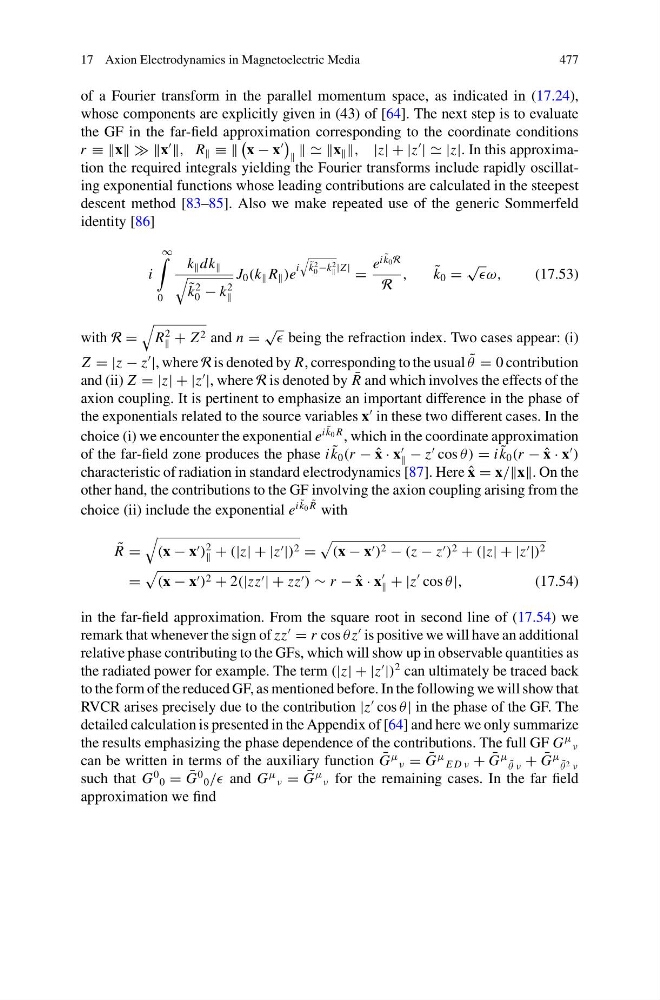
| | |z|. In this approximation the required integrals yielding the Fourier transforms include rapidly oscillating exponential functions whose leading contributions are calculated in the steepest
descent method [83–85]. Also we make repeated use of the generic Sommerfeld
identity [86]
i
∞
0
k dk
˜
k
2
0 − k
2
J 0 (k R )e
i
˜
k
2
0 −k
2
|Z | =
e
i ˜
k 0 R
R
,
˜
k 0 =
√
ω,
(17.53)
with R =
R
2
+ Z 2 and n =
√
being the refraction index. Two cases appear: (i)
Z = |z − z
|, where R is denoted by R, corresponding to the usual ˜
θ = 0 contribution
and (ii) Z = |z| + |z
|, where R is denoted by ¯
R and which involves the effects of the
axion coupling. It is pertinent to emphasize an important difference in the phase of
the exponentials related to the source variables x
in these two different cases. In the
choice (i) we encounter the exponential e
i ˜
k 0 R , which in the coordinate approximation
of the far-field zone produces the phase i ˜
k 0 (r − ˆ
x · x
− z
cos θ) = i ˜
k 0 (r − ˆ
x · x
)
characteristic of radiation in standard electrodynamics [87]. Here ˆ
x = x/x. On the
other hand, the contributions to the GF involving the axion coupling arising from the
choice (ii) include the exponential e
i ˜
k 0 ˜
R with
˜
R =
(x − x )
2
+ (|z| + |z |) 2 =
(x − x ) 2 − (z − z ) 2 + (|z| + |z |) 2
=
(x − x ) 2 + 2(|zz | + zz ) ∼ r − ˆ
x · x
+ |z
cos θ |,
(17.54)
in the far-field approximation. From the square root in second line of (17.54) we
remark that whenever the sign of zz
= r cos θ z
is positive we will have an additional
relative phase contributing to the GFs, which will show up in observable quantities as
the radiated power for example. The term (|z| + |z
|)
2 can ultimately be traced back
to the form of the reduced GF, as mentioned before. In the following we will show that
RVCR arises precisely due to the contribution |z
cos θ | in the phase of the GF. The
detailed calculation is presented in the Appendix of [64] and here we only summarize
the results emphasizing the phase dependence of the contributions. The full GF G
μ ν
can be written in terms of the auxiliary function ¯
G
μ ν = ¯
G
μ
E D ν + ¯
G
μ ˜
θ ν + ¯
G
μ ˜
θ 2 ν
such that G
0
0 = ¯
G
0
0 // and G
μ ν = ¯
G
μ ν for the remaining cases. In the far field
approximation we find
477
of a Fourier transform in the parallel momentum space, as indicated in (17.24),
whose components are explicitly given in (43) of [64]. The next step is to evaluate
the GF in the far-field approximation corresponding to the coordinate conditions
r ≡ ≡x x
, R ≡ ≡
x − x
x , |z| + |z
| | |z|. In this approximation the required integrals yielding the Fourier transforms include rapidly oscillating exponential functions whose leading contributions are calculated in the steepest
descent method [83–85]. Also we make repeated use of the generic Sommerfeld
identity [86]
i
∞
0
k dk
˜
k
2
0 − k
2
J 0 (k R )e
i
˜
k
2
0 −k
2
|Z | =
e
i ˜
k 0 R
R
,
˜
k 0 =
√
ω,
(17.53)
with R =
R
2
+ Z 2 and n =
√
being the refraction index. Two cases appear: (i)
Z = |z − z
|, where R is denoted by R, corresponding to the usual ˜
θ = 0 contribution
and (ii) Z = |z| + |z
|, where R is denoted by ¯
R and which involves the effects of the
axion coupling. It is pertinent to emphasize an important difference in the phase of
the exponentials related to the source variables x
in these two different cases. In the
choice (i) we encounter the exponential e
i ˜
k 0 R , which in the coordinate approximation
of the far-field zone produces the phase i ˜
k 0 (r − ˆ
x · x
− z
cos θ) = i ˜
k 0 (r − ˆ
x · x
)
characteristic of radiation in standard electrodynamics [87]. Here ˆ
x = x/x. On the
other hand, the contributions to the GF involving the axion coupling arising from the
choice (ii) include the exponential e
i ˜
k 0 ˜
R with
˜
R =
(x − x )
2
+ (|z| + |z |) 2 =
(x − x ) 2 − (z − z ) 2 + (|z| + |z |) 2
=
(x − x ) 2 + 2(|zz | + zz ) ∼ r − ˆ
x · x
+ |z
cos θ |,
(17.54)
in the far-field approximation. From the square root in second line of (17.54) we
remark that whenever the sign of zz
= r cos θ z
is positive we will have an additional
relative phase contributing to the GFs, which will show up in observable quantities as
the radiated power for example. The term (|z| + |z
|)
2 can ultimately be traced back
to the form of the reduced GF, as mentioned before. In the following we will show that
RVCR arises precisely due to the contribution |z
cos θ | in the phase of the GF. The
detailed calculation is presented in the Appendix of [64] and here we only summarize
the results emphasizing the phase dependence of the contributions. The full GF G
μ ν
can be written in terms of the auxiliary function ¯
G
μ ν = ¯
G
μ
E D ν + ¯
G
μ ˜
θ ν + ¯
G
μ ˜
θ 2 ν
such that G
0
0 = ¯
G
0
0 // and G
μ ν = ¯
G
μ ν for the remaining cases. In the far field
approximation we find