

476
A. Martín-Ruiz et al.
role in the study of high-energy particle physics, high-power microwave sources and
nuclear and cosmic-ray physics [68, 69], both theoretically and experimentally.
In 1968 Veselago theoretically proposed that RVCR could be produced in materials having simultaneously a negative permittivity and permeability, dubbed as lefthanded media (LHM). A medium is left-handed when the momentum k of a propagating electromagnetic wave is antiparallel to its Poynting vector E × B, i. e., when
the group velocity and the phase velocity of the wave are antiparallel [70]. In this
case photons would be emitted in the backward direction with respect to the velocity
of the propagating charge. Since these materials are not found in nature, this proposal
has generated a great boost to the design and construction of metamaterials, that is,
artifacts built in the laboratory that can reproduce these properties in certain frequency ranges. In recent years the study of RVCR has been of considerable interest
[71–79]. The realization of a LHM in an interface between an ordinary media was
experimentally proved in [80]. It is interesting that Reversed Cherenkov radiation
has also been found for sound in topological insulators in [81, 82].
Let us consider two semi infinite magnetoelectric media (θ 1 = θ 2 ) separated by a
planar interface located at z = 0. The setup is described by θ -ED according to the
conventions in Sect. 17.2 and the modified Maxwell equations are (17.4). This time
we take into account the permittivity of the media, but choose 1 = 2 = to avoid
the interference with transition radiation. Still we consider non-magnetic media with
μ 1 = μ 2 = 1. These choices provide a first approximation to the problem which aims
to single out the effects of the axion coupling, determined by ˜
θ = α(θ 2 − θ 1 )/π .
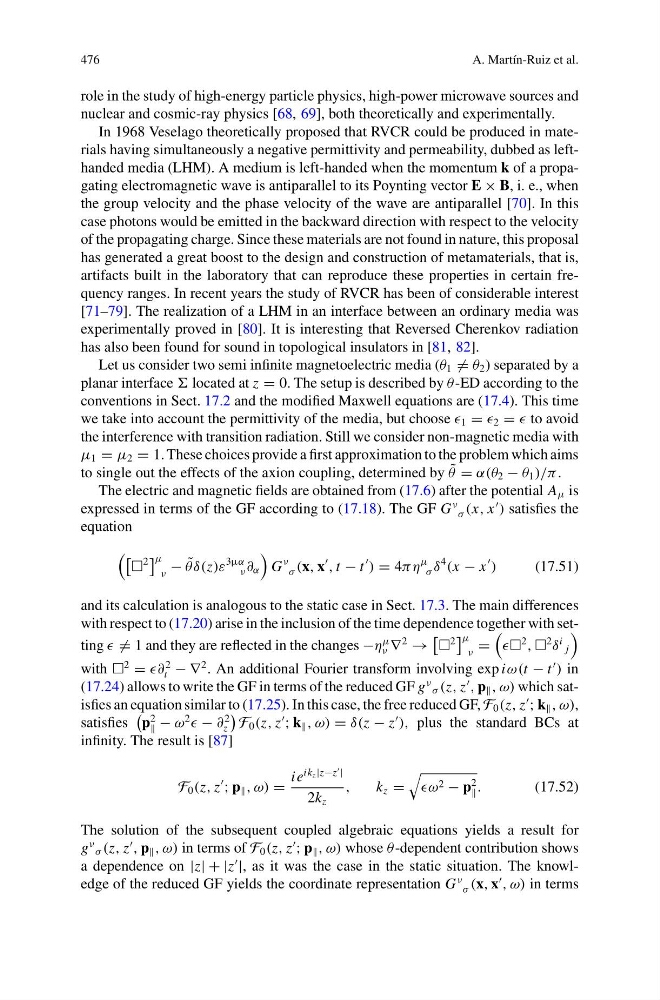
The electric and magnetic fields are obtained from (17.6) after the potential A μ is
expressed in terms of the GF according to (17.18). The GF G
ν σ (x, x
) satisfies the
equation
2
μ
ν
− ˜
θδ(z)ε
3µα
ν ∂ α
G
ν
σ (x, x
, t − t
) = 4πη
μ
σ δ
4
(x − x
)
(17.51)
and its calculation is analogous to the static case in Sect. 17.3. The main differences
with respect to (17.20) arise in the inclusion of the time dependence together with setting = 1 and they are reflected in the changes −η
μ
ν ∇
2
→
2
μ
ν
=
2
,
2
δ
i
j
with
2
= ∂
2
t − ∇
2 . An additional Fourier transform involving exp iω(t − t
) in
(17.24) allows to write the GF in terms of the reduced GF g
ν σ (z, z
, p , ω) which satisfies an equation similar to (17.25). In this case, the free reduced GF, F 0 (z, z
; k , ω),
satisfies
p
2
− ω
2
− ∂
2
z
F 0 (z, z
; k , ω) = δ(z − z
), plus the standard BCs at
infinity. The result is [87]
F 0 (z, z
; p , ω) =
ie
ik z |z−z
|
2k z
,
k z =
ω 2 − p
2
.
(17.52)
The solution of the subsequent coupled algebraic equations yields a result for
g
ν σ (z, z
, p , ω) in terms of F 0 (z, z
; p , ω) whose θ -dependent contribution shows
a dependence on |z| + |z
|, as it was the case in the static situation. The knowledge of the reduced GF yields the coordinate representation G
ν σ (x, x
, ω) in terms
A. Martín-Ruiz et al.
role in the study of high-energy particle physics, high-power microwave sources and
nuclear and cosmic-ray physics [68, 69], both theoretically and experimentally.
In 1968 Veselago theoretically proposed that RVCR could be produced in materials having simultaneously a negative permittivity and permeability, dubbed as lefthanded media (LHM). A medium is left-handed when the momentum k of a propagating electromagnetic wave is antiparallel to its Poynting vector E × B, i. e., when
the group velocity and the phase velocity of the wave are antiparallel [70]. In this
case photons would be emitted in the backward direction with respect to the velocity
of the propagating charge. Since these materials are not found in nature, this proposal
has generated a great boost to the design and construction of metamaterials, that is,
artifacts built in the laboratory that can reproduce these properties in certain frequency ranges. In recent years the study of RVCR has been of considerable interest
[71–79]. The realization of a LHM in an interface between an ordinary media was
experimentally proved in [80]. It is interesting that Reversed Cherenkov radiation
has also been found for sound in topological insulators in [81, 82].
Let us consider two semi infinite magnetoelectric media (θ 1 = θ 2 ) separated by a
planar interface located at z = 0. The setup is described by θ -ED according to the
conventions in Sect. 17.2 and the modified Maxwell equations are (17.4). This time
we take into account the permittivity of the media, but choose 1 = 2 = to avoid
the interference with transition radiation. Still we consider non-magnetic media with
μ 1 = μ 2 = 1. These choices provide a first approximation to the problem which aims
to single out the effects of the axion coupling, determined by ˜
θ = α(θ 2 − θ 1 )/π .
The electric and magnetic fields are obtained from (17.6) after the potential A μ is
expressed in terms of the GF according to (17.18). The GF G
ν σ (x, x
) satisfies the
equation
2
μ
ν
− ˜
θδ(z)ε
3µα
ν ∂ α
G
ν
σ (x, x
, t − t
) = 4πη
μ
σ δ
4
(x − x
)
(17.51)
and its calculation is analogous to the static case in Sect. 17.3. The main differences
with respect to (17.20) arise in the inclusion of the time dependence together with setting = 1 and they are reflected in the changes −η
μ
ν ∇
2
→
2
μ
ν
=
2
,
2
δ
i
j
with
2
= ∂
2
t − ∇
2 . An additional Fourier transform involving exp iω(t − t
) in
(17.24) allows to write the GF in terms of the reduced GF g
ν σ (z, z
, p , ω) which satisfies an equation similar to (17.25). In this case, the free reduced GF, F 0 (z, z
; k , ω),
satisfies
p
2
− ω
2
− ∂
2
z
F 0 (z, z
; k , ω) = δ(z − z
), plus the standard BCs at
infinity. The result is [87]
F 0 (z, z
; p , ω) =
ie
ik z |z−z
|
2k z
,
k z =
ω 2 − p
2
.
(17.52)
The solution of the subsequent coupled algebraic equations yields a result for
g
ν σ (z, z
, p , ω) in terms of F 0 (z, z
; p , ω) whose θ -dependent contribution shows
a dependence on |z| + |z
|, as it was the case in the static situation. The knowledge of the reduced GF yields the coordinate representation G
ν σ (x, x
, ω) in terms