

17 Axion Electrodynamics in Magnetoelectric Media
475
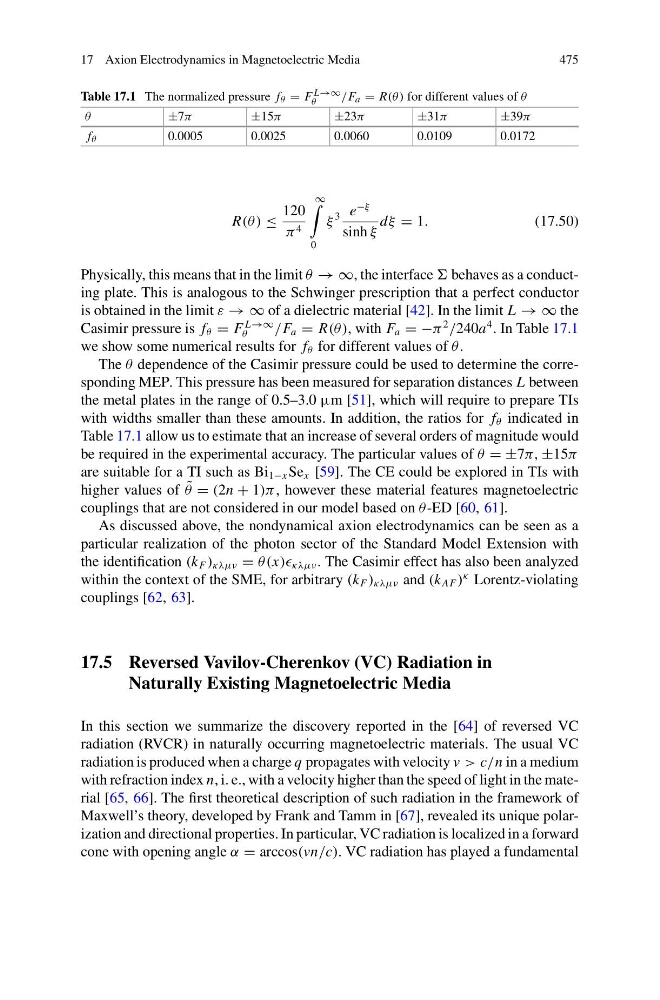
Table 17.1 The normalized pressure f θ = F L→∞
θ
/F a = R(θ) for different values of θ
θ
±7π
±15π
±23π
±31π
±39π
f θ
0.0005
0.0025
0.0060
0.0109
0.0172
R(θ ) ≤
120
π 4
∞
0
ξ
3 e
−ξ
sinh ξ
dξ = 1.
(17.50)
Physically, this means that in the limit θ → ∞, the interface behaves as a conducting plate. This is analogous to the Schwinger prescription that a perfect conductor
is obtained in the limit ε → ∞ of a dielectric material [42]. In the limit L → ∞ the
Casimir pressure is f θ = F
L→∞
θ
/F a = R(θ ), with F a = −π
2
/240a
4 . In Table 17.1
we show some numerical results for f θ for different values of θ .
The θ dependence of the Casimir pressure could be used to determine the corresponding MEP. This pressure has been measured for separation distances L between
the metal plates in the range of 0.5–3.0 µm [51], which will require to prepare TIs
with widths smaller than these amounts. In addition, the ratios for f θ indicated in
Table 17.1 allow us to estimate that an increase of several orders of magnitude would
be required in the experimental accuracy. The particular values of θ = ±7π, ±15π
are suitable for a TI such as Bi 1−x Se x [59]. The CE could be explored in TIs with
higher values of ˜
θ = (2n + 1)π , however these material features magnetoelectric
couplings that are not considered in our model based on θ -ED [60, 61].
As discussed above, the nondynamical axion electrodynamics can be seen as a
particular realization of the photon sector of the Standard Model Extension with
the identification (k F ) κλμν = θ(x)) κλμν . The Casimir effect has also been analyzed
within the context of the SME, for arbitrary (k F ) κλμν and (k AF )
κ Lorentz-violating
couplings [62, 63].
17.5 Reversed Vavilov-Cherenkov (VC) Radiation in
Naturally Existing Magnetoelectric Media
In this section we summarize the discovery reported in the [64] of reversed VC
radiation (RVCR) in naturally occurring magnetoelectric materials. The usual VC
radiation is produced when a charge q propagates with velocity v > c/n in a medium
with refraction index n, i. e., with a velocity higher than the speed of light in the material [65, 66]. The first theoretical description of such radiation in the framework of
Maxwell’s theory, developed by Frank and Tamm in [67], revealed its unique polarization and directional properties. In particular, VC radiation is localized in a forward
cone with opening angle α = arccos(vn/c). VC radiation has played a fundamental
475
Table 17.1 The normalized pressure f θ = F L→∞
θ
/F a = R(θ) for different values of θ
θ
±7π
±15π
±23π
±31π
±39π
f θ
0.0005
0.0025
0.0060
0.0109
0.0172
R(θ ) ≤
120
π 4
∞
0
ξ
3 e
−ξ
sinh ξ
dξ = 1.
(17.50)
Physically, this means that in the limit θ → ∞, the interface behaves as a conducting plate. This is analogous to the Schwinger prescription that a perfect conductor
is obtained in the limit ε → ∞ of a dielectric material [42]. In the limit L → ∞ the
Casimir pressure is f θ = F
L→∞
θ
/F a = R(θ ), with F a = −π
2
/240a
4 . In Table 17.1
we show some numerical results for f θ for different values of θ .
The θ dependence of the Casimir pressure could be used to determine the corresponding MEP. This pressure has been measured for separation distances L between
the metal plates in the range of 0.5–3.0 µm [51], which will require to prepare TIs
with widths smaller than these amounts. In addition, the ratios for f θ indicated in
Table 17.1 allow us to estimate that an increase of several orders of magnitude would
be required in the experimental accuracy. The particular values of θ = ±7π, ±15π
are suitable for a TI such as Bi 1−x Se x [59]. The CE could be explored in TIs with
higher values of ˜
θ = (2n + 1)π , however these material features magnetoelectric
couplings that are not considered in our model based on θ -ED [60, 61].
As discussed above, the nondynamical axion electrodynamics can be seen as a
particular realization of the photon sector of the Standard Model Extension with
the identification (k F ) κλμν = θ(x)) κλμν . The Casimir effect has also been analyzed
within the context of the SME, for arbitrary (k F ) κλμν and (k AF )
κ Lorentz-violating
couplings [62, 63].
17.5 Reversed Vavilov-Cherenkov (VC) Radiation in
Naturally Existing Magnetoelectric Media
In this section we summarize the discovery reported in the [64] of reversed VC
radiation (RVCR) in naturally occurring magnetoelectric materials. The usual VC
radiation is produced when a charge q propagates with velocity v > c/n in a medium
with refraction index n, i. e., with a velocity higher than the speed of light in the material [65, 66]. The first theoretical description of such radiation in the framework of
Maxwell’s theory, developed by Frank and Tamm in [67], revealed its unique polarization and directional properties. In particular, VC radiation is localized in a forward
cone with opening angle α = arccos(vn/c). VC radiation has played a fundamental