

484
A. Martín-Ruiz et al.
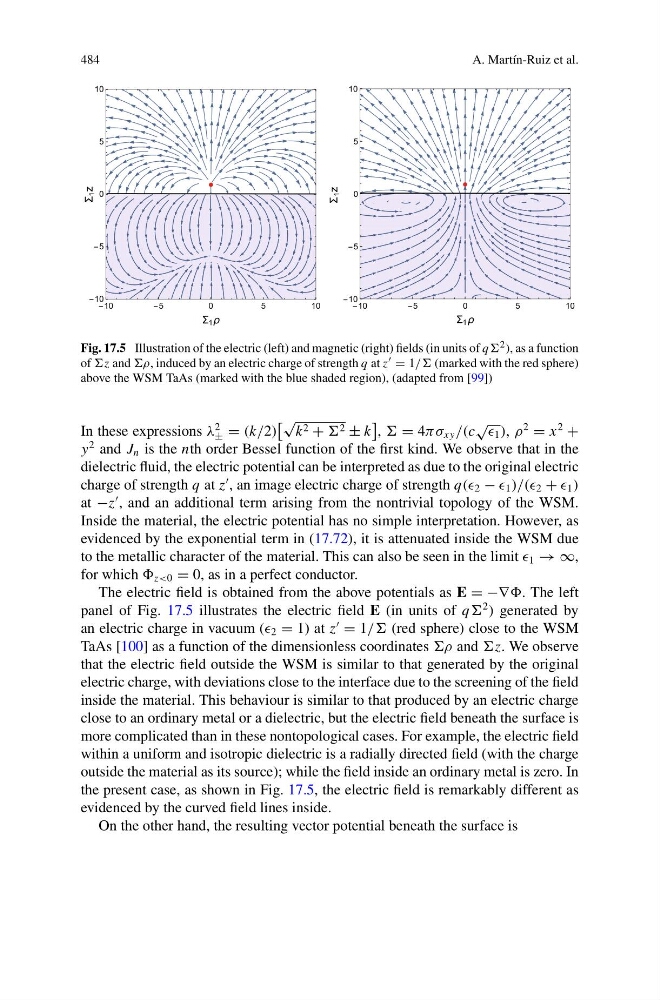
Fig. 17.5 Illustration of the electric (left) and magnetic (right) fields (in units of q 2 ), as a function
of and induced by an electric charge of strength q at z = 1// (marked with the red sphere)
above the WSM TaAs (marked with the blue shaded region), (adapted from [99])
In these expressions λ
2
± = (k/2)
√
k 2 + 2 ± k
, = 4πσ xy /(c
√ 1 ), ρ
2
= x
2
+
y
2 and J n is the nth order Bessel function of the first kind. We observe that in the
dielectric fluid, the electric potential can be interpreted as due to the original electric
charge of strength q at z
, an image electric charge of strength q(( 2 − 1 )/(( 2 + 1 )
at −z
, and an additional term arising from the nontrivial topology of the WSM.
Inside the material, the electric potential has no simple interpretation. However, as
evidenced by the exponential term in (17.72), it is attenuated inside the WSM due
to the metallic character of the material. This can also be seen in the limit 1 → ∞,
for which z<0 = 0, as in a perfect conductor.
The electric field is obtained from the above potentials as E = −∇. The left
panel of Fig. 17.5 illustrates the electric field E (in units of q
2 ) generated by
an electric charge in vacuum ( 2 = 1) at z
= 1// (red sphere) close to the WSM
TaAs [100] as a function of the dimensionless coordinates ρ and We observe
that the electric field outside the WSM is similar to that generated by the original
electric charge, with deviations close to the interface due to the screening of the field
inside the material. This behaviour is similar to that produced by an electric charge
close to an ordinary metal or a dielectric, but the electric field beneath the surface is
more complicated than in these nontopological cases. For example, the electric field
within a uniform and isotropic dielectric is a radially directed field (with the charge
outside the material as its source); while the field inside an ordinary metal is zero. In
the present case, as shown in Fig. 17.5, the electric field is remarkably different as
evidenced by the curved field lines inside.
On the other hand, the resulting vector potential beneath the surface is
A. Martín-Ruiz et al.
Fig. 17.5 Illustration of the electric (left) and magnetic (right) fields (in units of q 2 ), as a function
of and induced by an electric charge of strength q at z = 1// (marked with the red sphere)
above the WSM TaAs (marked with the blue shaded region), (adapted from [99])
In these expressions λ
2
± = (k/2)
√
k 2 + 2 ± k
, = 4πσ xy /(c
√ 1 ), ρ
2
= x
2
+
y
2 and J n is the nth order Bessel function of the first kind. We observe that in the
dielectric fluid, the electric potential can be interpreted as due to the original electric
charge of strength q at z
, an image electric charge of strength q(( 2 − 1 )/(( 2 + 1 )
at −z
, and an additional term arising from the nontrivial topology of the WSM.
Inside the material, the electric potential has no simple interpretation. However, as
evidenced by the exponential term in (17.72), it is attenuated inside the WSM due
to the metallic character of the material. This can also be seen in the limit 1 → ∞,
for which z<0 = 0, as in a perfect conductor.
The electric field is obtained from the above potentials as E = −∇. The left
panel of Fig. 17.5 illustrates the electric field E (in units of q
2 ) generated by
an electric charge in vacuum ( 2 = 1) at z
= 1// (red sphere) close to the WSM
TaAs [100] as a function of the dimensionless coordinates ρ and We observe
that the electric field outside the WSM is similar to that generated by the original
electric charge, with deviations close to the interface due to the screening of the field
inside the material. This behaviour is similar to that produced by an electric charge
close to an ordinary metal or a dielectric, but the electric field beneath the surface is
more complicated than in these nontopological cases. For example, the electric field
within a uniform and isotropic dielectric is a radially directed field (with the charge
outside the material as its source); while the field inside an ordinary metal is zero. In
the present case, as shown in Fig. 17.5, the electric field is remarkably different as
evidenced by the curved field lines inside.
On the other hand, the resulting vector potential beneath the surface is