

470
A. Martín-Ruiz et al.
g
0
σ
z, z
= η
0
σ g
z, z
− i ˜
θθ
30i
j p i η
j
σ g (z, a) g
a, z
− ˜
θ
2 p
2 g (z, a) g (a, a) g
0
σ
a, z
.
(17.31)
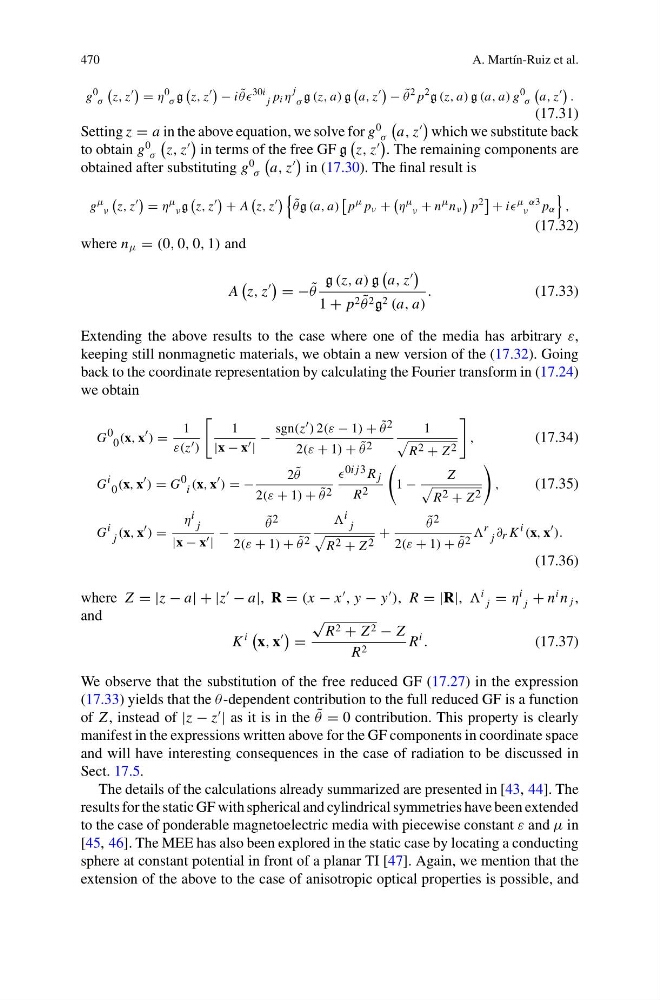
Setting z = a in the above equation, we solve for g
0
σ
a, z
which we substitute back
to obtain g
0
σ
z, z
in terms of the free GF g
z, z
. The remaining components are
obtained after substituting g
0
σ
a, z
in (17.30). The final result is
g
μ
ν
z, z
= η
μ
ν g
z, z
+ A
z, z
˜
θg (a, a)
p
μ p ν +
η
μ
ν + n
μ n ν
p
2
+ i
μ α3
ν p α
,
(17.32)
where n μ = (0, 0, 0, 1) and
A
z, z
= − ˜
θ
g (z, a) g
a, z
1 + p 2 ˜
θ 2 g 2 (a, a)
.
(17.33)
Extending the above results to the case where one of the media has arbitrary ε,
keeping still nonmagnetic materials, we obtain a new version of the (17.32). Going
back to the coordinate representation by calculating the Fourier transform in (17.24)
we obtain
G 0
0 (x, x ) =
1
ε(z )
1
|x − x |
−
sgn(z ) 2(ε − 1) + ˜
θ 2
2(ε + 1) + ˜
θ 2
1
R 2 + Z 2
,
(17.34)
G i
0 (x, x ) = G 0
i (x, x ) = −
2 ˜
θ
2(ε + 1) + ˜
θ 2
0i j3 R j
R 2
1 −
Z
R 2 + Z 2
,
(17.35)
G i
j (x, x ) =
η i
j
|x − x |
−
˜
θ 2
2(ε + 1) + ˜
θ 2
i
j
R 2 + Z 2
+
˜
θ 2
2(ε + 1) + ˜
θ 2
r
j ∂ r K i (x, x ).
(17.36)
where Z = |z − a| + |z
− a|, R = (x − x
, y − y
), R = |R|,
i
j = η
i
j + n
i n j ,
and
K
i
x, x
=
√
R 2 + Z 2 − Z
R 2
R
i
.
(17.37)
We observe that the substitution of the free reduced GF (17.27) in the expression
(17.33) yields that the θ -dependent contribution to the full reduced GF is a function
of Z , instead of |z − z
| as it is in the ˜
θ = 0 contribution. This property is clearly
manifest in the expressions written above for the GF components in coordinate space
and will have interesting consequences in the case of radiation to be discussed in
Sect. 17.5.
The details of the calculations already summarized are presented in [43, 44]. The
results for the static GF with spherical and cylindrical symmetries have been extended
to the case of ponderable magnetoelectric media with piecewise constant ε and μ in
[45, 46]. The MEE has also been explored in the static case by locating a conducting
sphere at constant potential in front of a planar TI [47]. Again, we mention that the
extension of the above to the case of anisotropic optical properties is possible, and
A. Martín-Ruiz et al.
g
0
σ
z, z
= η
0
σ g
z, z
− i ˜
θθ
30i
j p i η
j
σ g (z, a) g
a, z
− ˜
θ
2 p
2 g (z, a) g (a, a) g
0
σ
a, z
.
(17.31)
Setting z = a in the above equation, we solve for g
0
σ
a, z
which we substitute back
to obtain g
0
σ
z, z
in terms of the free GF g
z, z
. The remaining components are
obtained after substituting g
0
σ
a, z
in (17.30). The final result is
g
μ
ν
z, z
= η
μ
ν g
z, z
+ A
z, z
˜
θg (a, a)
p
μ p ν +
η
μ
ν + n
μ n ν
p
2
+ i
μ α3
ν p α
,
(17.32)
where n μ = (0, 0, 0, 1) and
A
z, z
= − ˜
θ
g (z, a) g
a, z
1 + p 2 ˜
θ 2 g 2 (a, a)
.
(17.33)
Extending the above results to the case where one of the media has arbitrary ε,
keeping still nonmagnetic materials, we obtain a new version of the (17.32). Going
back to the coordinate representation by calculating the Fourier transform in (17.24)
we obtain
G 0
0 (x, x ) =
1
ε(z )
1
|x − x |
−
sgn(z ) 2(ε − 1) + ˜
θ 2
2(ε + 1) + ˜
θ 2
1
R 2 + Z 2
,
(17.34)
G i
0 (x, x ) = G 0
i (x, x ) = −
2 ˜
θ
2(ε + 1) + ˜
θ 2
0i j3 R j
R 2
1 −
Z
R 2 + Z 2
,
(17.35)
G i
j (x, x ) =
η i
j
|x − x |
−
˜
θ 2
2(ε + 1) + ˜
θ 2
i
j
R 2 + Z 2
+
˜
θ 2
2(ε + 1) + ˜
θ 2
r
j ∂ r K i (x, x ).
(17.36)
where Z = |z − a| + |z
− a|, R = (x − x
, y − y
), R = |R|,
i
j = η
i
j + n
i n j ,
and
K
i
x, x
=
√
R 2 + Z 2 − Z
R 2
R
i
.
(17.37)
We observe that the substitution of the free reduced GF (17.27) in the expression
(17.33) yields that the θ -dependent contribution to the full reduced GF is a function
of Z , instead of |z − z
| as it is in the ˜
θ = 0 contribution. This property is clearly
manifest in the expressions written above for the GF components in coordinate space
and will have interesting consequences in the case of radiation to be discussed in
Sect. 17.5.
The details of the calculations already summarized are presented in [43, 44]. The
results for the static GF with spherical and cylindrical symmetries have been extended
to the case of ponderable magnetoelectric media with piecewise constant ε and μ in
[45, 46]. The MEE has also been explored in the static case by locating a conducting
sphere at constant potential in front of a planar TI [47]. Again, we mention that the
extension of the above to the case of anisotropic optical properties is possible, and