

17 Axion Electrodynamics in Magnetoelectric Media
471
so is the case for anisotropic MEP. Concretely, the antiferromagnet Cr 2 O 3 possess
a θ i j ∼ 1.26 × 10
−3 (in non-rationalized CGS units), which is however small compared to non magnetoelectric effects. Larger MEE signals can be found in the TbPO 4 ,
whose coupling is ∼ 0.22 (in non-rationalized CGS units) and the search for giant
ME couplings continues mainly in composite multiferroics [48]. An early review of
numerous works on the study of infinite linear homogeneous bianisotropic media
can be found in [49], which deals mainly with the calculation of the Green functions
and the plane-wave propagation in various classes of these media. An alternative way
of taking into account magnetoelectric effects in such media would be to introduce
interfaces among them. This certainly requires an extension of the methods previously developed. Our GF approach precisely facilitates such extension and this has
been one of our motivations.
17.4 The Casimir Effect
The Casimir effect (CE) is one of the most remarkable consequences predicted by
quantum field theory as a result of the nonzero energy of the vacuum [50] and has
already been experimentally confirmed [51]. For a review of the subject see [52,
53]. Experimental access to probe distances of the order of microns, together with
the recent discovery of three-dimensional topological insulators provide additional
ground to study the CE [54].
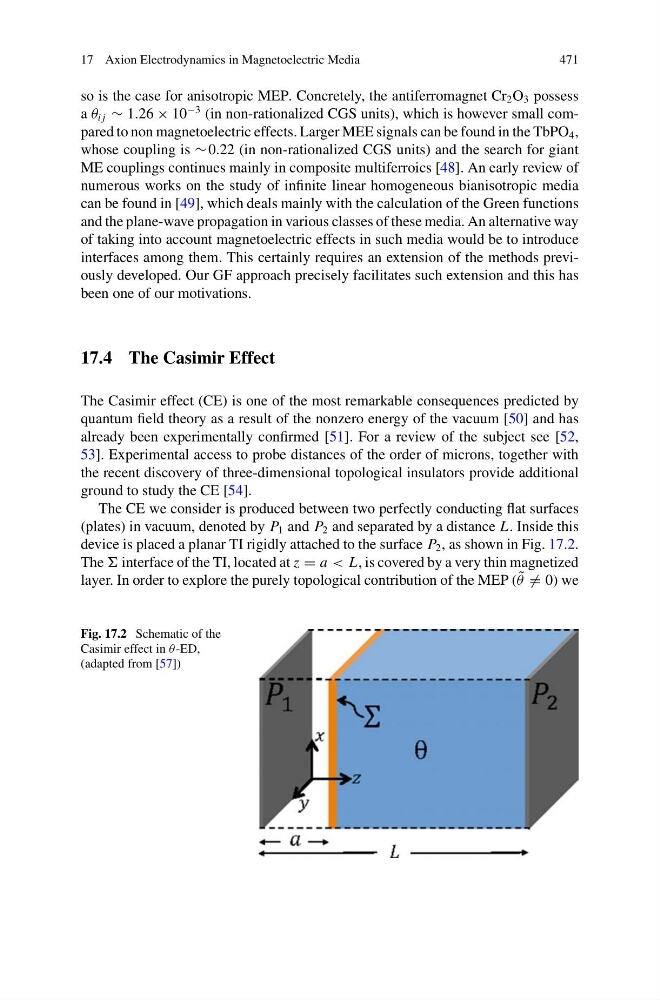
The CE we consider is produced between two perfectly conducting flat surfaces
(plates) in vacuum, denoted by P 1 and P 2 and separated by a distance L. Inside this
device is placed a planar TI rigidly attached to the surface P 2 , as shown in Fig. 17.2.
The interface of the TI, located at z = a < L, is covered by a very thin magnetized
layer. In order to explore the purely topological contribution of the MEP ( ˜
θ = 0) we
Fig. 17.2 Schematic of the
Casimir effect in θ-ED,
(adapted from [57])
471
so is the case for anisotropic MEP. Concretely, the antiferromagnet Cr 2 O 3 possess
a θ i j ∼ 1.26 × 10
−3 (in non-rationalized CGS units), which is however small compared to non magnetoelectric effects. Larger MEE signals can be found in the TbPO 4 ,
whose coupling is ∼ 0.22 (in non-rationalized CGS units) and the search for giant
ME couplings continues mainly in composite multiferroics [48]. An early review of
numerous works on the study of infinite linear homogeneous bianisotropic media
can be found in [49], which deals mainly with the calculation of the Green functions
and the plane-wave propagation in various classes of these media. An alternative way
of taking into account magnetoelectric effects in such media would be to introduce
interfaces among them. This certainly requires an extension of the methods previously developed. Our GF approach precisely facilitates such extension and this has
been one of our motivations.
17.4 The Casimir Effect
The Casimir effect (CE) is one of the most remarkable consequences predicted by
quantum field theory as a result of the nonzero energy of the vacuum [50] and has
already been experimentally confirmed [51]. For a review of the subject see [52,
53]. Experimental access to probe distances of the order of microns, together with
the recent discovery of three-dimensional topological insulators provide additional
ground to study the CE [54].
The CE we consider is produced between two perfectly conducting flat surfaces
(plates) in vacuum, denoted by P 1 and P 2 and separated by a distance L. Inside this
device is placed a planar TI rigidly attached to the surface P 2 , as shown in Fig. 17.2.
The interface of the TI, located at z = a < L, is covered by a very thin magnetized
layer. In order to explore the purely topological contribution of the MEP ( ˜
θ = 0) we
Fig. 17.2 Schematic of the
Casimir effect in θ-ED,
(adapted from [57])