

16 Antiferromagnetic Skyrmions and Bimerons
449
antiferromagnetic skyrmions in future high-performance spintronic devices with
higher storage density and operation speed.
16.5 Antiferromagnetic Skyrmions Driven by the Magnetic
Anisotropy Gradient
Previous section shows that antiferromagnetic skyrmions can be driven by electric
currents. However, using the electric current as a driving source faces the issue of
Joule heating, and the dynamics of the insulating antiferromagnet cannot be excited
by an electric current. Therefore, alternative methods are crucial and have been
explored, for example, using a voltage-controlled magnetic anisotropy gradient. The
voltage-controlled magnetic anisotropy gradient is a promising method to drive the
magnetic textures, because it has ultralow power consumption and is applicable in
both metals and insulators. Recent studies experimentally and theoretically demonstrate that such a voltage-controlled magnetic anisotropy gradient can be used to
manipulate the magnetic textures [35, 60–63]. Particularly, in 2019, Ma et al. [60]
experimentally presented the electric field-induced creation and motion of domain
walls and skyrmion bubbles. In this section, we first describe the calculation results
of using a magnetic anisotropy gradient to drive antiferromagnetic skyrmions, and
then compare the velocities of antiferromagnetic and ferromagnetic skyrmions.
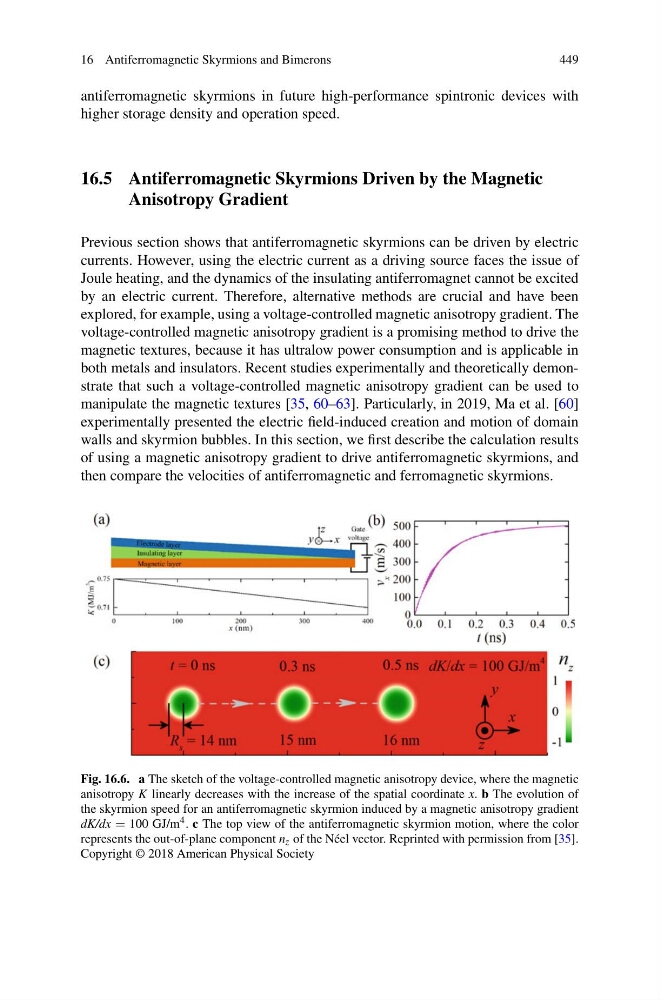
Fig. 16.6. a The sketch of the voltage-controlled magnetic anisotropy device, where the magnetic
anisotropy K linearly decreases with the increase of the spatial coordinate x. b The evolution of
the skyrmion speed for an antiferromagnetic skyrmion induced by a magnetic anisotropy gradient
dK/dx = 100 GJ/m 4 . c The top view of the antiferromagnetic skyrmion motion, where the color
represents the out-of-plane component n z of the Néel vector. Reprinted with permission from [35].
Copyright © 2018 American Physical Society
449
antiferromagnetic skyrmions in future high-performance spintronic devices with
higher storage density and operation speed.
16.5 Antiferromagnetic Skyrmions Driven by the Magnetic
Anisotropy Gradient
Previous section shows that antiferromagnetic skyrmions can be driven by electric
currents. However, using the electric current as a driving source faces the issue of
Joule heating, and the dynamics of the insulating antiferromagnet cannot be excited
by an electric current. Therefore, alternative methods are crucial and have been
explored, for example, using a voltage-controlled magnetic anisotropy gradient. The
voltage-controlled magnetic anisotropy gradient is a promising method to drive the
magnetic textures, because it has ultralow power consumption and is applicable in
both metals and insulators. Recent studies experimentally and theoretically demonstrate that such a voltage-controlled magnetic anisotropy gradient can be used to
manipulate the magnetic textures [35, 60–63]. Particularly, in 2019, Ma et al. [60]
experimentally presented the electric field-induced creation and motion of domain
walls and skyrmion bubbles. In this section, we first describe the calculation results
of using a magnetic anisotropy gradient to drive antiferromagnetic skyrmions, and
then compare the velocities of antiferromagnetic and ferromagnetic skyrmions.
Fig. 16.6. a The sketch of the voltage-controlled magnetic anisotropy device, where the magnetic
anisotropy K linearly decreases with the increase of the spatial coordinate x. b The evolution of
the skyrmion speed for an antiferromagnetic skyrmion induced by a magnetic anisotropy gradient
dK/dx = 100 GJ/m 4 . c The top view of the antiferromagnetic skyrmion motion, where the color
represents the out-of-plane component n z of the Néel vector. Reprinted with permission from [35].
Copyright © 2018 American Physical Society