

448
L. Shen et al.
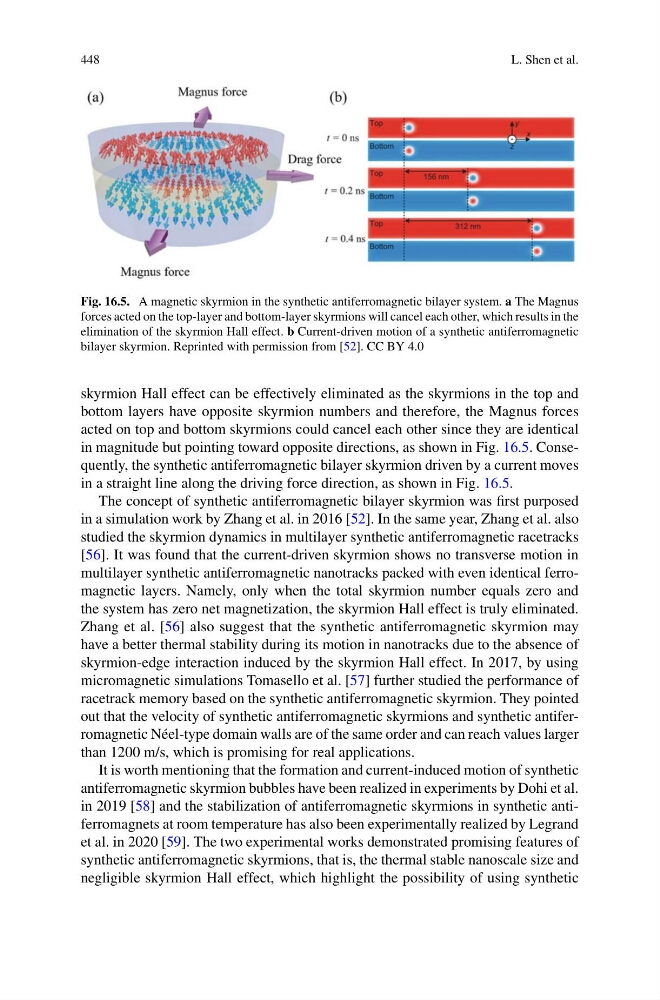
Fig. 16.5. A magnetic skyrmion in the synthetic antiferromagnetic bilayer system. a The Magnus
forces acted on the top-layer and bottom-layer skyrmions will cancel each other, which results in the
elimination of the skyrmion Hall effect. b Current-driven motion of a synthetic antiferromagnetic
bilayer skyrmion. Reprinted with permission from [52]. CC BY 4.0
skyrmion Hall effect can be effectively eliminated as the skyrmions in the top and
bottom layers have opposite skyrmion numbers and therefore, the Magnus forces
acted on top and bottom skyrmions could cancel each other since they are identical
in magnitude but pointing toward opposite directions, as shown in Fig. 16.5. Consequently, the synthetic antiferromagnetic bilayer skyrmion driven by a current moves
in a straight line along the driving force direction, as shown in Fig. 16.5.
The concept of synthetic antiferromagnetic bilayer skyrmion was first purposed
in a simulation work by Zhang et al. in 2016 [52]. In the same year, Zhang et al. also
studied the skyrmion dynamics in multilayer synthetic antiferromagnetic racetracks
[56]. It was found that the current-driven skyrmion shows no transverse motion in
multilayer synthetic antiferromagnetic nanotracks packed with even identical ferromagnetic layers. Namely, only when the total skyrmion number equals zero and
the system has zero net magnetization, the skyrmion Hall effect is truly eliminated.
Zhang et al. [56] also suggest that the synthetic antiferromagnetic skyrmion may
have a better thermal stability during its motion in nanotracks due to the absence of
skyrmion-edge interaction induced by the skyrmion Hall effect. In 2017, by using
micromagnetic simulations Tomasello et al. [57] further studied the performance of
racetrack memory based on the synthetic antiferromagnetic skyrmion. They pointed
out that the velocity of synthetic antiferromagnetic skyrmions and synthetic antiferromagnetic Néel-type domain walls are of the same order and can reach values larger
than 1200 m/s, which is promising for real applications.
It is worth mentioning that the formation and current-induced motion of synthetic
antiferromagnetic skyrmion bubbles have been realized in experiments by Dohi et al.
in 2019 [58] and the stabilization of antiferromagnetic skyrmions in synthetic antiferromagnets at room temperature has also been experimentally realized by Legrand
et al. in 2020 [59]. The two experimental works demonstrated promising features of
synthetic antiferromagnetic skyrmions, that is, the thermal stable nanoscale size and
negligible skyrmion Hall effect, which highlight the possibility of using synthetic
L. Shen et al.
Fig. 16.5. A magnetic skyrmion in the synthetic antiferromagnetic bilayer system. a The Magnus
forces acted on the top-layer and bottom-layer skyrmions will cancel each other, which results in the
elimination of the skyrmion Hall effect. b Current-driven motion of a synthetic antiferromagnetic
bilayer skyrmion. Reprinted with permission from [52]. CC BY 4.0
skyrmion Hall effect can be effectively eliminated as the skyrmions in the top and
bottom layers have opposite skyrmion numbers and therefore, the Magnus forces
acted on top and bottom skyrmions could cancel each other since they are identical
in magnitude but pointing toward opposite directions, as shown in Fig. 16.5. Consequently, the synthetic antiferromagnetic bilayer skyrmion driven by a current moves
in a straight line along the driving force direction, as shown in Fig. 16.5.
The concept of synthetic antiferromagnetic bilayer skyrmion was first purposed
in a simulation work by Zhang et al. in 2016 [52]. In the same year, Zhang et al. also
studied the skyrmion dynamics in multilayer synthetic antiferromagnetic racetracks
[56]. It was found that the current-driven skyrmion shows no transverse motion in
multilayer synthetic antiferromagnetic nanotracks packed with even identical ferromagnetic layers. Namely, only when the total skyrmion number equals zero and
the system has zero net magnetization, the skyrmion Hall effect is truly eliminated.
Zhang et al. [56] also suggest that the synthetic antiferromagnetic skyrmion may
have a better thermal stability during its motion in nanotracks due to the absence of
skyrmion-edge interaction induced by the skyrmion Hall effect. In 2017, by using
micromagnetic simulations Tomasello et al. [57] further studied the performance of
racetrack memory based on the synthetic antiferromagnetic skyrmion. They pointed
out that the velocity of synthetic antiferromagnetic skyrmions and synthetic antiferromagnetic Néel-type domain walls are of the same order and can reach values larger
than 1200 m/s, which is promising for real applications.
It is worth mentioning that the formation and current-induced motion of synthetic
antiferromagnetic skyrmion bubbles have been realized in experiments by Dohi et al.
in 2019 [58] and the stabilization of antiferromagnetic skyrmions in synthetic antiferromagnets at room temperature has also been experimentally realized by Legrand
et al. in 2020 [59]. The two experimental works demonstrated promising features of
synthetic antiferromagnetic skyrmions, that is, the thermal stable nanoscale size and
negligible skyrmion Hall effect, which highlight the possibility of using synthetic