

16 Antiferromagnetic Skyrmions and Bimerons
447
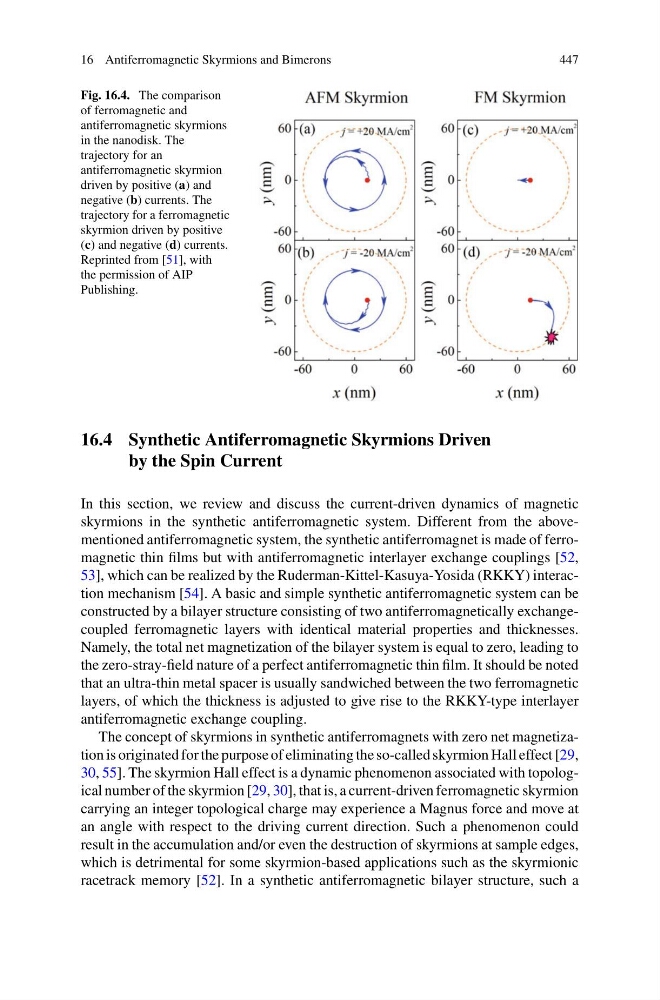
Fig. 16.4. The comparison
of ferromagnetic and
antiferromagnetic skyrmions
in the nanodisk. The
trajectory for an
antiferromagnetic skyrmion
driven by positive (a) and
negative (b) currents. The
trajectory for a ferromagnetic
skyrmion driven by positive
(c) and negative (d) currents.
Reprinted from [51], with
the permission of AIP
Publishing.
16.4 Synthetic Antiferromagnetic Skyrmions Driven
by the Spin Current
In this section, we review and discuss the current-driven dynamics of magnetic
skyrmions in the synthetic antiferromagnetic system. Different from the abovementioned antiferromagnetic system, the synthetic antiferromagnet is made of ferromagnetic thin films but with antiferromagnetic interlayer exchange couplings [52,
53], which can be realized by the Ruderman-Kittel-Kasuya-Yosida (RKKY) interaction mechanism [54]. A basic and simple synthetic antiferromagnetic system can be
constructed by a bilayer structure consisting of two antiferromagnetically exchangecoupled ferromagnetic layers with identical material properties and thicknesses.
Namely, the total net magnetization of the bilayer system is equal to zero, leading to
the zero-stray-field nature of a perfect antiferromagnetic thin film. It should be noted
that an ultra-thin metal spacer is usually sandwiched between the two ferromagnetic
layers, of which the thickness is adjusted to give rise to the RKKY-type interlayer
antiferromagnetic exchange coupling.
The concept of skyrmions in synthetic antiferromagnets with zero net magnetization is originated for the purpose of eliminating the so-called skyrmion Hall effect [29,
30, 55]. The skyrmion Hall effect is a dynamic phenomenon associated with topological number of the skyrmion [29, 30], that is, a current-driven ferromagnetic skyrmion
carrying an integer topological charge may experience a Magnus force and move at
an angle with respect to the driving current direction. Such a phenomenon could
result in the accumulation and/or even the destruction of skyrmions at sample edges,
which is detrimental for some skyrmion-based applications such as the skyrmionic
racetrack memory [52]. In a synthetic antiferromagnetic bilayer structure, such a
447
Fig. 16.4. The comparison
of ferromagnetic and
antiferromagnetic skyrmions
in the nanodisk. The
trajectory for an
antiferromagnetic skyrmion
driven by positive (a) and
negative (b) currents. The
trajectory for a ferromagnetic
skyrmion driven by positive
(c) and negative (d) currents.
Reprinted from [51], with
the permission of AIP
Publishing.
16.4 Synthetic Antiferromagnetic Skyrmions Driven
by the Spin Current
In this section, we review and discuss the current-driven dynamics of magnetic
skyrmions in the synthetic antiferromagnetic system. Different from the abovementioned antiferromagnetic system, the synthetic antiferromagnet is made of ferromagnetic thin films but with antiferromagnetic interlayer exchange couplings [52,
53], which can be realized by the Ruderman-Kittel-Kasuya-Yosida (RKKY) interaction mechanism [54]. A basic and simple synthetic antiferromagnetic system can be
constructed by a bilayer structure consisting of two antiferromagnetically exchangecoupled ferromagnetic layers with identical material properties and thicknesses.
Namely, the total net magnetization of the bilayer system is equal to zero, leading to
the zero-stray-field nature of a perfect antiferromagnetic thin film. It should be noted
that an ultra-thin metal spacer is usually sandwiched between the two ferromagnetic
layers, of which the thickness is adjusted to give rise to the RKKY-type interlayer
antiferromagnetic exchange coupling.
The concept of skyrmions in synthetic antiferromagnets with zero net magnetization is originated for the purpose of eliminating the so-called skyrmion Hall effect [29,
30, 55]. The skyrmion Hall effect is a dynamic phenomenon associated with topological number of the skyrmion [29, 30], that is, a current-driven ferromagnetic skyrmion
carrying an integer topological charge may experience a Magnus force and move at
an angle with respect to the driving current direction. Such a phenomenon could
result in the accumulation and/or even the destruction of skyrmions at sample edges,
which is detrimental for some skyrmion-based applications such as the skyrmionic
racetrack memory [52]. In a synthetic antiferromagnetic bilayer structure, such a