

15 Topological Dynamics of Spin Texture Based Metamaterials
425
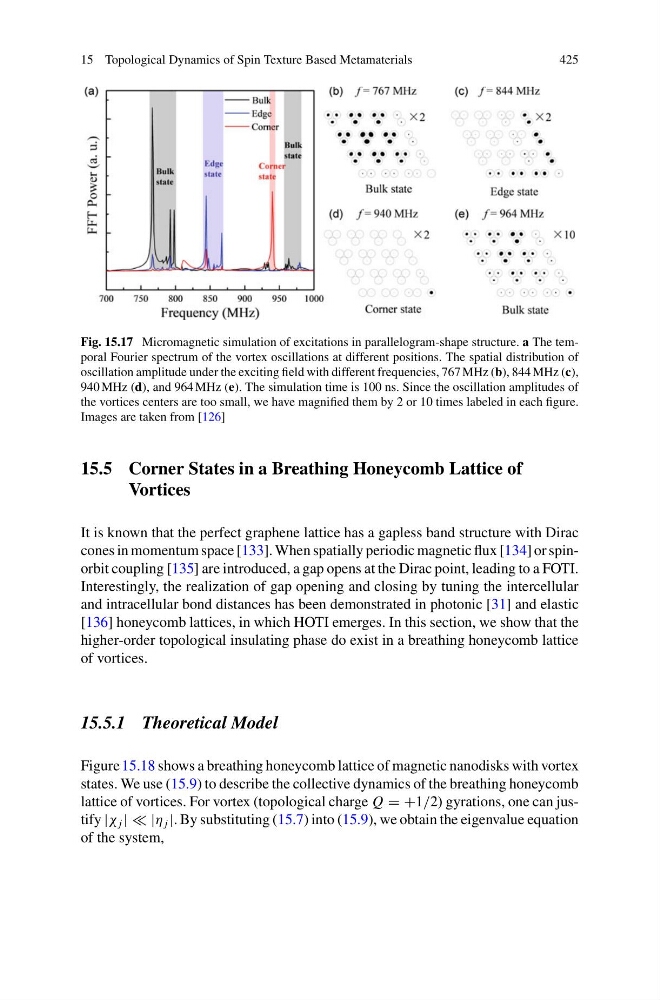
Fig. 15.17 Micromagnetic simulation of excitations in parallelogram-shape structure. a The temporal Fourier spectrum of the vortex oscillations at different positions. The spatial distribution of
oscillation amplitude under the exciting field with different frequencies, 767 MHz (b), 844 MHz (c),
940 MHz (d), and 964 MHz (e). The simulation time is 100 ns. Since the oscillation amplitudes of
the vortices centers are too small, we have magnified them by 2 or 10 times labeled in each figure.
Images are taken from [126]
15.5 Corner States in a Breathing Honeycomb Lattice of
Vortices
It is known that the perfect graphene lattice has a gapless band structure with Dirac
cones in momentum space [133]. When spatially periodic magnetic flux [134] or spinorbit coupling [135] are introduced, a gap opens at the Dirac point, leading to a FOTI.
Interestingly, the realization of gap opening and closing by tuning the intercellular
and intracellular bond distances has been demonstrated in photonic [31] and elastic
[136] honeycomb lattices, in which HOTI emerges. In this section, we show that the
higher-order topological insulating phase do exist in a breathing honeycomb lattice
of vortices.
15.5.1 Theoretical Model
Figure 15.18 shows a breathing honeycomb lattice of magnetic nanodisks with vortex
states. We use (15.9) to describe the collective dynamics of the breathing honeycomb
lattice of vortices. For vortex (topological charge Q = +1/2) gyrations, one can justify |χ j | | |η j |. By substituting (15.7) into (15.9), we obtain the eigenvalue equation
of the system,
425
Fig. 15.17 Micromagnetic simulation of excitations in parallelogram-shape structure. a The temporal Fourier spectrum of the vortex oscillations at different positions. The spatial distribution of
oscillation amplitude under the exciting field with different frequencies, 767 MHz (b), 844 MHz (c),
940 MHz (d), and 964 MHz (e). The simulation time is 100 ns. Since the oscillation amplitudes of
the vortices centers are too small, we have magnified them by 2 or 10 times labeled in each figure.
Images are taken from [126]
15.5 Corner States in a Breathing Honeycomb Lattice of
Vortices
It is known that the perfect graphene lattice has a gapless band structure with Dirac
cones in momentum space [133]. When spatially periodic magnetic flux [134] or spinorbit coupling [135] are introduced, a gap opens at the Dirac point, leading to a FOTI.
Interestingly, the realization of gap opening and closing by tuning the intercellular
and intracellular bond distances has been demonstrated in photonic [31] and elastic
[136] honeycomb lattices, in which HOTI emerges. In this section, we show that the
higher-order topological insulating phase do exist in a breathing honeycomb lattice
of vortices.
15.5.1 Theoretical Model
Figure 15.18 shows a breathing honeycomb lattice of magnetic nanodisks with vortex
states. We use (15.9) to describe the collective dynamics of the breathing honeycomb
lattice of vortices. For vortex (topological charge Q = +1/2) gyrations, one can justify |χ j | | |η j |. By substituting (15.7) into (15.9), we obtain the eigenvalue equation
of the system,