

426
Z. Li et al.
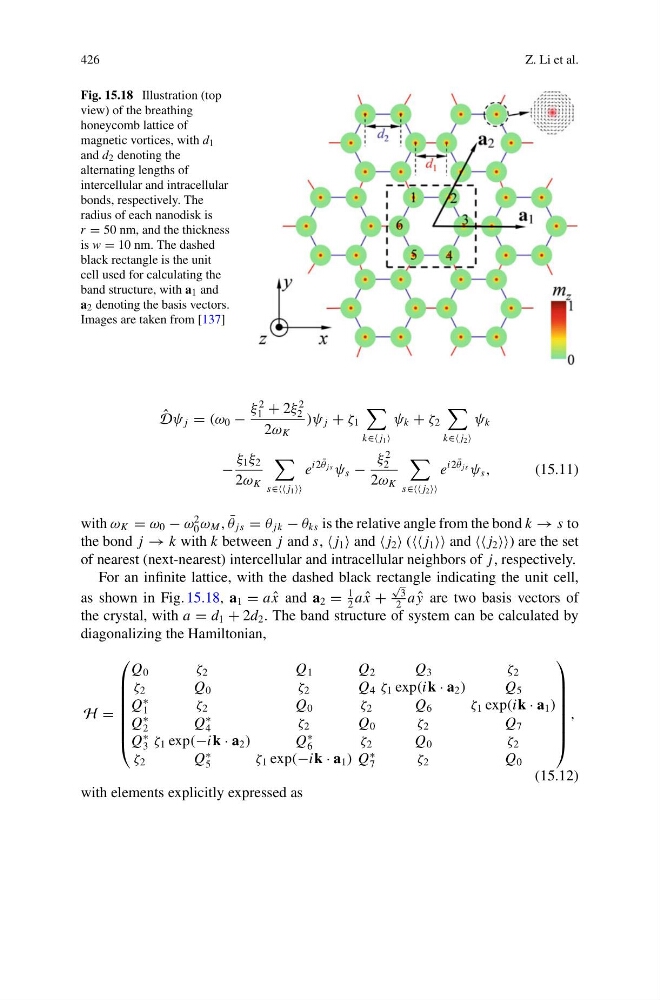
Fig. 15.18 Illustration (top
view) of the breathing
honeycomb lattice of
magnetic vortices, with d 1
and d 2 denoting the
alternating lengths of
intercellular and intracellular
bonds, respectively. The
radius of each nanodisk is
r = 50 nm, and the thickness
is w = 10 nm. The dashed
black rectangle is the unit
cell used for calculating the
band structure, with a 1 and
a 2 denoting the basis vectors.
Images are taken from [137]
ˆ
Dψ j = (ω 0 −
ξ
2
1 + 2ξ
2
2
2ω K
)ψ j + ζ 1
k∈∈ j 1
ψ k + ζ 2
k∈∈ j 2
ψ k
−
ξ 1 ξ 2
2ω K
s∈∈∈ j 1
e
i2 ¯
θ js ψ s −
ξ
2
2
2ω K
s∈∈∈ j 2
e
i2 ¯
θ js ψ s ,
(15.11)
with ω K = ω 0 − ω
2
0 ω M , ¯
θ js = θ jk − θ ks is the relative angle from the bond k → s to
the bond j → k with k between j and s, j 1 and j 2 ( j 1 and j 2 ) are the set
of nearest (next-nearest) intercellular and intracellular neighbors of j, respectively.
For an infinite lattice, with the dashed black rectangle indicating the unit cell,
as shown in Fig. 15.18, a 1 = a ˆ
x and a 2 =
1
2
a ˆ
x +
√
3
2
a ˆ
y are two basis vectors of
the crystal, with a = d 1 + 2d 2 . The band structure of system can be calculated by
diagonalizing the Hamiltonian,
H =
⎛
⎜
⎜
⎜
⎜
⎜
⎜
⎝
Q 0
ζ 2
Q 1
Q 2
Q 3
ζ 2
ζ 2
Q 0
ζ 2
Q 4 ζ 1 exp(ik · a 2 )
Q 5
Q
∗
1
ζ 2
Q 0
ζ 2
Q 6
ζ 1 exp(ik · a 1 )
Q
∗
2
Q
∗
4
ζ 2
Q 0
ζ 2
Q 7
Q
∗
3 ζ 1 exp(−ik · a 2 )
Q
∗
6
ζ 2
Q 0
ζ 2
ζ 2
Q
∗
5
ζ 1 exp(−ik · a 1 ) Q
∗
7
ζ 2
Q 0
⎞
⎟
⎟
⎟
⎟
⎟
⎟
⎠
,
(15.12)
with elements explicitly expressed as
Z. Li et al.
Fig. 15.18 Illustration (top
view) of the breathing
honeycomb lattice of
magnetic vortices, with d 1
and d 2 denoting the
alternating lengths of
intercellular and intracellular
bonds, respectively. The
radius of each nanodisk is
r = 50 nm, and the thickness
is w = 10 nm. The dashed
black rectangle is the unit
cell used for calculating the
band structure, with a 1 and
a 2 denoting the basis vectors.
Images are taken from [137]
ˆ
Dψ j = (ω 0 −
ξ
2
1 + 2ξ
2
2
2ω K
)ψ j + ζ 1
k∈∈ j 1
ψ k + ζ 2
k∈∈ j 2
ψ k
−
ξ 1 ξ 2
2ω K
s∈∈∈ j 1
e
i2 ¯
θ js ψ s −
ξ
2
2
2ω K
s∈∈∈ j 2
e
i2 ¯
θ js ψ s ,
(15.11)
with ω K = ω 0 − ω
2
0 ω M , ¯
θ js = θ jk − θ ks is the relative angle from the bond k → s to
the bond j → k with k between j and s, j 1 and j 2 ( j 1 and j 2 ) are the set
of nearest (next-nearest) intercellular and intracellular neighbors of j, respectively.
For an infinite lattice, with the dashed black rectangle indicating the unit cell,
as shown in Fig. 15.18, a 1 = a ˆ
x and a 2 =
1
2
a ˆ
x +
√
3
2
a ˆ
y are two basis vectors of
the crystal, with a = d 1 + 2d 2 . The band structure of system can be calculated by
diagonalizing the Hamiltonian,
H =
⎛
⎜
⎜
⎜
⎜
⎜
⎜
⎝
Q 0
ζ 2
Q 1
Q 2
Q 3
ζ 2
ζ 2
Q 0
ζ 2
Q 4 ζ 1 exp(ik · a 2 )
Q 5
Q
∗
1
ζ 2
Q 0
ζ 2
Q 6
ζ 1 exp(ik · a 1 )
Q
∗
2
Q
∗
4
ζ 2
Q 0
ζ 2
Q 7
Q
∗
3 ζ 1 exp(−ik · a 2 )
Q
∗
6
ζ 2
Q 0
ζ 2
ζ 2
Q
∗
5
ζ 1 exp(−ik · a 1 ) Q
∗
7
ζ 2
Q 0
⎞
⎟
⎟
⎟
⎟
⎟
⎟
⎠
,
(15.12)
with elements explicitly expressed as