

15 Topological Dynamics of Spin Texture Based Metamaterials
421
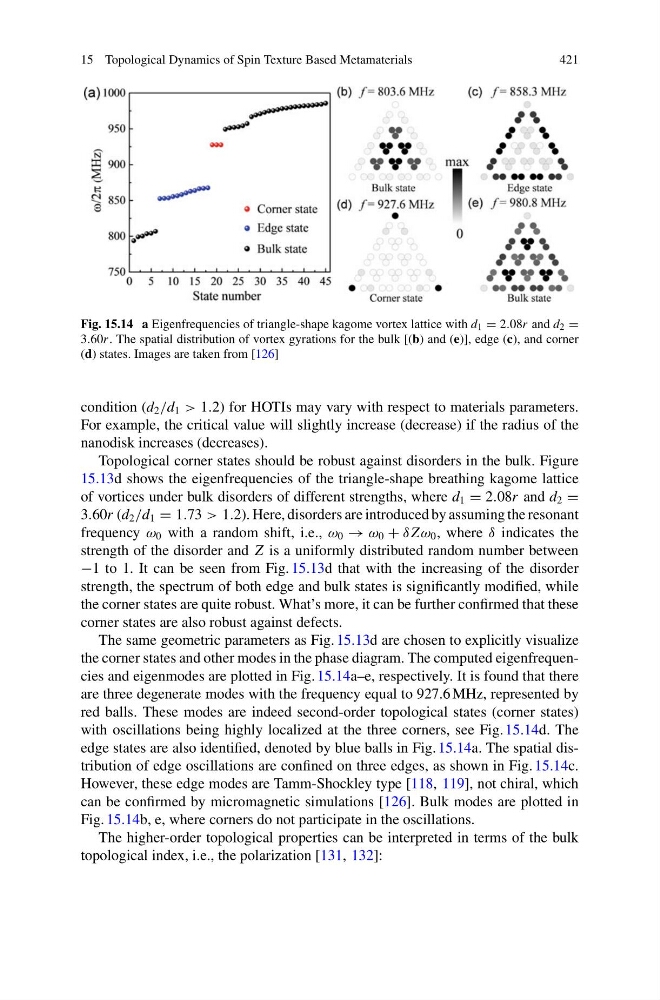
Fig. 15.14 a Eigenfrequencies of triangle-shape kagome vortex lattice with d 1 = 2.08r and d 2 =
3.60r . The spatial distribution of vortex gyrations for the bulk [(b) and (e)], edge (c), and corner
(d) states. Images are taken from [126]
condition (d 2 /d 1 > 1.2) for HOTIs may vary with respect to materials parameters.
For example, the critical value will slightly increase (decrease) if the radius of the
nanodisk increases (decreases).
Topological corner states should be robust against disorders in the bulk. Figure
15.13d shows the eigenfrequencies of the triangle-shape breathing kagome lattice
of vortices under bulk disorders of different strengths, where d 1 = 2.08r and d 2 =
3.60r (d 2 /d 1 = 1.73 > 1.2). Here, disorders are introduced by assuming the resonant
frequency ω 0 with a random shift, i.e., ω 0 → ω 0 + δ Z ω 0 , where δ indicates the
strength of the disorder and Z is a uniformly distributed random number between
−1 to 1. It can be seen from Fig. 15.13d that with the increasing of the disorder
strength, the spectrum of both edge and bulk states is significantly modified, while
the corner states are quite robust. What’s more, it can be further confirmed that these
corner states are also robust against defects.
The same geometric parameters as Fig. 15.13d are chosen to explicitly visualize
the corner states and other modes in the phase diagram. The computed eigenfrequencies and eigenmodes are plotted in Fig. 15.14a–e, respectively. It is found that there
are three degenerate modes with the frequency equal to 927.6 MHz, represented by
red balls. These modes are indeed second-order topological states (corner states)
with oscillations being highly localized at the three corners, see Fig. 15.14d. The
edge states are also identified, denoted by blue balls in Fig. 15.14a. The spatial distribution of edge oscillations are confined on three edges, as shown in Fig. 15.14c.
However, these edge modes are Tamm-Shockley type [118, 119], not chiral, which
can be confirmed by micromagnetic simulations [126]. Bulk modes are plotted in
Fig. 15.14b, e, where corners do not participate in the oscillations.
The higher-order topological properties can be interpreted in terms of the bulk
topological index, i.e., the polarization [131, 132]:
421
Fig. 15.14 a Eigenfrequencies of triangle-shape kagome vortex lattice with d 1 = 2.08r and d 2 =
3.60r . The spatial distribution of vortex gyrations for the bulk [(b) and (e)], edge (c), and corner
(d) states. Images are taken from [126]
condition (d 2 /d 1 > 1.2) for HOTIs may vary with respect to materials parameters.
For example, the critical value will slightly increase (decrease) if the radius of the
nanodisk increases (decreases).
Topological corner states should be robust against disorders in the bulk. Figure
15.13d shows the eigenfrequencies of the triangle-shape breathing kagome lattice
of vortices under bulk disorders of different strengths, where d 1 = 2.08r and d 2 =
3.60r (d 2 /d 1 = 1.73 > 1.2). Here, disorders are introduced by assuming the resonant
frequency ω 0 with a random shift, i.e., ω 0 → ω 0 + δ Z ω 0 , where δ indicates the
strength of the disorder and Z is a uniformly distributed random number between
−1 to 1. It can be seen from Fig. 15.13d that with the increasing of the disorder
strength, the spectrum of both edge and bulk states is significantly modified, while
the corner states are quite robust. What’s more, it can be further confirmed that these
corner states are also robust against defects.
The same geometric parameters as Fig. 15.13d are chosen to explicitly visualize
the corner states and other modes in the phase diagram. The computed eigenfrequencies and eigenmodes are plotted in Fig. 15.14a–e, respectively. It is found that there
are three degenerate modes with the frequency equal to 927.6 MHz, represented by
red balls. These modes are indeed second-order topological states (corner states)
with oscillations being highly localized at the three corners, see Fig. 15.14d. The
edge states are also identified, denoted by blue balls in Fig. 15.14a. The spatial distribution of edge oscillations are confined on three edges, as shown in Fig. 15.14c.
However, these edge modes are Tamm-Shockley type [118, 119], not chiral, which
can be confirmed by micromagnetic simulations [126]. Bulk modes are plotted in
Fig. 15.14b, e, where corners do not participate in the oscillations.
The higher-order topological properties can be interpreted in terms of the bulk
topological index, i.e., the polarization [131, 132]: