

422
Z. Li et al.
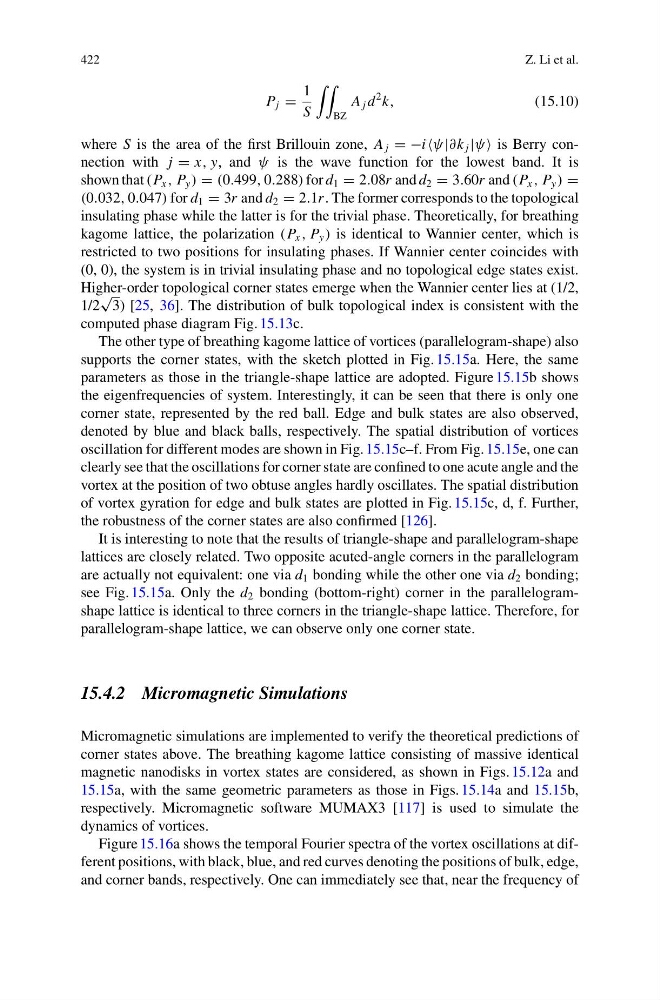
P j =
1
S
BZ
A j d
2 k,
(15.10)
where S is the area of the first Brillouin zone, A j = −iψ|∂k j |ψ is Berry connection with j = x, y, and ψ is the wave function for the lowest band. It is
shown that (P x , P y ) = (0.499, 0.288) for d 1 = 2.08r and d 2 = 3.60r and (P x , P y ) =
(0.032, 0.047) for d 1 = 3r and d 2 = 2.1r . The former corresponds to the topological
insulating phase while the latter is for the trivial phase. Theoretically, for breathing
kagome lattice, the polarization (P x , P y ) is identical to Wannier center, which is
restricted to two positions for insulating phases. If Wannier center coincides with
(0, 0), the system is in trivial insulating phase and no topological edge states exist.
Higher-order topological corner states emerge when the Wannier center lies at (1/2,
1/2
√
3) [25, 36]. The distribution of bulk topological index is consistent with the
computed phase diagram Fig. 15.13c.
The other type of breathing kagome lattice of vortices (parallelogram-shape) also
supports the corner states, with the sketch plotted in Fig. 15.15a. Here, the same
parameters as those in the triangle-shape lattice are adopted. Figure 15.15b shows
the eigenfrequencies of system. Interestingly, it can be seen that there is only one
corner state, represented by the red ball. Edge and bulk states are also observed,
denoted by blue and black balls, respectively. The spatial distribution of vortices
oscillation for different modes are shown in Fig. 15.15c–f. From Fig. 15.15e, one can
clearly see that the oscillations for corner state are confined to one acute angle and the
vortex at the position of two obtuse angles hardly oscillates. The spatial distribution
of vortex gyration for edge and bulk states are plotted in Fig. 15.15c, d, f. Further,
the robustness of the corner states are also confirmed [126].
It is interesting to note that the results of triangle-shape and parallelogram-shape
lattices are closely related. Two opposite acuted-angle corners in the parallelogram
are actually not equivalent: one via d 1 bonding while the other one via d 2 bonding;
see Fig. 15.15a. Only the d 2 bonding (bottom-right) corner in the parallelogramshape lattice is identical to three corners in the triangle-shape lattice. Therefore, for
parallelogram-shape lattice, we can observe only one corner state.
15.4.2 Micromagnetic Simulations
Micromagnetic simulations are implemented to verify the theoretical predictions of
corner states above. The breathing kagome lattice consisting of massive identical
magnetic nanodisks in vortex states are considered, as shown in Figs. 15.12a and
15.15a, with the same geometric parameters as those in Figs. 15.14a and 15.15b,
respectively. Micromagnetic software MUMAX3 [117] is used to simulate the
dynamics of vortices.
Figure 15.16a shows the temporal Fourier spectra of the vortex oscillations at different positions, with black, blue, and red curves denoting the positions of bulk, edge,
and corner bands, respectively. One can immediately see that, near the frequency of
Z. Li et al.
P j =
1
S
BZ
A j d
2 k,
(15.10)
where S is the area of the first Brillouin zone, A j = −iψ|∂k j |ψ is Berry connection with j = x, y, and ψ is the wave function for the lowest band. It is
shown that (P x , P y ) = (0.499, 0.288) for d 1 = 2.08r and d 2 = 3.60r and (P x , P y ) =
(0.032, 0.047) for d 1 = 3r and d 2 = 2.1r . The former corresponds to the topological
insulating phase while the latter is for the trivial phase. Theoretically, for breathing
kagome lattice, the polarization (P x , P y ) is identical to Wannier center, which is
restricted to two positions for insulating phases. If Wannier center coincides with
(0, 0), the system is in trivial insulating phase and no topological edge states exist.
Higher-order topological corner states emerge when the Wannier center lies at (1/2,
1/2
√
3) [25, 36]. The distribution of bulk topological index is consistent with the
computed phase diagram Fig. 15.13c.
The other type of breathing kagome lattice of vortices (parallelogram-shape) also
supports the corner states, with the sketch plotted in Fig. 15.15a. Here, the same
parameters as those in the triangle-shape lattice are adopted. Figure 15.15b shows
the eigenfrequencies of system. Interestingly, it can be seen that there is only one
corner state, represented by the red ball. Edge and bulk states are also observed,
denoted by blue and black balls, respectively. The spatial distribution of vortices
oscillation for different modes are shown in Fig. 15.15c–f. From Fig. 15.15e, one can
clearly see that the oscillations for corner state are confined to one acute angle and the
vortex at the position of two obtuse angles hardly oscillates. The spatial distribution
of vortex gyration for edge and bulk states are plotted in Fig. 15.15c, d, f. Further,
the robustness of the corner states are also confirmed [126].
It is interesting to note that the results of triangle-shape and parallelogram-shape
lattices are closely related. Two opposite acuted-angle corners in the parallelogram
are actually not equivalent: one via d 1 bonding while the other one via d 2 bonding;
see Fig. 15.15a. Only the d 2 bonding (bottom-right) corner in the parallelogramshape lattice is identical to three corners in the triangle-shape lattice. Therefore, for
parallelogram-shape lattice, we can observe only one corner state.
15.4.2 Micromagnetic Simulations
Micromagnetic simulations are implemented to verify the theoretical predictions of
corner states above. The breathing kagome lattice consisting of massive identical
magnetic nanodisks in vortex states are considered, as shown in Figs. 15.12a and
15.15a, with the same geometric parameters as those in Figs. 15.14a and 15.15b,
respectively. Micromagnetic software MUMAX3 [117] is used to simulate the
dynamics of vortices.
Figure 15.16a shows the temporal Fourier spectra of the vortex oscillations at different positions, with black, blue, and red curves denoting the positions of bulk, edge,
and corner bands, respectively. One can immediately see that, near the frequency of