

420
Z. Li et al.
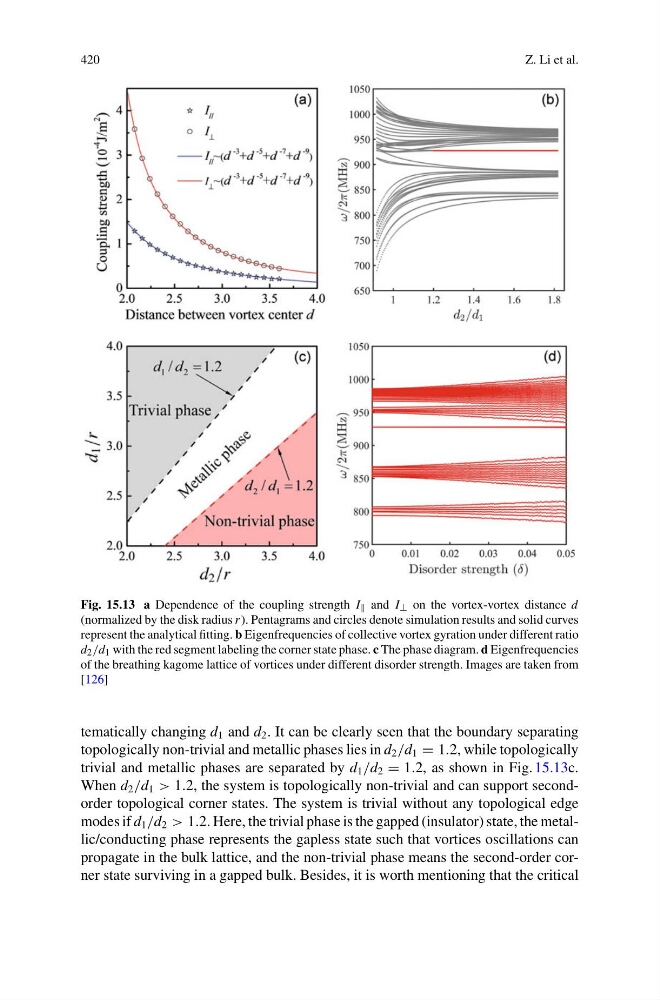
Fig. 15.13 a Dependence of the coupling strength I and I ⊥ on the vortex-vortex distance d
(normalized by the disk radius r ). Pentagrams and circles denote simulation results and solid curves
represent the analytical fitting. b Eigenfrequencies of collective vortex gyration under different ratio
d 2 /d 1 with the red segment labeling the corner state phase. c The phase diagram. d Eigenfrequencies
of the breathing kagome lattice of vortices under different disorder strength. Images are taken from
[126]
tematically changing d 1 and d 2 . It can be clearly seen that the boundary separating
topologically non-trivial and metallic phases lies in d 2 /d 1 = 1.2, while topologically
trivial and metallic phases are separated by d 1 /d 2 = 1.2, as shown in Fig. 15.13c.
When d 2 /d 1 > 1.2, the system is topologically non-trivial and can support secondorder topological corner states. The system is trivial without any topological edge
modes if d 1 /d 2 > 1.2. Here, the trivial phase is the gapped (insulator) state, the metallic/conducting phase represents the gapless state such that vortices oscillations can
propagate in the bulk lattice, and the non-trivial phase means the second-order corner state surviving in a gapped bulk. Besides, it is worth mentioning that the critical
Z. Li et al.
Fig. 15.13 a Dependence of the coupling strength I and I ⊥ on the vortex-vortex distance d
(normalized by the disk radius r ). Pentagrams and circles denote simulation results and solid curves
represent the analytical fitting. b Eigenfrequencies of collective vortex gyration under different ratio
d 2 /d 1 with the red segment labeling the corner state phase. c The phase diagram. d Eigenfrequencies
of the breathing kagome lattice of vortices under different disorder strength. Images are taken from
[126]
tematically changing d 1 and d 2 . It can be clearly seen that the boundary separating
topologically non-trivial and metallic phases lies in d 2 /d 1 = 1.2, while topologically
trivial and metallic phases are separated by d 1 /d 2 = 1.2, as shown in Fig. 15.13c.
When d 2 /d 1 > 1.2, the system is topologically non-trivial and can support secondorder topological corner states. The system is trivial without any topological edge
modes if d 1 /d 2 > 1.2. Here, the trivial phase is the gapped (insulator) state, the metallic/conducting phase represents the gapless state such that vortices oscillations can
propagate in the bulk lattice, and the non-trivial phase means the second-order corner state surviving in a gapped bulk. Besides, it is worth mentioning that the critical