

15 Topological Dynamics of Spin Texture Based Metamaterials
419
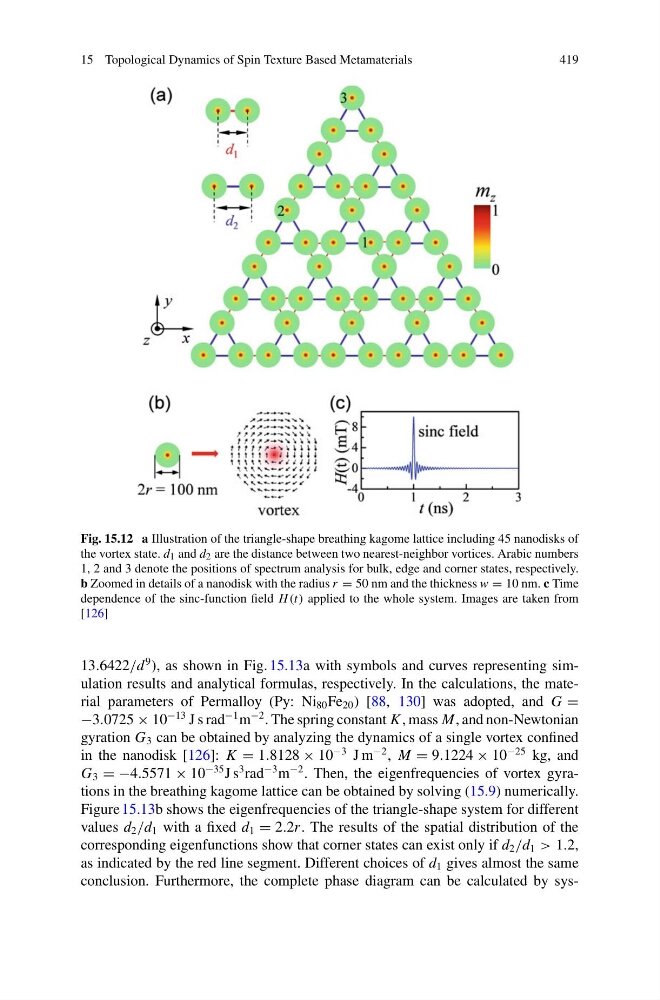
Fig. 15.12 a Illustration of the triangle-shape breathing kagome lattice including 45 nanodisks of
the vortex state. d 1 and d 2 are the distance between two nearest-neighbor vortices. Arabic numbers
1, 2 and 3 denote the positions of spectrum analysis for bulk, edge and corner states, respectively.
b Zoomed in details of a nanodisk with the radius r = 50 nm and the thickness w = 10 nm. c Time
dependence of the sinc-function field H (t) applied to the whole system. Images are taken from
[126]
13.6422/d
9 ), as shown in Fig. 15.13a with symbols and curves representing simulation results and analytical formulas, respectively. In the calculations, the material parameters of Permalloy (Py: Ni 80 Fe 20 ) [88, 130] was adopted, and G =
−3.0725 × 10
−13 J s rad
−1 m
−2 . The spring constant K , mass M, and non-Newtonian
gyration G 3 can be obtained by analyzing the dynamics of a single vortex confined
in the nanodisk [126]: K = 1.8128 × 10
−3 J m
−2 , M = 9.1224 × 10
−25 kg, and
G 3 = −4.5571 × 10
−35 J s
3 rad
−3 m
−2 . Then, the eigenfrequencies of vortex gyrations in the breathing kagome lattice can be obtained by solving (15.9) numerically.
Figure 15.13b shows the eigenfrequencies of the triangle-shape system for different
values d 2 /d 1 with a fixed d 1 = 2.2r . The results of the spatial distribution of the
corresponding eigenfunctions show that corner states can exist only if d 2 /d 1 > 1.2,
as indicated by the red line segment. Different choices of d 1 gives almost the same
conclusion. Furthermore, the complete phase diagram can be calculated by sys-
419
Fig. 15.12 a Illustration of the triangle-shape breathing kagome lattice including 45 nanodisks of
the vortex state. d 1 and d 2 are the distance between two nearest-neighbor vortices. Arabic numbers
1, 2 and 3 denote the positions of spectrum analysis for bulk, edge and corner states, respectively.
b Zoomed in details of a nanodisk with the radius r = 50 nm and the thickness w = 10 nm. c Time
dependence of the sinc-function field H (t) applied to the whole system. Images are taken from
[126]
13.6422/d
9 ), as shown in Fig. 15.13a with symbols and curves representing simulation results and analytical formulas, respectively. In the calculations, the material parameters of Permalloy (Py: Ni 80 Fe 20 ) [88, 130] was adopted, and G =
−3.0725 × 10
−13 J s rad
−1 m
−2 . The spring constant K , mass M, and non-Newtonian
gyration G 3 can be obtained by analyzing the dynamics of a single vortex confined
in the nanodisk [126]: K = 1.8128 × 10
−3 J m
−2 , M = 9.1224 × 10
−25 kg, and
G 3 = −4.5571 × 10
−35 J s
3 rad
−3 m
−2 . Then, the eigenfrequencies of vortex gyrations in the breathing kagome lattice can be obtained by solving (15.9) numerically.
Figure 15.13b shows the eigenfrequencies of the triangle-shape system for different
values d 2 /d 1 with a fixed d 1 = 2.2r . The results of the spatial distribution of the
corresponding eigenfunctions show that corner states can exist only if d 2 /d 1 > 1.2,
as indicated by the red line segment. Different choices of d 1 gives almost the same
conclusion. Furthermore, the complete phase diagram can be calculated by sys-