

15 Topological Dynamics of Spin Texture Based Metamaterials
413
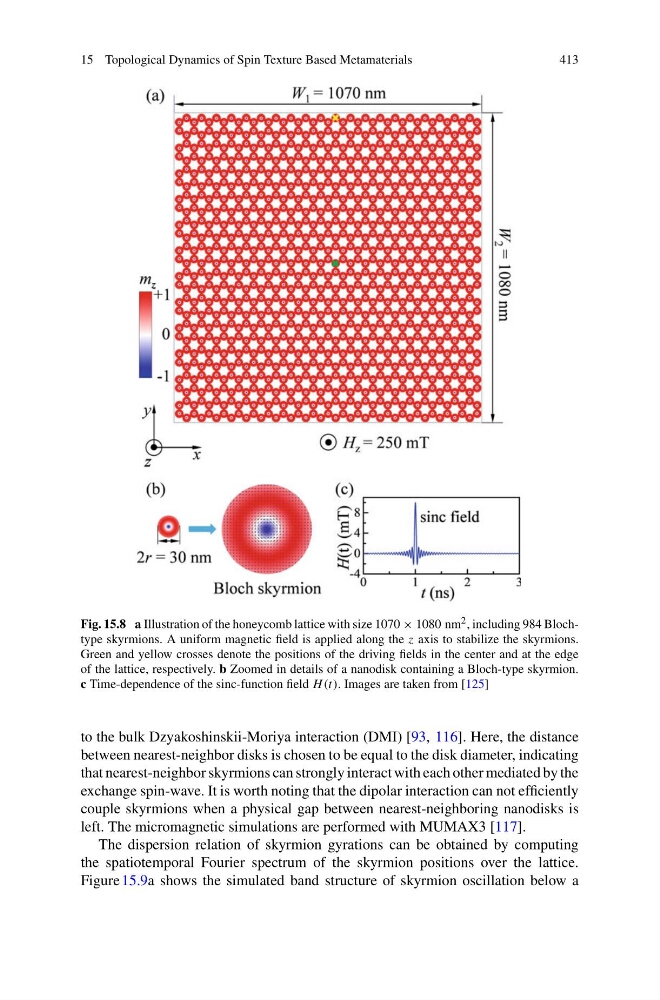
Fig. 15.8 a Illustration of the honeycomb lattice with size 1070 × 1080 nm 2 , including 984 Blochtype skyrmions. A uniform magnetic field is applied along the z axis to stabilize the skyrmions.
Green and yellow crosses denote the positions of the driving fields in the center and at the edge
of the lattice, respectively. b Zoomed in details of a nanodisk containing a Bloch-type skyrmion.
c Time-dependence of the sinc-function field H (t). Images are taken from [125]
to the bulk Dzyakoshinskii-Moriya interaction (DMI) [93, 116]. Here, the distance
between nearest-neighbor disks is chosen to be equal to the disk diameter, indicating
that nearest-neighbor skyrmions can strongly interact with each other mediated by the
exchange spin-wave. It is worth noting that the dipolar interaction can not efficiently
couple skyrmions when a physical gap between nearest-neighboring nanodisks is
left. The micromagnetic simulations are performed with MUMAX3 [117].
The dispersion relation of skyrmion gyrations can be obtained by computing
the spatiotemporal Fourier spectrum of the skyrmion positions over the lattice.
Figure 15.9a shows the simulated band structure of skyrmion oscillation below a
413
Fig. 15.8 a Illustration of the honeycomb lattice with size 1070 × 1080 nm 2 , including 984 Blochtype skyrmions. A uniform magnetic field is applied along the z axis to stabilize the skyrmions.
Green and yellow crosses denote the positions of the driving fields in the center and at the edge
of the lattice, respectively. b Zoomed in details of a nanodisk containing a Bloch-type skyrmion.
c Time-dependence of the sinc-function field H (t). Images are taken from [125]
to the bulk Dzyakoshinskii-Moriya interaction (DMI) [93, 116]. Here, the distance
between nearest-neighbor disks is chosen to be equal to the disk diameter, indicating
that nearest-neighbor skyrmions can strongly interact with each other mediated by the
exchange spin-wave. It is worth noting that the dipolar interaction can not efficiently
couple skyrmions when a physical gap between nearest-neighboring nanodisks is
left. The micromagnetic simulations are performed with MUMAX3 [117].
The dispersion relation of skyrmion gyrations can be obtained by computing
the spatiotemporal Fourier spectrum of the skyrmion positions over the lattice.
Figure 15.9a shows the simulated band structure of skyrmion oscillation below a