

412
Z. Li et al.
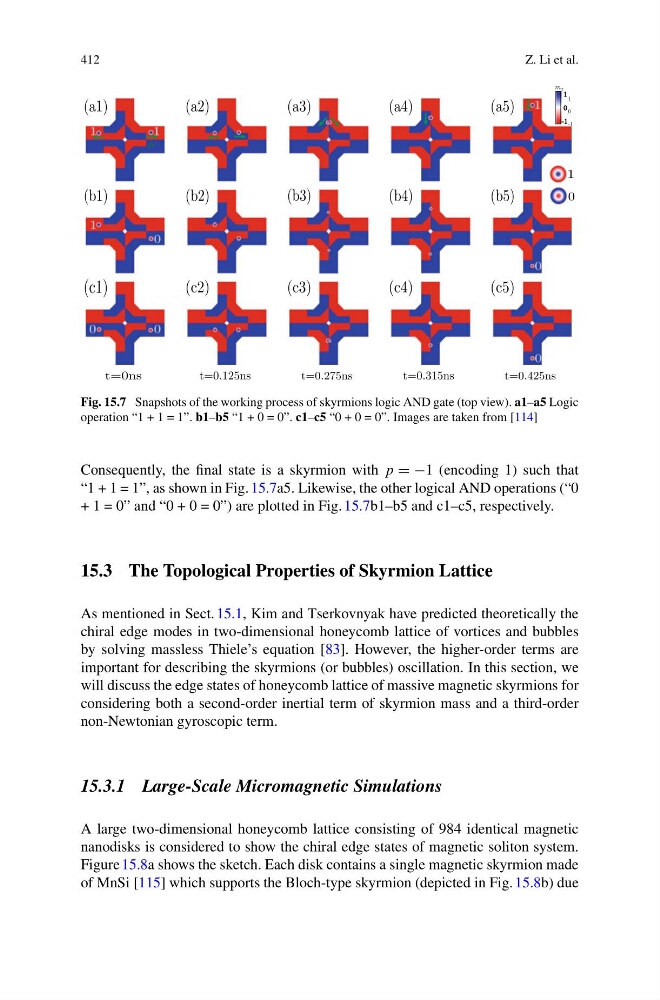
Fig. 15.7 Snapshots of the working process of skyrmions logic AND gate (top view). a1–a5 Logic
operation “1 + 1 = 1”. b1–b5 “1 + 0 = 0”. c1–c5 “0 + 0 = 0”. Images are taken from [114]
Consequently, the final state is a skyrmion with p = −1 (encoding 1) such that
“1 + 1 = 1”, as shown in Fig. 15.7a5. Likewise, the other logical AND operations (“0
+ 1 = 0” and “0 + 0 = 0”) are plotted in Fig. 15.7b1–b5 and c1–c5, respectively.
15.3 The Topological Properties of Skyrmion Lattice
As mentioned in Sect. 15.1, Kim and Tserkovnyak have predicted theoretically the
chiral edge modes in two-dimensional honeycomb lattice of vortices and bubbles
by solving massless Thiele’s equation [83]. However, the higher-order terms are
important for describing the skyrmions (or bubbles) oscillation. In this section, we
will discuss the edge states of honeycomb lattice of massive magnetic skyrmions for
considering both a second-order inertial term of skyrmion mass and a third-order
non-Newtonian gyroscopic term.
15.3.1 Large-Scale Micromagnetic Simulations
A large two-dimensional honeycomb lattice consisting of 984 identical magnetic
nanodisks is considered to show the chiral edge states of magnetic soliton system.
Figure 15.8a shows the sketch. Each disk contains a single magnetic skyrmion made
of MnSi [115] which supports the Bloch-type skyrmion (depicted in Fig. 15.8b) due
Z. Li et al.
Fig. 15.7 Snapshots of the working process of skyrmions logic AND gate (top view). a1–a5 Logic
operation “1 + 1 = 1”. b1–b5 “1 + 0 = 0”. c1–c5 “0 + 0 = 0”. Images are taken from [114]
Consequently, the final state is a skyrmion with p = −1 (encoding 1) such that
“1 + 1 = 1”, as shown in Fig. 15.7a5. Likewise, the other logical AND operations (“0
+ 1 = 0” and “0 + 0 = 0”) are plotted in Fig. 15.7b1–b5 and c1–c5, respectively.
15.3 The Topological Properties of Skyrmion Lattice
As mentioned in Sect. 15.1, Kim and Tserkovnyak have predicted theoretically the
chiral edge modes in two-dimensional honeycomb lattice of vortices and bubbles
by solving massless Thiele’s equation [83]. However, the higher-order terms are
important for describing the skyrmions (or bubbles) oscillation. In this section, we
will discuss the edge states of honeycomb lattice of massive magnetic skyrmions for
considering both a second-order inertial term of skyrmion mass and a third-order
non-Newtonian gyroscopic term.
15.3.1 Large-Scale Micromagnetic Simulations
A large two-dimensional honeycomb lattice consisting of 984 identical magnetic
nanodisks is considered to show the chiral edge states of magnetic soliton system.
Figure 15.8a shows the sketch. Each disk contains a single magnetic skyrmion made
of MnSi [115] which supports the Bloch-type skyrmion (depicted in Fig. 15.8b) due