

14 Topology in Magnetism
389
t = 10
t = 30
t = 50
t = 50
t =100
t = 200
(a)
(b)
Wave source
Wave source
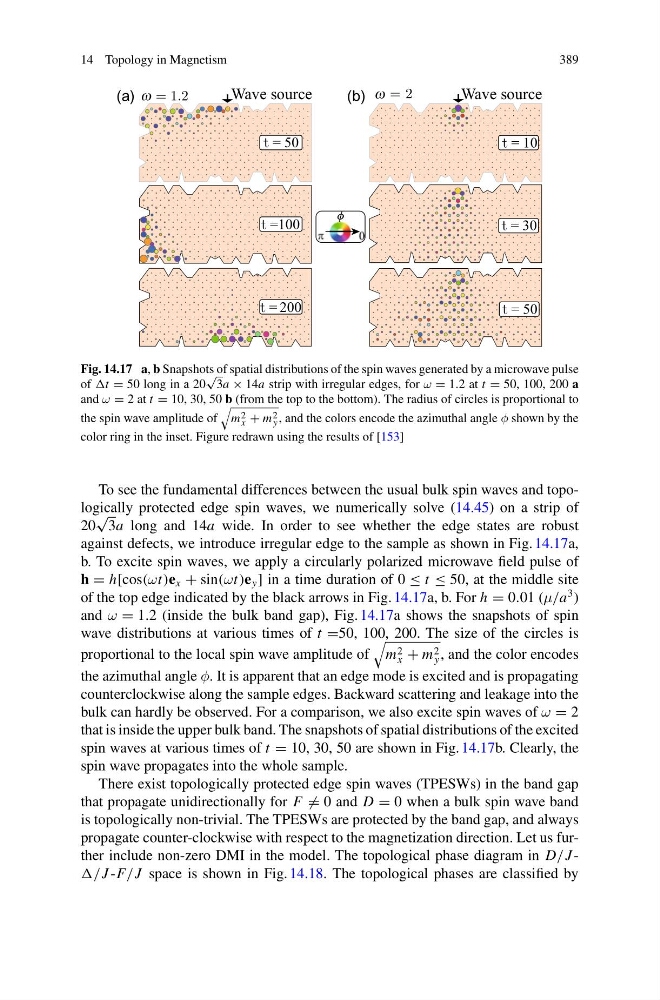
Fig. 14.17 a, b Snapshots of spatial distributions of the spin waves generated by a microwave pulse
of = 50 long in a 20
√
3a × 14a strip with irregular edges, for ω = 1.2 at t = 50, 100, 200 a
and ω = 2 at t = 10, 30, 50 b (from the top to the bottom). The radius of circles is proportional to
the spin wave amplitude of
m 2
x + m 2
y , and the colors encode the azimuthal angle φ shown by the
color ring in the inset. Figure redrawn using the results of [153]
To see the fundamental differences between the usual bulk spin waves and topologically protected edge spin waves, we numerically solve (14.45) on a strip of
20
√
3a long and 14a wide. In order to see whether the edge states are robust
against defects, we introduce irregular edge to the sample as shown in Fig. 14.17a,
b. To excite spin waves, we apply a circularly polarized microwave field pulse of
h = h[cos(ωt)e x + sin(ωt)e y ] in a time duration of 0 ≤ t ≤ 50, at the middle site
of the top edge indicated by the black arrows in Fig. 14.17a, b. For h = 0.01 (μ/a
3 )
and ω = 1.2 (inside the bulk band gap), Fig. 14.17a shows the snapshots of spin
wave distributions at various times of t =50, 100, 200. The size of the circles is
proportional to the local spin wave amplitude of
m 2
x + m 2
y , and the color encodes
the azimuthal angle φ. It is apparent that an edge mode is excited and is propagating
counterclockwise along the sample edges. Backward scattering and leakage into the
bulk can hardly be observed. For a comparison, we also excite spin waves of ω = 2
that is inside the upper bulk band. The snapshots of spatial distributions of the excited
spin waves at various times of t = 10, 30, 50 are shown in Fig. 14.17b. Clearly, the
spin wave propagates into the whole sample.
There exist topologically protected edge spin waves (TPESWs) in the band gap
that propagate unidirectionally for F = 0 and D = 0 when a bulk spin wave band
is topologically non-trivial. The TPESWs are protected by the band gap, and always
propagate counter-clockwise with respect to the magnetization direction. Let us further include non-zero DMI in the model. The topological phase diagram in D/J -
-F/J space is shown in Fig. 14.18. The topological phases are classified by
389
t = 10
t = 30
t = 50
t = 50
t =100
t = 200
(a)
(b)
Wave source
Wave source
Fig. 14.17 a, b Snapshots of spatial distributions of the spin waves generated by a microwave pulse
of = 50 long in a 20
√
3a × 14a strip with irregular edges, for ω = 1.2 at t = 50, 100, 200 a
and ω = 2 at t = 10, 30, 50 b (from the top to the bottom). The radius of circles is proportional to
the spin wave amplitude of
m 2
x + m 2
y , and the colors encode the azimuthal angle φ shown by the
color ring in the inset. Figure redrawn using the results of [153]
To see the fundamental differences between the usual bulk spin waves and topologically protected edge spin waves, we numerically solve (14.45) on a strip of
20
√
3a long and 14a wide. In order to see whether the edge states are robust
against defects, we introduce irregular edge to the sample as shown in Fig. 14.17a,
b. To excite spin waves, we apply a circularly polarized microwave field pulse of
h = h[cos(ωt)e x + sin(ωt)e y ] in a time duration of 0 ≤ t ≤ 50, at the middle site
of the top edge indicated by the black arrows in Fig. 14.17a, b. For h = 0.01 (μ/a
3 )
and ω = 1.2 (inside the bulk band gap), Fig. 14.17a shows the snapshots of spin
wave distributions at various times of t =50, 100, 200. The size of the circles is
proportional to the local spin wave amplitude of
m 2
x + m 2
y , and the color encodes
the azimuthal angle φ. It is apparent that an edge mode is excited and is propagating
counterclockwise along the sample edges. Backward scattering and leakage into the
bulk can hardly be observed. For a comparison, we also excite spin waves of ω = 2
that is inside the upper bulk band. The snapshots of spatial distributions of the excited
spin waves at various times of t = 10, 30, 50 are shown in Fig. 14.17b. Clearly, the
spin wave propagates into the whole sample.
There exist topologically protected edge spin waves (TPESWs) in the band gap
that propagate unidirectionally for F = 0 and D = 0 when a bulk spin wave band
is topologically non-trivial. The TPESWs are protected by the band gap, and always
propagate counter-clockwise with respect to the magnetization direction. Let us further include non-zero DMI in the model. The topological phase diagram in D/J -
-F/J space is shown in Fig. 14.18. The topological phases are classified by