

390
X. S. Wang and X. R. Wang
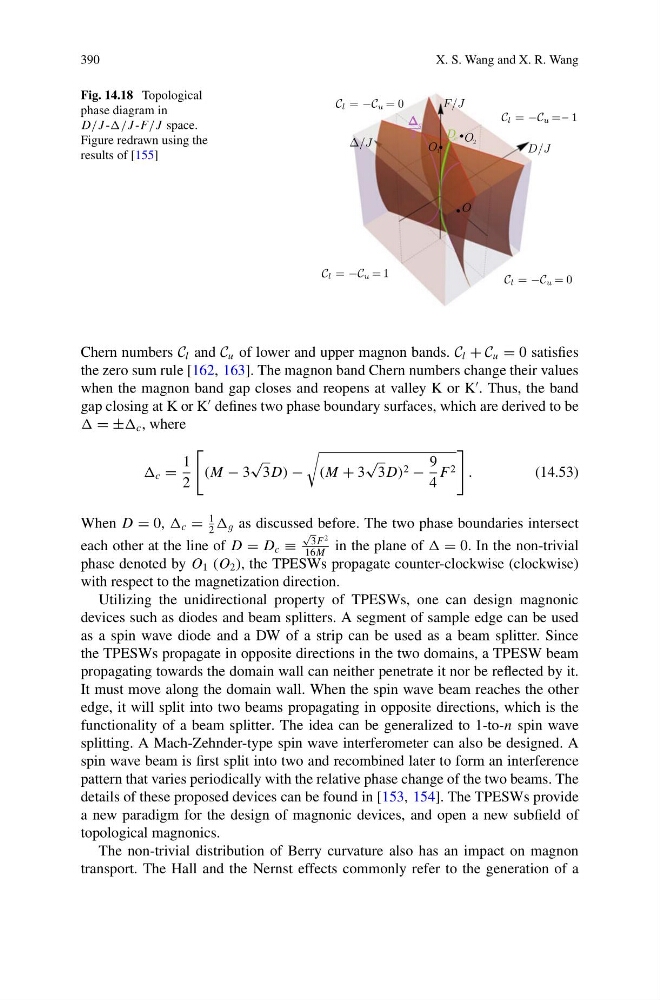
Fig. 14.18 Topological
phase diagram in
D/J - -F/J space.
Figure redrawn using the
results of [155]
1
0
0
Chern numbers C l and C u of lower and upper magnon bands. C l + C u = 0 satisfies
the zero sum rule [162, 163]. The magnon band Chern numbers change their values
when the magnon band gap closes and reopens at valley K or K
. Thus, the band
gap closing at K or K
defines two phase boundary surfaces, which are derived to be
= ± c , where
c =
1
2
(M − 3
√
3D) −
(M + 3
√
3D) 2 −
9
4
F 2
.
(14.53)
When D = 0, c =
1
2
g as discussed before. The two phase boundaries intersect
each other at the line of D = D c ≡
√
3F
2
16M
in the plane of = 0. In the non-trivial
phase denoted by O 1 (O 2 ), the TPESWs propagate counter-clockwise (clockwise)
with respect to the magnetization direction.
Utilizing the unidirectional property of TPESWs, one can design magnonic
devices such as diodes and beam splitters. A segment of sample edge can be used
as a spin wave diode and a DW of a strip can be used as a beam splitter. Since
the TPESWs propagate in opposite directions in the two domains, a TPESW beam
propagating towards the domain wall can neither penetrate it nor be reflected by it.
It must move along the domain wall. When the spin wave beam reaches the other
edge, it will split into two beams propagating in opposite directions, which is the
functionality of a beam splitter. The idea can be generalized to 1-to-n spin wave
splitting. A Mach-Zehnder-type spin wave interferometer can also be designed. A
spin wave beam is first split into two and recombined later to form an interference
pattern that varies periodically with the relative phase change of the two beams. The
details of these proposed devices can be found in [153, 154]. The TPESWs provide
a new paradigm for the design of magnonic devices, and open a new subfield of
topological magnonics.
The non-trivial distribution of Berry curvature also has an impact on magnon
transport. The Hall and the Nernst effects commonly refer to the generation of a
X. S. Wang and X. R. Wang
Fig. 14.18 Topological
phase diagram in
D/J - -F/J space.
Figure redrawn using the
results of [155]
1
0
0
Chern numbers C l and C u of lower and upper magnon bands. C l + C u = 0 satisfies
the zero sum rule [162, 163]. The magnon band Chern numbers change their values
when the magnon band gap closes and reopens at valley K or K
. Thus, the band
gap closing at K or K
defines two phase boundary surfaces, which are derived to be
= ± c , where
c =
1
2
(M − 3
√
3D) −
(M + 3
√
3D) 2 −
9
4
F 2
.
(14.53)
When D = 0, c =
1
2
g as discussed before. The two phase boundaries intersect
each other at the line of D = D c ≡
√
3F
2
16M
in the plane of = 0. In the non-trivial
phase denoted by O 1 (O 2 ), the TPESWs propagate counter-clockwise (clockwise)
with respect to the magnetization direction.
Utilizing the unidirectional property of TPESWs, one can design magnonic
devices such as diodes and beam splitters. A segment of sample edge can be used
as a spin wave diode and a DW of a strip can be used as a beam splitter. Since
the TPESWs propagate in opposite directions in the two domains, a TPESW beam
propagating towards the domain wall can neither penetrate it nor be reflected by it.
It must move along the domain wall. When the spin wave beam reaches the other
edge, it will split into two beams propagating in opposite directions, which is the
functionality of a beam splitter. The idea can be generalized to 1-to-n spin wave
splitting. A Mach-Zehnder-type spin wave interferometer can also be designed. A
spin wave beam is first split into two and recombined later to form an interference
pattern that varies periodically with the relative phase change of the two beams. The
details of these proposed devices can be found in [153, 154]. The TPESWs provide
a new paradigm for the design of magnonic devices, and open a new subfield of
topological magnonics.
The non-trivial distribution of Berry curvature also has an impact on magnon
transport. The Hall and the Nernst effects commonly refer to the generation of a