

388
X. S. Wang and X. R. Wang
2
1
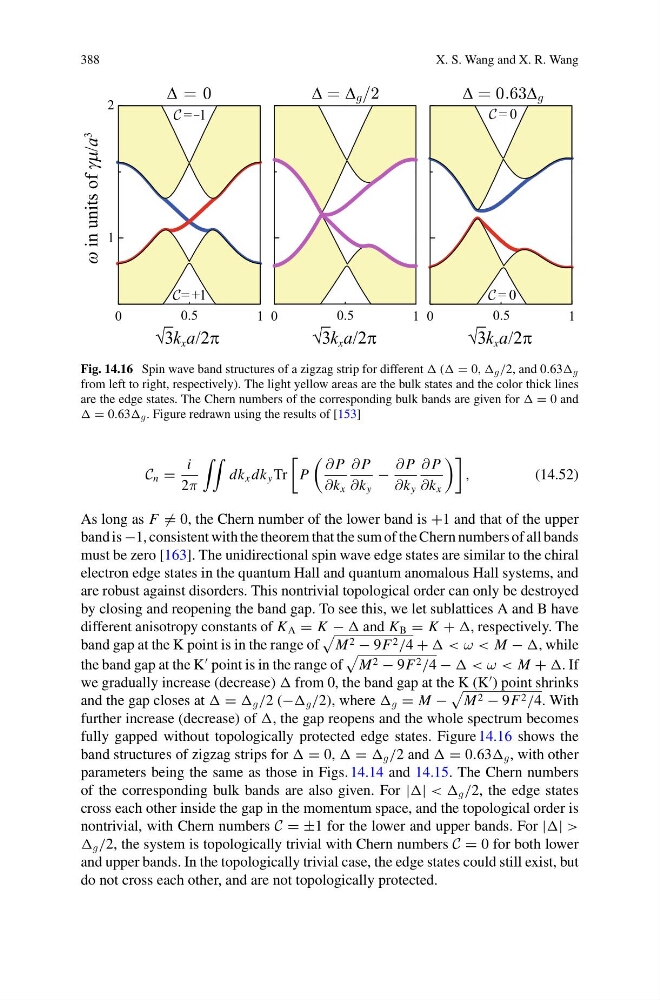
Fig. 14.16 Spin wave band structures of a zigzag strip for different ( = 0, g /2, and 0.63 g
from left to right, respectively). The light yellow areas are the bulk states and the color thick lines
are the edge states. The Chern numbers of the corresponding bulk bands are given for = 0 and
= 0.63 g . Figure redrawn using the results of [153]
C n =
i
2π
dk x dk y Tr
P
∂ P
∂k x
∂ P
∂k y
−
∂ P
∂k y
∂ P
∂k x
,
(14.52)
As long as F = 0, the Chern number of the lower band is +1 and that of the upper
band is −1, consistent with the theorem that the sum of the Chern numbers of all bands
must be zero [163]. The unidirectional spin wave edge states are similar to the chiral
electron edge states in the quantum Hall and quantum anomalous Hall systems, and
are robust against disorders. This nontrivial topological order can only be destroyed
by closing and reopening the band gap. To see this, we let sublattices A and B have
different anisotropy constants of K A = K − and K B = K + , respectively. The
band gap at the K point is in the range of
M 2 − 9F 2 /4 + < ω < M − , while
the band gap at the K
point is in the range of
M 2 − 9F 2 /4 − < ω < M + . If
we gradually increase (decrease) from 0, the band gap at the K (K
) point shrinks
and the gap closes at = g /2 (− g /2), where g = M −
M 2 − 9F 2 /4. With
further increase (decrease) of , the gap reopens and the whole spectrum becomes
fully gapped without topologically protected edge states. Figure 14.16 shows the
band structures of zigzag strips for = 0, = g /2 and = 0.63 g , with other
parameters being the same as those in Figs. 14.14 and 14.15. The Chern numbers
of the corresponding bulk bands are also given. For | < < g /2, the edge states
cross each other inside the gap in the momentum space, and the topological order is
nontrivial, with Chern numbers C = ±1 for the lower and upper bands. For | >
g /2, the system is topologically trivial with Chern numbers C = 0 for both lower
and upper bands. In the topologically trivial case, the edge states could still exist, but
do not cross each other, and are not topologically protected.
X. S. Wang and X. R. Wang
2
1
Fig. 14.16 Spin wave band structures of a zigzag strip for different ( = 0, g /2, and 0.63 g
from left to right, respectively). The light yellow areas are the bulk states and the color thick lines
are the edge states. The Chern numbers of the corresponding bulk bands are given for = 0 and
= 0.63 g . Figure redrawn using the results of [153]
C n =
i
2π
dk x dk y Tr
P
∂ P
∂k x
∂ P
∂k y
−
∂ P
∂k y
∂ P
∂k x
,
(14.52)
As long as F = 0, the Chern number of the lower band is +1 and that of the upper
band is −1, consistent with the theorem that the sum of the Chern numbers of all bands
must be zero [163]. The unidirectional spin wave edge states are similar to the chiral
electron edge states in the quantum Hall and quantum anomalous Hall systems, and
are robust against disorders. This nontrivial topological order can only be destroyed
by closing and reopening the band gap. To see this, we let sublattices A and B have
different anisotropy constants of K A = K − and K B = K + , respectively. The
band gap at the K point is in the range of
M 2 − 9F 2 /4 + < ω < M − , while
the band gap at the K
point is in the range of
M 2 − 9F 2 /4 − < ω < M + . If
we gradually increase (decrease) from 0, the band gap at the K (K
) point shrinks
and the gap closes at = g /2 (− g /2), where g = M −
M 2 − 9F 2 /4. With
further increase (decrease) of , the gap reopens and the whole spectrum becomes
fully gapped without topologically protected edge states. Figure 14.16 shows the
band structures of zigzag strips for = 0, = g /2 and = 0.63 g , with other
parameters being the same as those in Figs. 14.14 and 14.15. The Chern numbers
of the corresponding bulk bands are also given. For | < < g /2, the edge states
cross each other inside the gap in the momentum space, and the topological order is
nontrivial, with Chern numbers C = ±1 for the lower and upper bands. For | >
g /2, the system is topologically trivial with Chern numbers C = 0 for both lower
and upper bands. In the topologically trivial case, the edge states could still exist, but
do not cross each other, and are not topologically protected.