

14 Topology in Magnetism
371
(a)
(b)
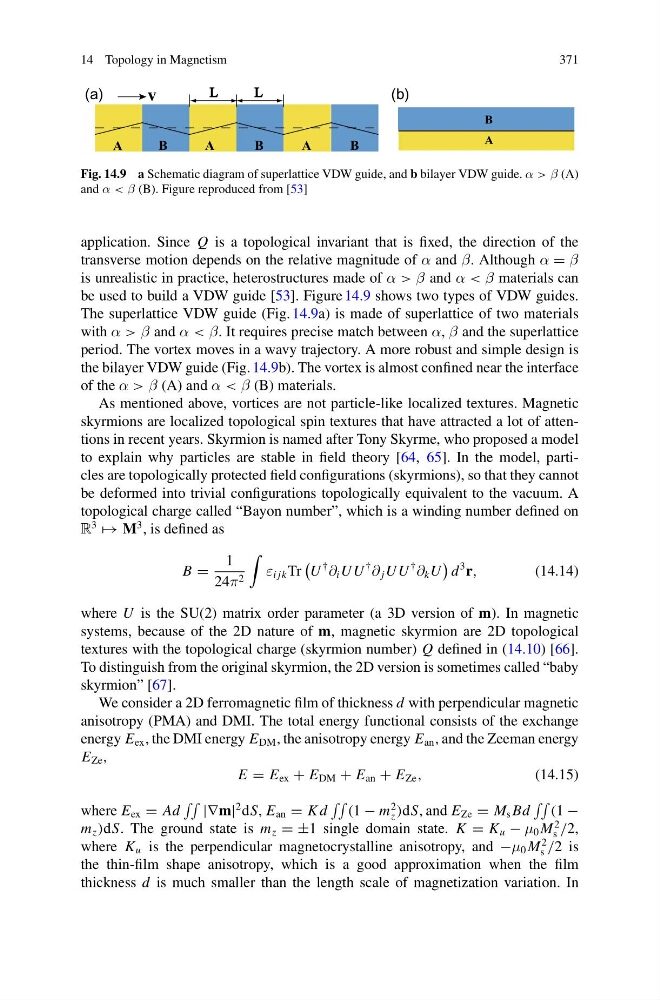
Fig. 14.9 a Schematic diagram of superlattice VDW guide, and b bilayer VDW guide. α > β (A)
and α < β (B). Figure reproduced from [53]
application. Since Q is a topological invariant that is fixed, the direction of the
transverse motion depends on the relative magnitude of α and β. Although α = β
is unrealistic in practice, heterostructures made of α > β and α < β materials can
be used to build a VDW guide [53]. Figure 14.9 shows two types of VDW guides.
The superlattice VDW guide (Fig. 14.9a) is made of superlattice of two materials
with α > β and α < β. It requires precise match between α, β and the superlattice
period. The vortex moves in a wavy trajectory. A more robust and simple design is
the bilayer VDW guide (Fig. 14.9b). The vortex is almost confined near the interface
of the α > β (A) and α < β (B) materials.
As mentioned above, vortices are not particle-like localized textures. Magnetic
skyrmions are localized topological spin textures that have attracted a lot of attentions in recent years. Skyrmion is named after Tony Skyrme, who proposed a model
to explain why particles are stable in field theory [64, 65]. In the model, particles are topologically protected field configurations (skyrmions), so that they cannot
be deformed into trivial configurations topologically equivalent to the vacuum. A
topological charge called “Bayon number”, which is a winding number defined on
R
3
→ M
3 , is defined as
B =
1
24π 2
ε i jk Tr
U
†
∂ i UU
†
∂ j UU
†
∂ k U
d
3 r,
(14.14)
where U is the SU(2) matrix order parameter (a 3D version of m). In magnetic
systems, because of the 2D nature of m, magnetic skyrmion are 2D topological
textures with the topological charge (skyrmion number) Q defined in (14.10) [66].
To distinguish from the original skyrmion, the 2D version is sometimes called “baby
skyrmion” [67].
We consider a 2D ferromagnetic film of thickness d with perpendicular magnetic
anisotropy (PMA) and DMI. The total energy functional consists of the exchange
energy E ex , the DMI energy E DM , the anisotropy energy E an , and the Zeeman energy
E Ze ,
E = E ex + E DM + E an + E Ze ,
(14.15)
where E ex = Ad
|∇m|
2 dS, E an = K d
(1 − m
2
z )dS, and E Ze = M s Bd
(1 −
m z )dS. The ground state is m z = ±1 single domain state. K = K u − μ 0 M
2
s /2,
where K u is the perpendicular magnetocrystalline anisotropy, and −μ 0 M
2
s /2 is
the thin-film shape anisotropy, which is a good approximation when the film
thickness d is much smaller than the length scale of magnetization variation. In
371
(a)
(b)
Fig. 14.9 a Schematic diagram of superlattice VDW guide, and b bilayer VDW guide. α > β (A)
and α < β (B). Figure reproduced from [53]
application. Since Q is a topological invariant that is fixed, the direction of the
transverse motion depends on the relative magnitude of α and β. Although α = β
is unrealistic in practice, heterostructures made of α > β and α < β materials can
be used to build a VDW guide [53]. Figure 14.9 shows two types of VDW guides.
The superlattice VDW guide (Fig. 14.9a) is made of superlattice of two materials
with α > β and α < β. It requires precise match between α, β and the superlattice
period. The vortex moves in a wavy trajectory. A more robust and simple design is
the bilayer VDW guide (Fig. 14.9b). The vortex is almost confined near the interface
of the α > β (A) and α < β (B) materials.
As mentioned above, vortices are not particle-like localized textures. Magnetic
skyrmions are localized topological spin textures that have attracted a lot of attentions in recent years. Skyrmion is named after Tony Skyrme, who proposed a model
to explain why particles are stable in field theory [64, 65]. In the model, particles are topologically protected field configurations (skyrmions), so that they cannot
be deformed into trivial configurations topologically equivalent to the vacuum. A
topological charge called “Bayon number”, which is a winding number defined on
R
3
→ M
3 , is defined as
B =
1
24π 2
ε i jk Tr
U
†
∂ i UU
†
∂ j UU
†
∂ k U
d
3 r,
(14.14)
where U is the SU(2) matrix order parameter (a 3D version of m). In magnetic
systems, because of the 2D nature of m, magnetic skyrmion are 2D topological
textures with the topological charge (skyrmion number) Q defined in (14.10) [66].
To distinguish from the original skyrmion, the 2D version is sometimes called “baby
skyrmion” [67].
We consider a 2D ferromagnetic film of thickness d with perpendicular magnetic
anisotropy (PMA) and DMI. The total energy functional consists of the exchange
energy E ex , the DMI energy E DM , the anisotropy energy E an , and the Zeeman energy
E Ze ,
E = E ex + E DM + E an + E Ze ,
(14.15)
where E ex = Ad
|∇m|
2 dS, E an = K d
(1 − m
2
z )dS, and E Ze = M s Bd
(1 −
m z )dS. The ground state is m z = ±1 single domain state. K = K u − μ 0 M
2
s /2,
where K u is the perpendicular magnetocrystalline anisotropy, and −μ 0 M
2
s /2 is
the thin-film shape anisotropy, which is a good approximation when the film
thickness d is much smaller than the length scale of magnetization variation. In