

370
X. S. Wang and X. R. Wang
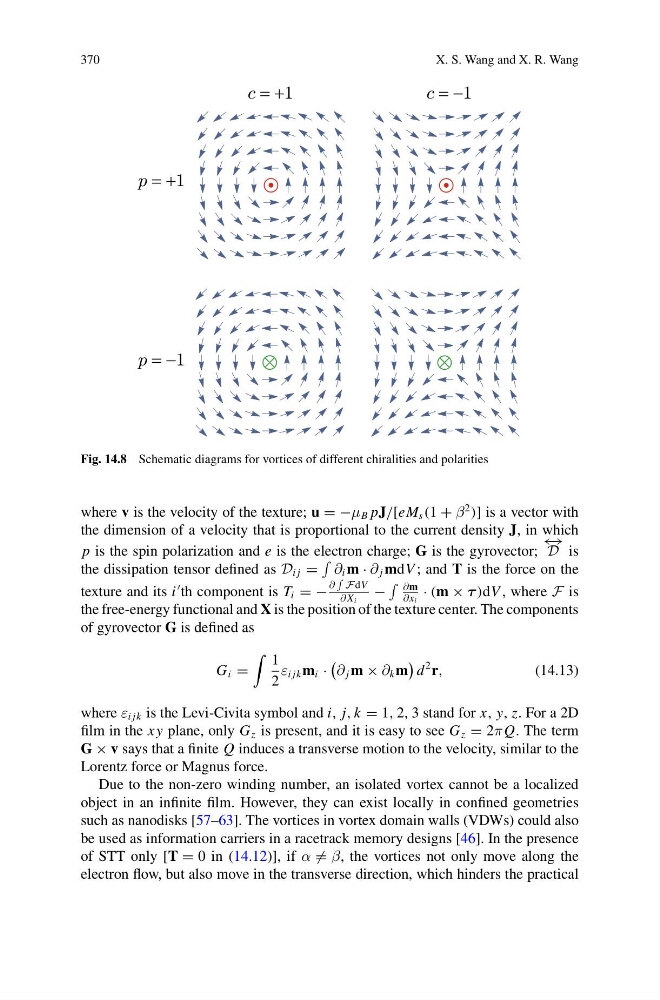
Fig. 14.8 Schematic diagrams for vortices of different chiralities and polarities
where v is the velocity of the texture; u = −μ B pJ/[eM s (1 + β
2
)] is a vector with
the dimension of a velocity that is proportional to the current density J, in which
p is the spin polarization and e is the electron charge; G is the gyrovector;
← →
D is
the dissipation tensor defined as D i j =
∂ i m · ∂ j mdV ; and T is the force on the
texture and its i
th component is T i = −
∂
F dV
∂ X i
−
∂m
∂x i
· (m × τ )dV , where F is
the free-energy functional and X is the position of the texture center. The components
of gyrovector G is defined as
G i =
1
2
ε i jk m i ·
∂ j m × ∂ k m
d
2 r,
(14.13)
where ε i jk is the Levi-Civita symbol and i, j, k = 1, 2, 3 stand for x, y, z. For a 2D
film in the x y plane, only G z is present, and it is easy to see G z = 2π Q. The term
G × v says that a finite Q induces a transverse motion to the velocity, similar to the
Lorentz force or Magnus force.
Due to the non-zero winding number, an isolated vortex cannot be a localized
object in an infinite film. However, they can exist locally in confined geometries
such as nanodisks [57–63]. The vortices in vortex domain walls (VDWs) could also
be used as information carriers in a racetrack memory designs [46]. In the presence
of STT only [T = 0 in (14.12)], if α = β, the vortices not only move along the
electron flow, but also move in the transverse direction, which hinders the practical
X. S. Wang and X. R. Wang
Fig. 14.8 Schematic diagrams for vortices of different chiralities and polarities
where v is the velocity of the texture; u = −μ B pJ/[eM s (1 + β
2
)] is a vector with
the dimension of a velocity that is proportional to the current density J, in which
p is the spin polarization and e is the electron charge; G is the gyrovector;
← →
D is
the dissipation tensor defined as D i j =
∂ i m · ∂ j mdV ; and T is the force on the
texture and its i
th component is T i = −
∂
F dV
∂ X i
−
∂m
∂x i
· (m × τ )dV , where F is
the free-energy functional and X is the position of the texture center. The components
of gyrovector G is defined as
G i =
1
2
ε i jk m i ·
∂ j m × ∂ k m
d
2 r,
(14.13)
where ε i jk is the Levi-Civita symbol and i, j, k = 1, 2, 3 stand for x, y, z. For a 2D
film in the x y plane, only G z is present, and it is easy to see G z = 2π Q. The term
G × v says that a finite Q induces a transverse motion to the velocity, similar to the
Lorentz force or Magnus force.
Due to the non-zero winding number, an isolated vortex cannot be a localized
object in an infinite film. However, they can exist locally in confined geometries
such as nanodisks [57–63]. The vortices in vortex domain walls (VDWs) could also
be used as information carriers in a racetrack memory designs [46]. In the presence
of STT only [T = 0 in (14.12)], if α = β, the vortices not only move along the
electron flow, but also move in the transverse direction, which hinders the practical