

372
X. S. Wang and X. R. Wang
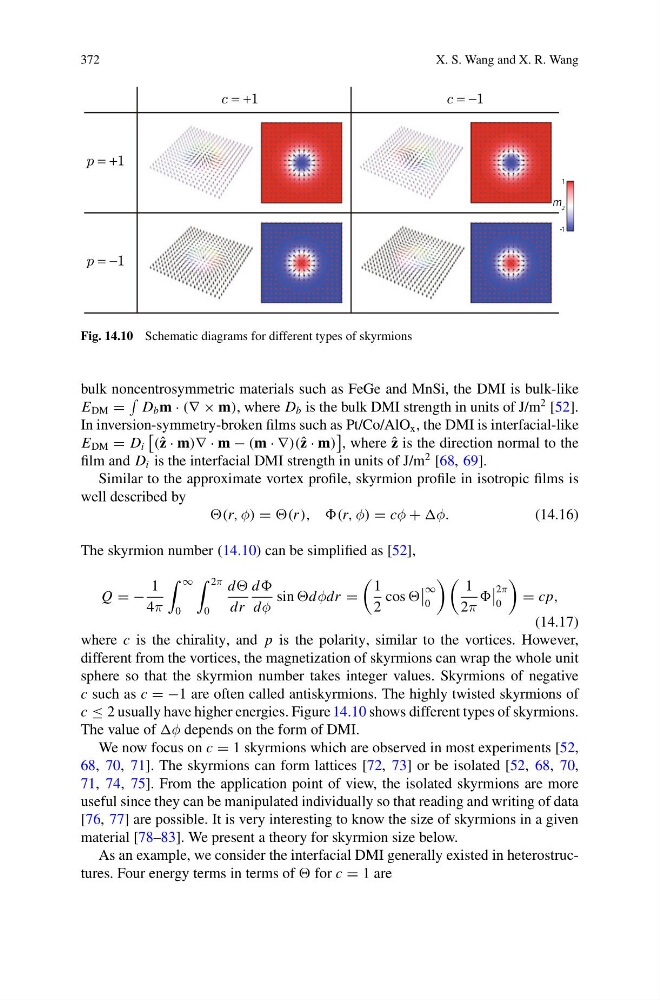
Fig. 14.10 Schematic diagrams for different types of skyrmions
bulk noncentrosymmetric materials such as FeGe and MnSi, the DMI is bulk-like
E DM =
D b m · (∇ × m), where D b is the bulk DMI strength in units of J/m
2 [52].
In inversion-symmetry-broken films such as Pt/Co/AlO x , the DMI is interfacial-like
E DM = D i
(ˆ z · m)∇ · m − (m · ∇)(ˆ z · m)
, where ˆ
z is the direction normal to the
film and D i is the interfacial DMI strength in units of J/m
2 [68, 69].
Similar to the approximate vortex profile, skyrmion profile in isotropic films is
well described by
φ) = ), ,(r, φ) = cφ +
(14.16)
The skyrmion number (14.10) can be simplified as [52],
Q = −
1
4π
∞
0
2π
0
d
dr
d
dφ
sin =
1
2
cos
∞
0
1
2π
2π
0
= cp,
(14.17)
where c is the chirality, and p is the polarity, similar to the vortices. However,
different from the vortices, the magnetization of skyrmions can wrap the whole unit
sphere so that the skyrmion number takes integer values. Skyrmions of negative
c such as c = −1 are often called antiskyrmions. The highly twisted skyrmions of
c ≤ 2 usually have higher energies. Figure 14.10 shows different types of skyrmions.
The value of depends on the form of DMI.
We now focus on c = 1 skyrmions which are observed in most experiments [52,
68, 70, 71]. The skyrmions can form lattices [72, 73] or be isolated [52, 68, 70,
71, 74, 75]. From the application point of view, the isolated skyrmions are more
useful since they can be manipulated individually so that reading and writing of data
[76, 77] are possible. It is very interesting to know the size of skyrmions in a given
material [78–83]. We present a theory for skyrmion size below.
As an example, we consider the interfacial DMI generally existed in heterostructures. Four energy terms in terms of for c = 1 are
X. S. Wang and X. R. Wang
Fig. 14.10 Schematic diagrams for different types of skyrmions
bulk noncentrosymmetric materials such as FeGe and MnSi, the DMI is bulk-like
E DM =
D b m · (∇ × m), where D b is the bulk DMI strength in units of J/m
2 [52].
In inversion-symmetry-broken films such as Pt/Co/AlO x , the DMI is interfacial-like
E DM = D i
(ˆ z · m)∇ · m − (m · ∇)(ˆ z · m)
, where ˆ
z is the direction normal to the
film and D i is the interfacial DMI strength in units of J/m
2 [68, 69].
Similar to the approximate vortex profile, skyrmion profile in isotropic films is
well described by
φ) = ), ,(r, φ) = cφ +
(14.16)
The skyrmion number (14.10) can be simplified as [52],
Q = −
1
4π
∞
0
2π
0
d
dr
d
dφ
sin =
1
2
cos
∞
0
1
2π
2π
0
= cp,
(14.17)
where c is the chirality, and p is the polarity, similar to the vortices. However,
different from the vortices, the magnetization of skyrmions can wrap the whole unit
sphere so that the skyrmion number takes integer values. Skyrmions of negative
c such as c = −1 are often called antiskyrmions. The highly twisted skyrmions of
c ≤ 2 usually have higher energies. Figure 14.10 shows different types of skyrmions.
The value of depends on the form of DMI.
We now focus on c = 1 skyrmions which are observed in most experiments [52,
68, 70, 71]. The skyrmions can form lattices [72, 73] or be isolated [52, 68, 70,
71, 74, 75]. From the application point of view, the isolated skyrmions are more
useful since they can be manipulated individually so that reading and writing of data
[76, 77] are possible. It is very interesting to know the size of skyrmions in a given
material [78–83]. We present a theory for skyrmion size below.
As an example, we consider the interfacial DMI generally existed in heterostructures. Four energy terms in terms of for c = 1 are