

344
J. E. Vázquez-Lozano and A. Martínez
original one for freely propagating optical fields, (13.52), when n = 1, as expected.
In addition, this simple relation provides important insights on account of the dependence on the dispersion-related phase and group velocities. Indeed, it is easy to realize
that the stored optical chirality density may be naturally enhanced in artificially engineered materials just by lowering both velocities. This is specifically accomplished
in the vicinity of the resonance frequency, i.e., in the anomalous dispersion region,
wherein the real part of the permittivity decreases abruptly. Notwithstanding, in a
dispersive and lossy media, there are, incidentally, some spectral ranges where the
precise physical meaning of the group velocity turns out to be somewhat unclear [30,
65]. Let’s see how to proceed on this matter.
13.4.2 Optical Chirality Density in Dispersive and Lossy
Media: Loudon’s Approach
According to the Kramers-Kronig relations [28], a physically realistic description
of dynamical properties in dispersive media would require careful considerations
of dissipative effects. As outlined above, this is very well known for the EM field
energy in metals, for which a general treatment has been developed [27, 29]. Herein
we shall do the same for the optical chirality density, thereby incorporating properly
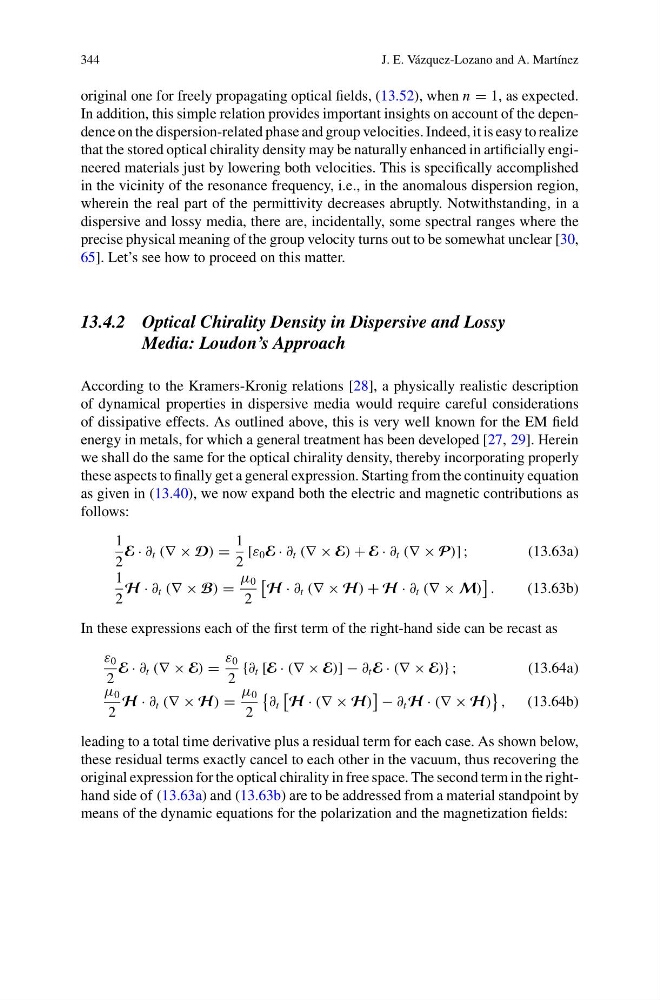
these aspects to finally get a general expression. Starting from the continuity equation
as given in (13.40), we now expand both the electric and magnetic contributions as
follows:
1
2
E · ∂ t (∇ × D) =
1
2
[ε 0 E · ∂ t (∇ × E) + E · ∂ t (∇ × P)] ;
(13.63a)
1
2
H · ∂ t (∇ × B) =
μ 0
2
H · ∂ t (∇ × H) + H · ∂ t (∇ × M)
.
(13.63b)
In these expressions each of the first term of the right-hand side can be recast as
ε 0
2
E · ∂ t (∇ × E) =
ε 0
2
{∂ t [E · (∇ × E)] − ∂ t E · (∇ × E)} ;
(13.64a)
μ 0
2
H · ∂ t (∇ × H) =
μ 0
2
∂ t
H · (∇ × H)
− ∂ t H · (∇ × H)
, (13.64b)
leading to a total time derivative plus a residual term for each case. As shown below,
these residual terms exactly cancel to each other in the vacuum, thus recovering the
original expression for the optical chirality in free space. The second term in the righthand side of (13.63a) and (13.63b) are to be addressed from a material standpoint by
means of the dynamic equations for the polarization and the magnetization fields:
J. E. Vázquez-Lozano and A. Martínez
original one for freely propagating optical fields, (13.52), when n = 1, as expected.
In addition, this simple relation provides important insights on account of the dependence on the dispersion-related phase and group velocities. Indeed, it is easy to realize
that the stored optical chirality density may be naturally enhanced in artificially engineered materials just by lowering both velocities. This is specifically accomplished
in the vicinity of the resonance frequency, i.e., in the anomalous dispersion region,
wherein the real part of the permittivity decreases abruptly. Notwithstanding, in a
dispersive and lossy media, there are, incidentally, some spectral ranges where the
precise physical meaning of the group velocity turns out to be somewhat unclear [30,
65]. Let’s see how to proceed on this matter.
13.4.2 Optical Chirality Density in Dispersive and Lossy
Media: Loudon’s Approach
According to the Kramers-Kronig relations [28], a physically realistic description
of dynamical properties in dispersive media would require careful considerations
of dissipative effects. As outlined above, this is very well known for the EM field
energy in metals, for which a general treatment has been developed [27, 29]. Herein
we shall do the same for the optical chirality density, thereby incorporating properly
these aspects to finally get a general expression. Starting from the continuity equation
as given in (13.40), we now expand both the electric and magnetic contributions as
follows:
1
2
E · ∂ t (∇ × D) =
1
2
[ε 0 E · ∂ t (∇ × E) + E · ∂ t (∇ × P)] ;
(13.63a)
1
2
H · ∂ t (∇ × B) =
μ 0
2
H · ∂ t (∇ × H) + H · ∂ t (∇ × M)
.
(13.63b)
In these expressions each of the first term of the right-hand side can be recast as
ε 0
2
E · ∂ t (∇ × E) =
ε 0
2
{∂ t [E · (∇ × E)] − ∂ t E · (∇ × E)} ;
(13.64a)
μ 0
2
H · ∂ t (∇ × H) =
μ 0
2
∂ t
H · (∇ × H)
− ∂ t H · (∇ × H)
, (13.64b)
leading to a total time derivative plus a residual term for each case. As shown below,
these residual terms exactly cancel to each other in the vacuum, thus recovering the
original expression for the optical chirality in free space. The second term in the righthand side of (13.63a) and (13.63b) are to be addressed from a material standpoint by
means of the dynamic equations for the polarization and the magnetization fields: