

13 Theoretical Generalization of the Optical Chirality to Arbitrary Optical Media
343
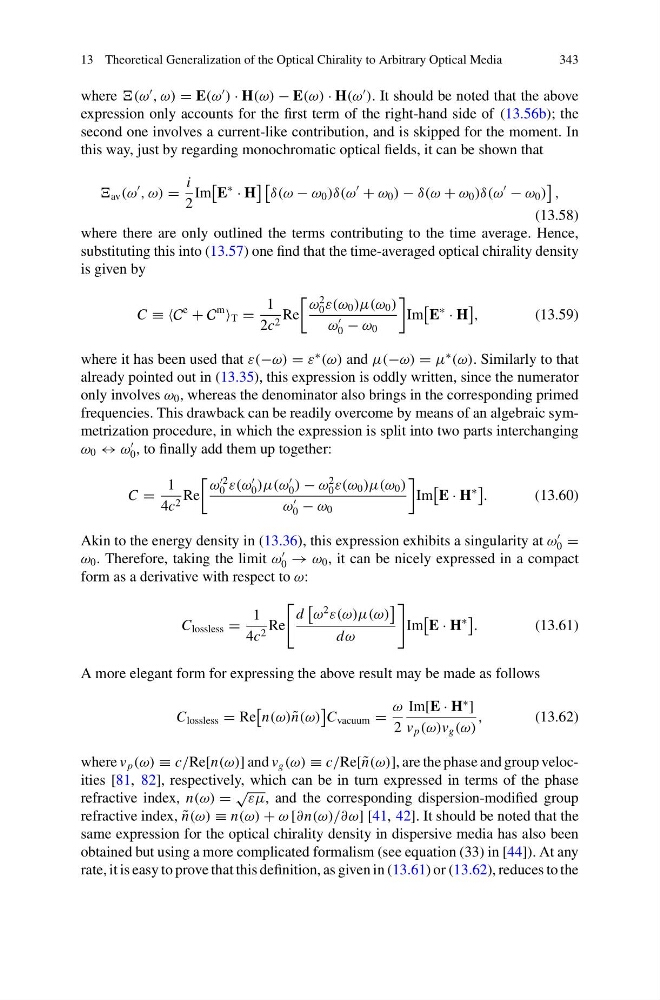
where
, ω) = E(ω
) · H(ω) − E(ω) · H(ω
). It should be noted that the above
expression only accounts for the first term of the right-hand side of (13.56b); the
second one involves a current-like contribution, and is skipped for the moment. In
this way, just by regarding monochromatic optical fields, it can be shown that
av (ω
, ω) =
i
2
Im
E
∗
· H
δ(ω − ω 0 )δ(ω
+ ω 0 ) − δ(ω + ω 0 )δ(ω
− ω 0 )
,
(13.58)
where there are only outlined the terms contributing to the time average. Hence,
substituting this into (13.57) one find that the time-averaged optical chirality density
is given by
C ≡ ≡C
e
+ C
m
T =
1
2c 2 Re
ω
2
0 ε(ω 0 )μ(ω 0 )
ω
0 − ω 0
Im
E
∗
· H
,
(13.59)
where it has been used that ε(−ω) = ε
∗
(ω) and μ(−ω) = μ
∗
(ω). Similarly to that
already pointed out in (13.35), this expression is oddly written, since the numerator
only involves ω 0 , whereas the denominator also brings in the corresponding primed
frequencies. This drawback can be readily overcome by means of an algebraic symmetrization procedure, in which the expression is split into two parts interchanging
ω 0 ↔ ω
0 , to finally add them up together:
C =
1
4c 2 Re
ω
2
0 ε(ω
0 )μ(ω
0 ) − ω
2
0 ε(ω 0 )μ(ω 0 )
ω
0 − ω 0
Im
E · H
∗
.
(13.60)
Akin to the energy density in (13.36), this expression exhibits a singularity at ω
0 =
ω 0 . Therefore, taking the limit ω
0 → ω 0 , it can be nicely expressed in a compact
form as a derivative with respect to ω:
C lossless =
1
4c 2 Re
d
ω
2
ε(ω)μ(ω)
dω
Im
E · H
∗
.
(13.61)
A more elegant form for expressing the above result may be made as follows
C lossless = Re
n(ω) ˜
n(ω)
C vacuum =
ω
2
Im[E · H
∗ ]
v p (ω)v g (ω)
,
(13.62)
where v p (ω) ≡ c/Re[n(ω)] and v g (ω) ≡ c/Re[ ˜
n(ω)], are the phase and group velocities [81, 82], respectively, which can be in turn expressed in terms of the phase
refractive index, n(ω) =
√ εμ, and the corresponding dispersion-modified group
refractive index, ˜
n(ω) ≡ n(ω) + ω [∂n(ω)/∂ω] [41, 42]. It should be noted that the
same expression for the optical chirality density in dispersive media has also been
obtained but using a more complicated formalism (see equation (33) in [44]). At any
rate, it is easy to prove that this definition, as given in (13.61) or (13.62), reduces to the
343
where
, ω) = E(ω
) · H(ω) − E(ω) · H(ω
). It should be noted that the above
expression only accounts for the first term of the right-hand side of (13.56b); the
second one involves a current-like contribution, and is skipped for the moment. In
this way, just by regarding monochromatic optical fields, it can be shown that
av (ω
, ω) =
i
2
Im
E
∗
· H
δ(ω − ω 0 )δ(ω
+ ω 0 ) − δ(ω + ω 0 )δ(ω
− ω 0 )
,
(13.58)
where there are only outlined the terms contributing to the time average. Hence,
substituting this into (13.57) one find that the time-averaged optical chirality density
is given by
C ≡ ≡C
e
+ C
m
T =
1
2c 2 Re
ω
2
0 ε(ω 0 )μ(ω 0 )
ω
0 − ω 0
Im
E
∗
· H
,
(13.59)
where it has been used that ε(−ω) = ε
∗
(ω) and μ(−ω) = μ
∗
(ω). Similarly to that
already pointed out in (13.35), this expression is oddly written, since the numerator
only involves ω 0 , whereas the denominator also brings in the corresponding primed
frequencies. This drawback can be readily overcome by means of an algebraic symmetrization procedure, in which the expression is split into two parts interchanging
ω 0 ↔ ω
0 , to finally add them up together:
C =
1
4c 2 Re
ω
2
0 ε(ω
0 )μ(ω
0 ) − ω
2
0 ε(ω 0 )μ(ω 0 )
ω
0 − ω 0
Im
E · H
∗
.
(13.60)
Akin to the energy density in (13.36), this expression exhibits a singularity at ω
0 =
ω 0 . Therefore, taking the limit ω
0 → ω 0 , it can be nicely expressed in a compact
form as a derivative with respect to ω:
C lossless =
1
4c 2 Re
d
ω
2
ε(ω)μ(ω)
dω
Im
E · H
∗
.
(13.61)
A more elegant form for expressing the above result may be made as follows
C lossless = Re
n(ω) ˜
n(ω)
C vacuum =
ω
2
Im[E · H
∗ ]
v p (ω)v g (ω)
,
(13.62)
where v p (ω) ≡ c/Re[n(ω)] and v g (ω) ≡ c/Re[ ˜
n(ω)], are the phase and group velocities [81, 82], respectively, which can be in turn expressed in terms of the phase
refractive index, n(ω) =
√ εμ, and the corresponding dispersion-modified group
refractive index, ˜
n(ω) ≡ n(ω) + ω [∂n(ω)/∂ω] [41, 42]. It should be noted that the
same expression for the optical chirality density in dispersive media has also been
obtained but using a more complicated formalism (see equation (33) in [44]). At any
rate, it is easy to prove that this definition, as given in (13.61) or (13.62), reduces to the