

342
J. E. Vázquez-Lozano and A. Martínez
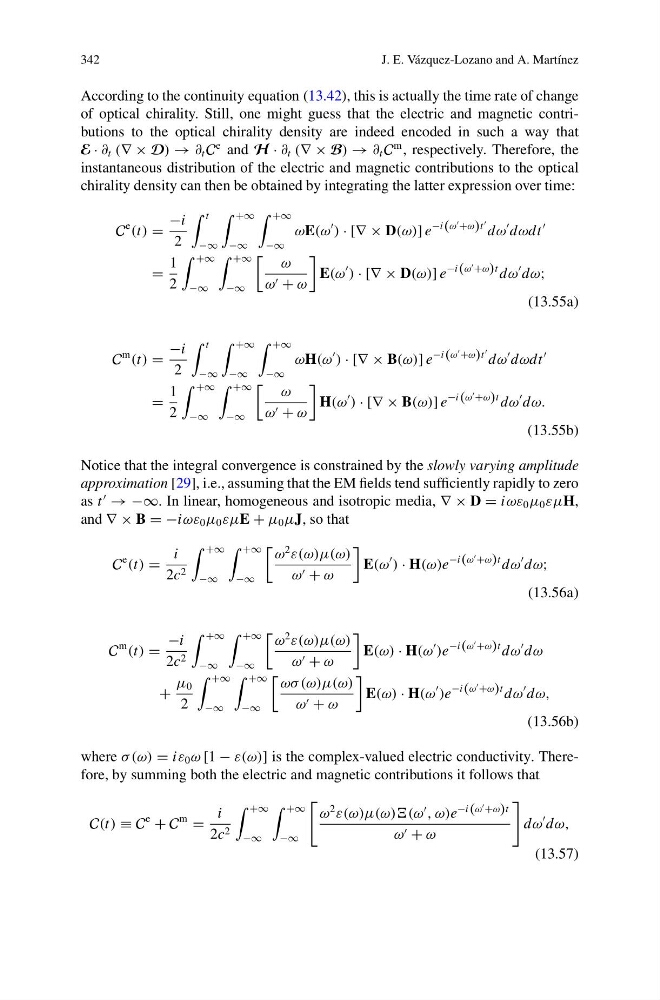
According to the continuity equation (13.42), this is actually the time rate of change
of optical chirality. Still, one might guess that the electric and magnetic contributions to the optical chirality density are indeed encoded in such a way that
E · ∂ t (∇ × D) → ∂ t C
e and H · ∂ t (∇ × B) → ∂ t C
m , respectively. Therefore, the
instantaneous distribution of the electric and magnetic contributions to the optical
chirality density can then be obtained by integrating the latter expression over time:
C
e
(t) =
−i
2
t
−∞
+∞
−∞
+∞
−∞
ωE(ω
) · [∇ × D(ω)] e
−i(ω
+ω)t
dω
dωdt
=
1
2
+∞
−∞
+∞
−∞
ω
ω + ω
E(ω
) · [∇ × D(ω)] e
−i(ω
+ω)t dω
dω;
(13.55a)
C
m
(t) =
−i
2
t
−∞
+∞
−∞
+∞
−∞
ωH(ω
) · [∇ × B(ω)] e
−i(ω
+ω)t
dω
dωdt
=
1
2
+∞
−∞
+∞
−∞
ω
ω + ω
H(ω
) · [∇ × B(ω)] e
−i(ω
+ω)t dω
dω.
(13.55b)
Notice that the integral convergence is constrained by the slowly varying amplitude
approximation [29], i.e., assuming that the EM fields tend sufficiently rapidly to zero
as t
→ −∞. In linear, homogeneous and isotropic media, ∇ × D = iωε 0 μ 0 εμH,
and ∇ × B = −iωε 0 μ 0 εμE + μ 0 μJ, so that
C
e
(t) =
i
2c 2
+∞
−∞
+∞
−∞
ω
2
ε(ω)μ(ω)
ω + ω
E(ω
) · H(ω)e
−i(ω
+ω)t dω
dω;
(13.56a)
C
m
(t) =
−i
2c 2
+∞
−∞
+∞
−∞
ω
2
ε(ω)μ(ω)
ω + ω
E(ω) · H(ω
)e
−i(ω
+ω)t dω
dω
+
μ 0
2
+∞
−∞
+∞
−∞
ωσ (ω)μ(ω)
ω + ω
E(ω) · H(ω
)e
−i(ω
+ω)t dω
dω,
(13.56b)
where σ (ω) = iε 0 ω [1 − ε(ω)] is the complex-valued electric conductivity. Therefore, by summing both the electric and magnetic contributions it follows that
C(t) ≡ C
e
+ C
m
=
i
2c 2
+∞
−∞
+∞
−∞
ω
2
ε(ω)μ(ω))(ω
, ω)e
−i(ω
+ω)t
ω + ω
dω
dω,
(13.57)
J. E. Vázquez-Lozano and A. Martínez
According to the continuity equation (13.42), this is actually the time rate of change
of optical chirality. Still, one might guess that the electric and magnetic contributions to the optical chirality density are indeed encoded in such a way that
E · ∂ t (∇ × D) → ∂ t C
e and H · ∂ t (∇ × B) → ∂ t C
m , respectively. Therefore, the
instantaneous distribution of the electric and magnetic contributions to the optical
chirality density can then be obtained by integrating the latter expression over time:
C
e
(t) =
−i
2
t
−∞
+∞
−∞
+∞
−∞
ωE(ω
) · [∇ × D(ω)] e
−i(ω
+ω)t
dω
dωdt
=
1
2
+∞
−∞
+∞
−∞
ω
ω + ω
E(ω
) · [∇ × D(ω)] e
−i(ω
+ω)t dω
dω;
(13.55a)
C
m
(t) =
−i
2
t
−∞
+∞
−∞
+∞
−∞
ωH(ω
) · [∇ × B(ω)] e
−i(ω
+ω)t
dω
dωdt
=
1
2
+∞
−∞
+∞
−∞
ω
ω + ω
H(ω
) · [∇ × B(ω)] e
−i(ω
+ω)t dω
dω.
(13.55b)
Notice that the integral convergence is constrained by the slowly varying amplitude
approximation [29], i.e., assuming that the EM fields tend sufficiently rapidly to zero
as t
→ −∞. In linear, homogeneous and isotropic media, ∇ × D = iωε 0 μ 0 εμH,
and ∇ × B = −iωε 0 μ 0 εμE + μ 0 μJ, so that
C
e
(t) =
i
2c 2
+∞
−∞
+∞
−∞
ω
2
ε(ω)μ(ω)
ω + ω
E(ω
) · H(ω)e
−i(ω
+ω)t dω
dω;
(13.56a)
C
m
(t) =
−i
2c 2
+∞
−∞
+∞
−∞
ω
2
ε(ω)μ(ω)
ω + ω
E(ω) · H(ω
)e
−i(ω
+ω)t dω
dω
+
μ 0
2
+∞
−∞
+∞
−∞
ωσ (ω)μ(ω)
ω + ω
E(ω) · H(ω
)e
−i(ω
+ω)t dω
dω,
(13.56b)
where σ (ω) = iε 0 ω [1 − ε(ω)] is the complex-valued electric conductivity. Therefore, by summing both the electric and magnetic contributions it follows that
C(t) ≡ C
e
+ C
m
=
i
2c 2
+∞
−∞
+∞
−∞
ω
2
ε(ω)μ(ω))(ω
, ω)e
−i(ω
+ω)t
ω + ω
dω
dω,
(13.57)