

13 Theoretical Generalization of the Optical Chirality to Arbitrary Optical Media
333
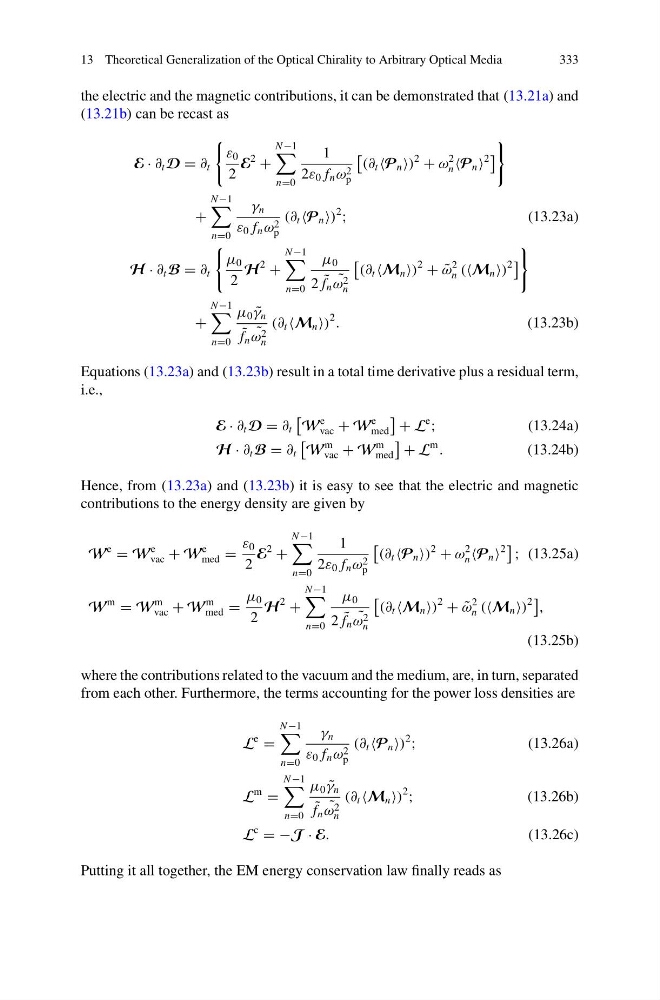
the electric and the magnetic contributions, it can be demonstrated that (13.21a) and
(13.21b) can be recast as
E · ∂ t D = ∂ t
ε 0
2
E
2
+
N −1
n=0
1
2ε 0 f n ω 2
p
(∂ t P n )
2
+ ω
2
n P n
2
+
N −1
n=0
γ n
ε 0 f n ω 2
p
(∂ t P n )
2
;
(13.23a)
H · ∂ t B = ∂ t
μ 0
2
H
2
+
N −1
n=0
μ 0
2 ˜
f n ˜
ω 2
n
(∂ t M n )
2
+ ˜
ω
2
n (M n )
2
+
N −1
n=0
μ 0 ˜
γ n
˜
f n ˜
ω 2
n
(∂ t M n )
2
.
(13.23b)
Equations (13.23a) and (13.23b) result in a total time derivative plus a residual term,
i.e.,
E · ∂ t D = ∂ t
W
e
vac + W
e
med
+ L
e
;
(13.24a)
H · ∂ t B = ∂ t
W
m
vac + W
m
med
+ L
m
.
(13.24b)
Hence, from (13.23a) and (13.23b) it is easy to see that the electric and magnetic
contributions to the energy density are given by
W
e
= W
e
vac + W
e
med =
ε 0
2
E
2
+
N −1
n=0
1
2ε 0 f n ω 2
p
(∂ t P n )
2
+ ω
2
n P n
2
; (13.25a)
W
m
= W
m
vac + W
m
med =
μ 0
2
H
2
+
N −1
n=0
μ 0
2 ˜
f n ˜
ω 2
n
(∂ t M n )
2
+ ˜
ω
2
n (M n )
2
,
(13.25b)
where the contributions related to the vacuum and the medium, are, in turn, separated
from each other. Furthermore, the terms accounting for the power loss densities are
L
e
=
N −1
n=0
γ n
ε 0 f n ω 2
p
(∂ t P n )
2
;
(13.26a)
L
m
=
N −1
n=0
μ 0 ˜
γ n
˜
f n ˜
ω 2
n
(∂ t M n )
2
;
(13.26b)
L
c
= −J · E.
(13.26c)
Putting it all together, the EM energy conservation law finally reads as
333
the electric and the magnetic contributions, it can be demonstrated that (13.21a) and
(13.21b) can be recast as
E · ∂ t D = ∂ t
ε 0
2
E
2
+
N −1
n=0
1
2ε 0 f n ω 2
p
(∂ t P n )
2
+ ω
2
n P n
2
+
N −1
n=0
γ n
ε 0 f n ω 2
p
(∂ t P n )
2
;
(13.23a)
H · ∂ t B = ∂ t
μ 0
2
H
2
+
N −1
n=0
μ 0
2 ˜
f n ˜
ω 2
n
(∂ t M n )
2
+ ˜
ω
2
n (M n )
2
+
N −1
n=0
μ 0 ˜
γ n
˜
f n ˜
ω 2
n
(∂ t M n )
2
.
(13.23b)
Equations (13.23a) and (13.23b) result in a total time derivative plus a residual term,
i.e.,
E · ∂ t D = ∂ t
W
e
vac + W
e
med
+ L
e
;
(13.24a)
H · ∂ t B = ∂ t
W
m
vac + W
m
med
+ L
m
.
(13.24b)
Hence, from (13.23a) and (13.23b) it is easy to see that the electric and magnetic
contributions to the energy density are given by
W
e
= W
e
vac + W
e
med =
ε 0
2
E
2
+
N −1
n=0
1
2ε 0 f n ω 2
p
(∂ t P n )
2
+ ω
2
n P n
2
; (13.25a)
W
m
= W
m
vac + W
m
med =
μ 0
2
H
2
+
N −1
n=0
μ 0
2 ˜
f n ˜
ω 2
n
(∂ t M n )
2
+ ˜
ω
2
n (M n )
2
,
(13.25b)
where the contributions related to the vacuum and the medium, are, in turn, separated
from each other. Furthermore, the terms accounting for the power loss densities are
L
e
=
N −1
n=0
γ n
ε 0 f n ω 2
p
(∂ t P n )
2
;
(13.26a)
L
m
=
N −1
n=0
μ 0 ˜
γ n
˜
f n ˜
ω 2
n
(∂ t M n )
2
;
(13.26b)
L
c
= −J · E.
(13.26c)
Putting it all together, the EM energy conservation law finally reads as