

13 Theoretical Generalization of the Optical Chirality to Arbitrary Optical Media
331
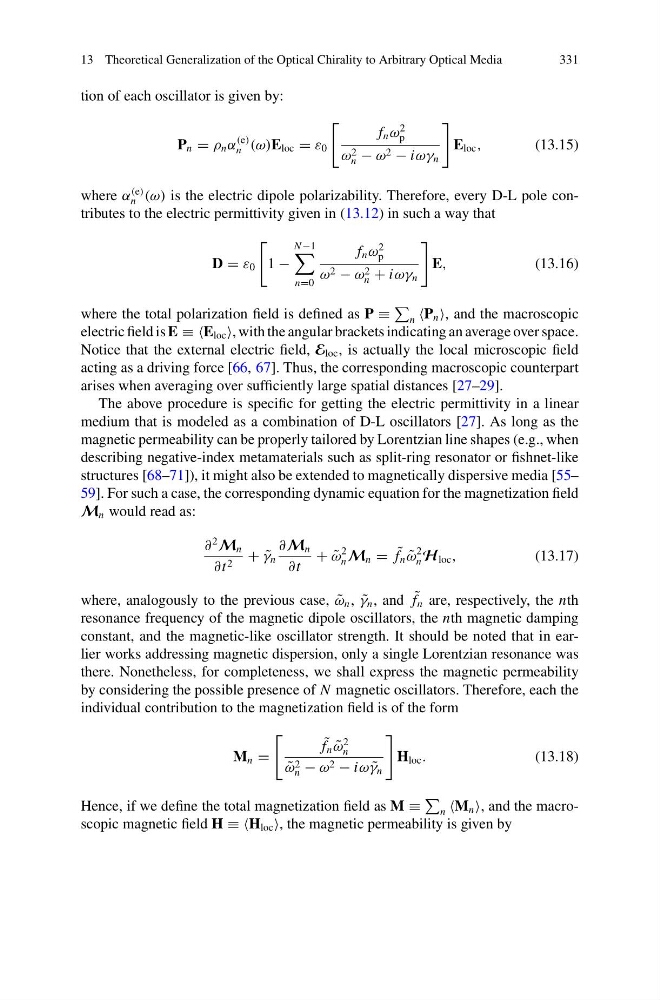
tion of each oscillator is given by:
P n = ρ n α
(e)
n (ω)E loc = ε 0
f n ω
2
p
ω 2
n − ω 2 − iωγ n
E loc ,
(13.15)
where α
(e)
n (ω) is the electric dipole polarizability. Therefore, every D-L pole contributes to the electric permittivity given in (13.12) in such a way that
D = ε 0
1 −
N −1
n=0
f n ω
2
p
ω 2 − ω 2
n + iωγ n
E,
(13.16)
where the total polarization field is defined as P ≡
n P n , and the macroscopic
electric field is E ≡ ≡E loc , with the angular brackets indicating an average over space.
Notice that the external electric field, E loc , is actually the local microscopic field
acting as a driving force [66, 67]. Thus, the corresponding macroscopic counterpart
arises when averaging over sufficiently large spatial distances [27–29].
The above procedure is specific for getting the electric permittivity in a linear
medium that is modeled as a combination of D-L oscillators [27]. As long as the
magnetic permeability can be properly tailored by Lorentzian line shapes (e.g., when
describing negative-index metamaterials such as split-ring resonator or fishnet-like
structures [68–71]), it might also be extended to magnetically dispersive media [55–
59]. For such a case, the corresponding dynamic equation for the magnetization field
M n would read as:
∂
2
M n
∂t 2 + ˜
γ n
∂M n
∂t
+ ˜
ω
2
n M n = ˜
f n ˜
ω
2
n H loc ,
(13.17)
where, analogously to the previous case, ˜
ω n , ˜
γ n , and ˜
f n are, respectively, the nth
resonance frequency of the magnetic dipole oscillators, the nth magnetic damping
constant, and the magnetic-like oscillator strength. It should be noted that in earlier works addressing magnetic dispersion, only a single Lorentzian resonance was
there. Nonetheless, for completeness, we shall express the magnetic permeability
by considering the possible presence of N magnetic oscillators. Therefore, each the
individual contribution to the magnetization field is of the form
M n =
˜
f n ˜
ω
2
n
˜
ω 2
n − ω 2 − iω ˜
γ n
H loc .
(13.18)
Hence, if we define the total magnetization field as M ≡
n M n , and the macroscopic magnetic field H ≡ ≡H loc , the magnetic permeability is given by
331
tion of each oscillator is given by:
P n = ρ n α
(e)
n (ω)E loc = ε 0
f n ω
2
p
ω 2
n − ω 2 − iωγ n
E loc ,
(13.15)
where α
(e)
n (ω) is the electric dipole polarizability. Therefore, every D-L pole contributes to the electric permittivity given in (13.12) in such a way that
D = ε 0
1 −
N −1
n=0
f n ω
2
p
ω 2 − ω 2
n + iωγ n
E,
(13.16)
where the total polarization field is defined as P ≡
n P n , and the macroscopic
electric field is E ≡ ≡E loc , with the angular brackets indicating an average over space.
Notice that the external electric field, E loc , is actually the local microscopic field
acting as a driving force [66, 67]. Thus, the corresponding macroscopic counterpart
arises when averaging over sufficiently large spatial distances [27–29].
The above procedure is specific for getting the electric permittivity in a linear
medium that is modeled as a combination of D-L oscillators [27]. As long as the
magnetic permeability can be properly tailored by Lorentzian line shapes (e.g., when
describing negative-index metamaterials such as split-ring resonator or fishnet-like
structures [68–71]), it might also be extended to magnetically dispersive media [55–
59]. For such a case, the corresponding dynamic equation for the magnetization field
M n would read as:
∂
2
M n
∂t 2 + ˜
γ n
∂M n
∂t
+ ˜
ω
2
n M n = ˜
f n ˜
ω
2
n H loc ,
(13.17)
where, analogously to the previous case, ˜
ω n , ˜
γ n , and ˜
f n are, respectively, the nth
resonance frequency of the magnetic dipole oscillators, the nth magnetic damping
constant, and the magnetic-like oscillator strength. It should be noted that in earlier works addressing magnetic dispersion, only a single Lorentzian resonance was
there. Nonetheless, for completeness, we shall express the magnetic permeability
by considering the possible presence of N magnetic oscillators. Therefore, each the
individual contribution to the magnetization field is of the form
M n =
˜
f n ˜
ω
2
n
˜
ω 2
n − ω 2 − iω ˜
γ n
H loc .
(13.18)
Hence, if we define the total magnetization field as M ≡
n M n , and the macroscopic magnetic field H ≡ ≡H loc , the magnetic permeability is given by