

330
J. E. Vázquez-Lozano and A. Martínez
dispersive and lossless media, which leads to the so-called Brillouin formula [30,
65].
13.2.2.1 Characterization of Linear Dispersive Media: Drude-Lorentz
Model
A physically realistic description of dispersive media would require a careful analysis
of dissipative effects. In classical theory there are many models to characterize the
optical properties of a medium, i.e., the electric permittivity ε and the magnetic
permeability μ. In the simplest case of a linear medium, the most commonly used is
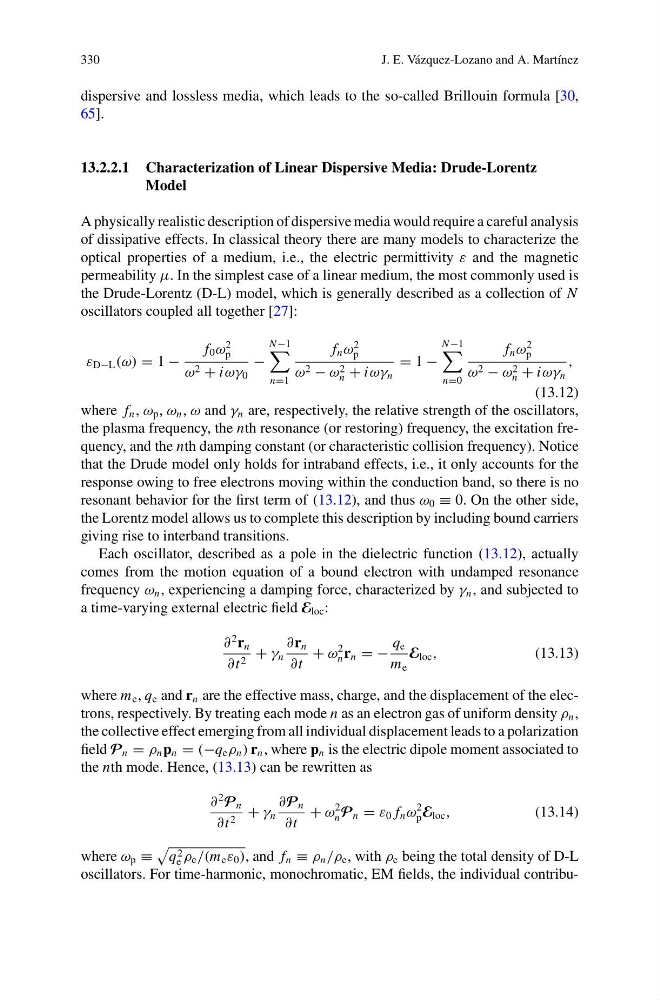
the Drude-Lorentz (D-L) model, which is generally described as a collection of N
oscillators coupled all together [27]:
ε D−L (ω) = 1 −
f 0 ω
2
p
ω 2 + iωγ 0
−
N −1
n=1
f n ω
2
p
ω 2 − ω 2
n + iωγ n
= 1 −
N −1
n=0
f n ω
2
p
ω 2 − ω 2
n + iωγ n
,
(13.12)
where f n , ω p , ω n , ω and γ n are, respectively, the relative strength of the oscillators,
the plasma frequency, the nth resonance (or restoring) frequency, the excitation frequency, and the nth damping constant (or characteristic collision frequency). Notice
that the Drude model only holds for intraband effects, i.e., it only accounts for the
response owing to free electrons moving within the conduction band, so there is no
resonant behavior for the first term of (13.12), and thus ω 0 ≡ 0. On the other side,
the Lorentz model allows us to complete this description by including bound carriers
giving rise to interband transitions.
Each oscillator, described as a pole in the dielectric function (13.12), actually
comes from the motion equation of a bound electron with undamped resonance
frequency ω n , experiencing a damping force, characterized by γ n , and subjected to
a time-varying external electric field E loc :
∂
2 r n
∂t 2 + γ n
∂r n
∂t
+ ω
2
n r n = −
q e
m e
E loc ,
(13.13)
where m e , q e and r n are the effective mass, charge, and the displacement of the electrons, respectively. By treating each mode n as an electron gas of uniform density ρ n ,
the collective effect emerging from all individual displacement leads to a polarization
field P n = ρ n p n = (−q e ρ n ) r n , where p n is the electric dipole moment associated to
the nth mode. Hence, (13.13) can be rewritten as
∂
2
P n
∂t 2 + γ n
∂P n
∂t
+ ω
2
n P n = ε 0 f n ω
2
p E loc ,
(13.14)
where ω p ≡
q 2
e ρ e /(m e ε 0 ), and f n ≡ ρ n /ρ e , with ρ e being the total density of D-L
oscillators. For time-harmonic, monochromatic, EM fields, the individual contribu-
J. E. Vázquez-Lozano and A. Martínez
dispersive and lossless media, which leads to the so-called Brillouin formula [30,
65].
13.2.2.1 Characterization of Linear Dispersive Media: Drude-Lorentz
Model
A physically realistic description of dispersive media would require a careful analysis
of dissipative effects. In classical theory there are many models to characterize the
optical properties of a medium, i.e., the electric permittivity ε and the magnetic
permeability μ. In the simplest case of a linear medium, the most commonly used is
the Drude-Lorentz (D-L) model, which is generally described as a collection of N
oscillators coupled all together [27]:
ε D−L (ω) = 1 −
f 0 ω
2
p
ω 2 + iωγ 0
−
N −1
n=1
f n ω
2
p
ω 2 − ω 2
n + iωγ n
= 1 −
N −1
n=0
f n ω
2
p
ω 2 − ω 2
n + iωγ n
,
(13.12)
where f n , ω p , ω n , ω and γ n are, respectively, the relative strength of the oscillators,
the plasma frequency, the nth resonance (or restoring) frequency, the excitation frequency, and the nth damping constant (or characteristic collision frequency). Notice
that the Drude model only holds for intraband effects, i.e., it only accounts for the
response owing to free electrons moving within the conduction band, so there is no
resonant behavior for the first term of (13.12), and thus ω 0 ≡ 0. On the other side,
the Lorentz model allows us to complete this description by including bound carriers
giving rise to interband transitions.
Each oscillator, described as a pole in the dielectric function (13.12), actually
comes from the motion equation of a bound electron with undamped resonance
frequency ω n , experiencing a damping force, characterized by γ n , and subjected to
a time-varying external electric field E loc :
∂
2 r n
∂t 2 + γ n
∂r n
∂t
+ ω
2
n r n = −
q e
m e
E loc ,
(13.13)
where m e , q e and r n are the effective mass, charge, and the displacement of the electrons, respectively. By treating each mode n as an electron gas of uniform density ρ n ,
the collective effect emerging from all individual displacement leads to a polarization
field P n = ρ n p n = (−q e ρ n ) r n , where p n is the electric dipole moment associated to
the nth mode. Hence, (13.13) can be rewritten as
∂
2
P n
∂t 2 + γ n
∂P n
∂t
+ ω
2
n P n = ε 0 f n ω
2
p E loc ,
(13.14)
where ω p ≡
q 2
e ρ e /(m e ε 0 ), and f n ≡ ρ n /ρ e , with ρ e being the total density of D-L
oscillators. For time-harmonic, monochromatic, EM fields, the individual contribu-