

13 Theoretical Generalization of the Optical Chirality to Arbitrary Optical Media
329
13.2.2 Electromagnetic Energy Density in Dispersive Media:
Lossless (Brillouin’s Approach) and Lossy (Loudon’s
Approach) Cases
The situation may become slightly trickier when the optical field is thought to propagate through a dispersive medium. In the time domain field representation this means
that the material response is not instantaneous, but it relies on all the past history.
According to the basic properties of Fourier transform, this should be described in
terms of a convolution in the time domain of EM fields characterizing the material
influence [28, 29]. Specifically, the dynamic response of a time-dependent EM field
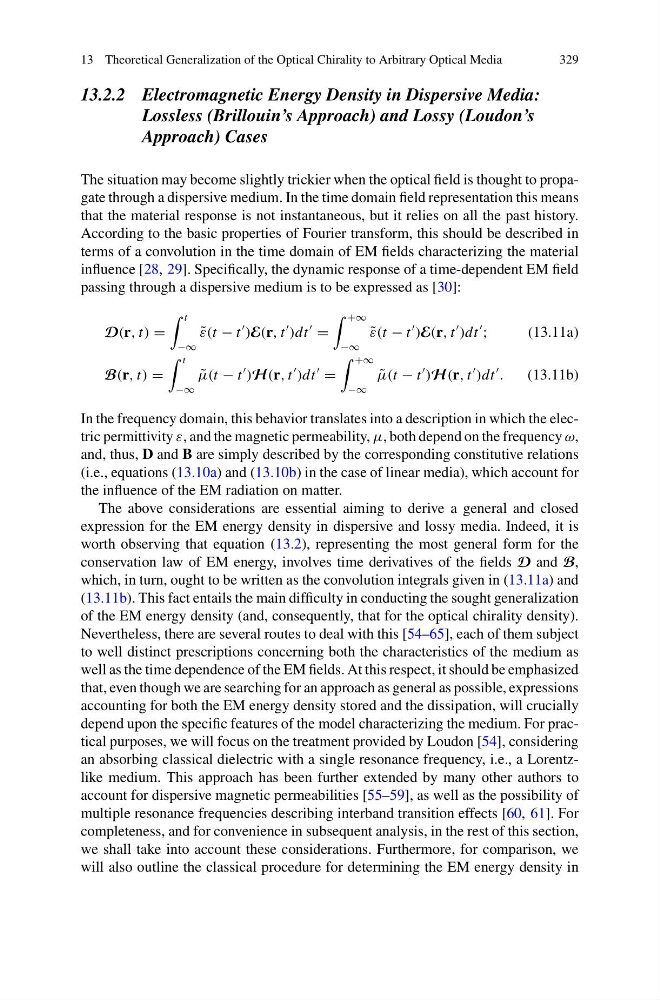
passing through a dispersive medium is to be expressed as [30]:
D(r, t) =
t
−∞
˜
ε(t − t
)E(r, t
)dt
=
+∞
−∞
˜
ε(t − t
)E(r, t
)dt
;
(13.11a)
B(r, t) =
t
−∞
˜
μ(t − t
)H(r, t
)dt
=
+∞
−∞
˜
μ(t − t
)H(r, t
)dt
.
(13.11b)
In the frequency domain, this behavior translates into a description in which the electric permittivity ε, and the magnetic permeability, μ, both depend on the frequency ω,
and, thus, D and B are simply described by the corresponding constitutive relations
(i.e., equations (13.10a) and (13.10b) in the case of linear media), which account for
the influence of the EM radiation on matter.
The above considerations are essential aiming to derive a general and closed
expression for the EM energy density in dispersive and lossy media. Indeed, it is
worth observing that equation (13.2), representing the most general form for the
conservation law of EM energy, involves time derivatives of the fields D and B,
which, in turn, ought to be written as the convolution integrals given in (13.11a) and
(13.11b). This fact entails the main difficulty in conducting the sought generalization
of the EM energy density (and, consequently, that for the optical chirality density).
Nevertheless, there are several routes to deal with this [54–65], each of them subject
to well distinct prescriptions concerning both the characteristics of the medium as
well as the time dependence of the EM fields. At this respect, it should be emphasized
that, even though we are searching for an approach as general as possible, expressions
accounting for both the EM energy density stored and the dissipation, will crucially
depend upon the specific features of the model characterizing the medium. For practical purposes, we will focus on the treatment provided by Loudon [54], considering
an absorbing classical dielectric with a single resonance frequency, i.e., a Lorentzlike medium. This approach has been further extended by many other authors to
account for dispersive magnetic permeabilities [55–59], as well as the possibility of
multiple resonance frequencies describing interband transition effects [60, 61]. For
completeness, and for convenience in subsequent analysis, in the rest of this section,
we shall take into account these considerations. Furthermore, for comparison, we
will also outline the classical procedure for determining the EM energy density in
329
13.2.2 Electromagnetic Energy Density in Dispersive Media:
Lossless (Brillouin’s Approach) and Lossy (Loudon’s
Approach) Cases
The situation may become slightly trickier when the optical field is thought to propagate through a dispersive medium. In the time domain field representation this means
that the material response is not instantaneous, but it relies on all the past history.
According to the basic properties of Fourier transform, this should be described in
terms of a convolution in the time domain of EM fields characterizing the material
influence [28, 29]. Specifically, the dynamic response of a time-dependent EM field
passing through a dispersive medium is to be expressed as [30]:
D(r, t) =
t
−∞
˜
ε(t − t
)E(r, t
)dt
=
+∞
−∞
˜
ε(t − t
)E(r, t
)dt
;
(13.11a)
B(r, t) =
t
−∞
˜
μ(t − t
)H(r, t
)dt
=
+∞
−∞
˜
μ(t − t
)H(r, t
)dt
.
(13.11b)
In the frequency domain, this behavior translates into a description in which the electric permittivity ε, and the magnetic permeability, μ, both depend on the frequency ω,
and, thus, D and B are simply described by the corresponding constitutive relations
(i.e., equations (13.10a) and (13.10b) in the case of linear media), which account for
the influence of the EM radiation on matter.
The above considerations are essential aiming to derive a general and closed
expression for the EM energy density in dispersive and lossy media. Indeed, it is
worth observing that equation (13.2), representing the most general form for the
conservation law of EM energy, involves time derivatives of the fields D and B,
which, in turn, ought to be written as the convolution integrals given in (13.11a) and
(13.11b). This fact entails the main difficulty in conducting the sought generalization
of the EM energy density (and, consequently, that for the optical chirality density).
Nevertheless, there are several routes to deal with this [54–65], each of them subject
to well distinct prescriptions concerning both the characteristics of the medium as
well as the time dependence of the EM fields. At this respect, it should be emphasized
that, even though we are searching for an approach as general as possible, expressions
accounting for both the EM energy density stored and the dissipation, will crucially
depend upon the specific features of the model characterizing the medium. For practical purposes, we will focus on the treatment provided by Loudon [54], considering
an absorbing classical dielectric with a single resonance frequency, i.e., a Lorentzlike medium. This approach has been further extended by many other authors to
account for dispersive magnetic permeabilities [55–59], as well as the possibility of
multiple resonance frequencies describing interband transition effects [60, 61]. For
completeness, and for convenience in subsequent analysis, in the rest of this section,
we shall take into account these considerations. Furthermore, for comparison, we
will also outline the classical procedure for determining the EM energy density in