

328
J. E. Vázquez-Lozano and A. Martínez
where F (r, t) and F(r, ω) stand, respectively, for the real-valued EM fields and
their corresponding complex-like counterparts. This way, we could consider independently every spectral component as if each of them were a single monochromatic
wave. Of course, one can always turn back to the time-dependent representation via
the inverse Fourier transform:
F (r, t) =
+∞
−∞
F(r, ω)e
−iωt dω.
(13.7)
Notice that, for the sake of clarity, throughout this chapter we will use the above
distinct notation either for the real-valued EM fields in the time domain, or for
the complex fields in the frequency domain, thus allowing us to omit, hereinafter,
the arguments in the field expressions so as to avoid cumbersome notation. After
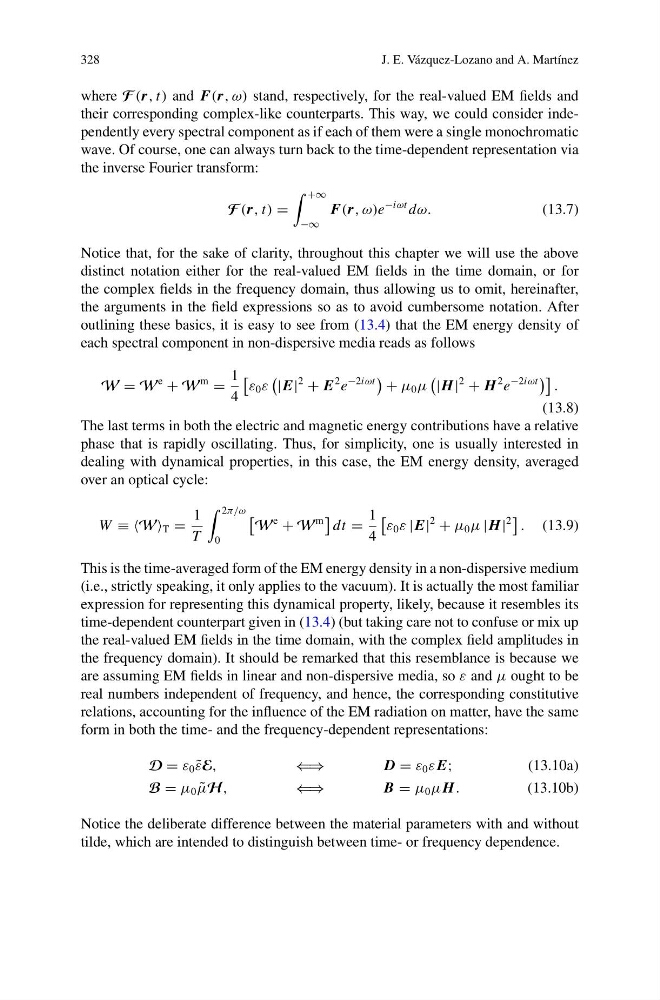
outlining these basics, it is easy to see from (13.4) that the EM energy density of
each spectral component in non-dispersive media reads as follows
W = W
e
+ W
m
=
1
4
ε 0 ε
|E|
2
+ E
2 e
−2iωt
+ μ 0 μ
|H|
2
+ H
2 e
−2iωt
.
(13.8)
The last terms in both the electric and magnetic energy contributions have a relative
phase that is rapidly oscillating. Thus, for simplicity, one is usually interested in
dealing with dynamical properties, in this case, the EM energy density, averaged
over an optical cycle:
W ≡ ≡W T =
1
T
2π/ω
0
W
e
+ W
m
dt =
1
4
ε 0 ε |E|
2
+ μ 0 μ |H|
2
. (13.9)
This is the time-averaged form of the EM energy density in a non-dispersive medium
(i.e., strictly speaking, it only applies to the vacuum). It is actually the most familiar
expression for representing this dynamical property, likely, because it resembles its
time-dependent counterpart given in (13.4) (but taking care not to confuse or mix up
the real-valued EM fields in the time domain, with the complex field amplitudes in
the frequency domain). It should be remarked that this resemblance is because we
are assuming EM fields in linear and non-dispersive media, so ε and μ ought to be
real numbers independent of frequency, and hence, the corresponding constitutive
relations, accounting for the influence of the EM radiation on matter, have the same
form in both the time- and the frequency-dependent representations:
D = ε 0 ˜
εE,
⇐⇒
D = ε 0 ε E;
(13.10a)
B = μ 0 ˜
μH,
⇐⇒
B = μ 0 μH.
(13.10b)
Notice the deliberate difference between the material parameters with and without
tilde, which are intended to distinguish between time- or frequency dependence.
J. E. Vázquez-Lozano and A. Martínez
where F (r, t) and F(r, ω) stand, respectively, for the real-valued EM fields and
their corresponding complex-like counterparts. This way, we could consider independently every spectral component as if each of them were a single monochromatic
wave. Of course, one can always turn back to the time-dependent representation via
the inverse Fourier transform:
F (r, t) =
+∞
−∞
F(r, ω)e
−iωt dω.
(13.7)
Notice that, for the sake of clarity, throughout this chapter we will use the above
distinct notation either for the real-valued EM fields in the time domain, or for
the complex fields in the frequency domain, thus allowing us to omit, hereinafter,
the arguments in the field expressions so as to avoid cumbersome notation. After
outlining these basics, it is easy to see from (13.4) that the EM energy density of
each spectral component in non-dispersive media reads as follows
W = W
e
+ W
m
=
1
4
ε 0 ε
|E|
2
+ E
2 e
−2iωt
+ μ 0 μ
|H|
2
+ H
2 e
−2iωt
.
(13.8)
The last terms in both the electric and magnetic energy contributions have a relative
phase that is rapidly oscillating. Thus, for simplicity, one is usually interested in
dealing with dynamical properties, in this case, the EM energy density, averaged
over an optical cycle:
W ≡ ≡W T =
1
T
2π/ω
0
W
e
+ W
m
dt =
1
4
ε 0 ε |E|
2
+ μ 0 μ |H|
2
. (13.9)
This is the time-averaged form of the EM energy density in a non-dispersive medium
(i.e., strictly speaking, it only applies to the vacuum). It is actually the most familiar
expression for representing this dynamical property, likely, because it resembles its
time-dependent counterpart given in (13.4) (but taking care not to confuse or mix up
the real-valued EM fields in the time domain, with the complex field amplitudes in
the frequency domain). It should be remarked that this resemblance is because we
are assuming EM fields in linear and non-dispersive media, so ε and μ ought to be
real numbers independent of frequency, and hence, the corresponding constitutive
relations, accounting for the influence of the EM radiation on matter, have the same
form in both the time- and the frequency-dependent representations:
D = ε 0 ˜
εE,
⇐⇒
D = ε 0 ε E;
(13.10a)
B = μ 0 ˜
μH,
⇐⇒
B = μ 0 μH.
(13.10b)
Notice the deliberate difference between the material parameters with and without
tilde, which are intended to distinguish between time- or frequency dependence.