

314
F. Vanderveken et al.
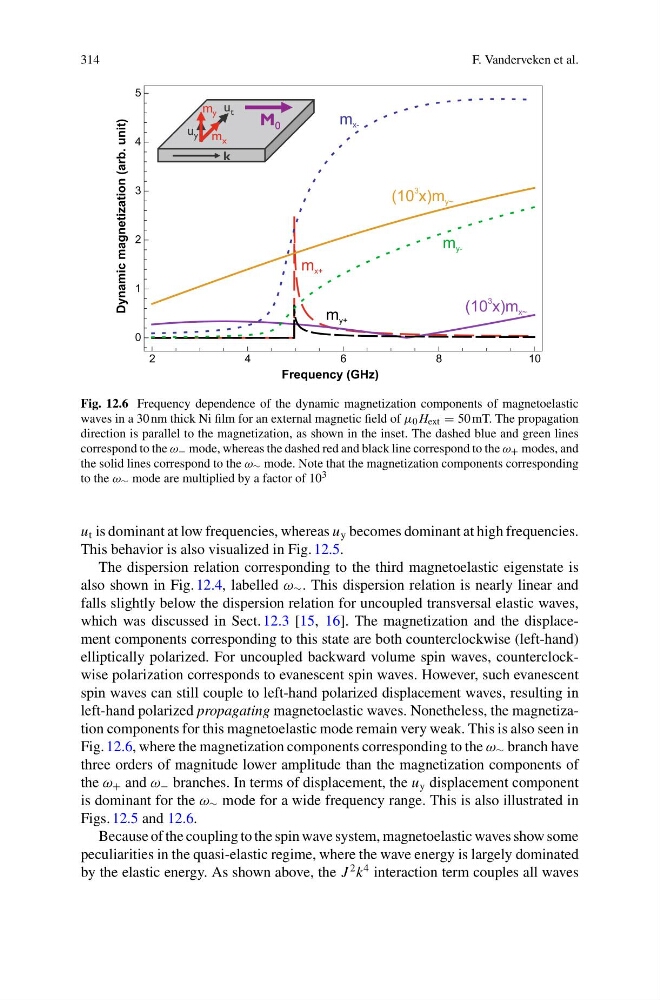
Fig. 12.6 Frequency dependence of the dynamic magnetization components of magnetoelastic
waves in a 30 nm thick Ni film for an external magnetic field of μ 0 H ext = 50 mT. The propagation
direction is parallel to the magnetization, as shown in the inset. The dashed blue and green lines
correspond to the ω − mode, whereas the dashed red and black line correspond to the ω + modes, and
the solid lines correspond to the ω ∼ mode. Note that the magnetization components corresponding
to the ω ∼ mode are multiplied by a factor of 10 3
u t is dominant at low frequencies, whereas u y becomes dominant at high frequencies.
This behavior is also visualized in Fig. 12.5.
The dispersion relation corresponding to the third magnetoelastic eigenstate is
also shown in Fig. 12.4, labelled ω ∼ . This dispersion relation is nearly linear and
falls slightly below the dispersion relation for uncoupled transversal elastic waves,
which was discussed in Sect. 12.3 [15, 16]. The magnetization and the displacement components corresponding to this state are both counterclockwise (left-hand)
elliptically polarized. For uncoupled backward volume spin waves, counterclockwise polarization corresponds to evanescent spin waves. However, such evanescent
spin waves can still couple to left-hand polarized displacement waves, resulting in
left-hand polarized propagating magnetoelastic waves. Nonetheless, the magnetization components for this magnetoelastic mode remain very weak. This is also seen in
Fig. 12.6, where the magnetization components corresponding to the ω ∼ branch have
three orders of magnitude lower amplitude than the magnetization components of
the ω + and ω − branches. In terms of displacement, the u y displacement component
is dominant for the ω ∼ mode for a wide frequency range. This is also illustrated in
Figs. 12.5 and 12.6.
Because of the coupling to the spin wave system, magnetoelastic waves show some
peculiarities in the quasi-elastic regime, where the wave energy is largely dominated
by the elastic energy. As shown above, the J
2 k
4 interaction term couples all waves
F. Vanderveken et al.
Fig. 12.6 Frequency dependence of the dynamic magnetization components of magnetoelastic
waves in a 30 nm thick Ni film for an external magnetic field of μ 0 H ext = 50 mT. The propagation
direction is parallel to the magnetization, as shown in the inset. The dashed blue and green lines
correspond to the ω − mode, whereas the dashed red and black line correspond to the ω + modes, and
the solid lines correspond to the ω ∼ mode. Note that the magnetization components corresponding
to the ω ∼ mode are multiplied by a factor of 10 3
u t is dominant at low frequencies, whereas u y becomes dominant at high frequencies.
This behavior is also visualized in Fig. 12.5.
The dispersion relation corresponding to the third magnetoelastic eigenstate is
also shown in Fig. 12.4, labelled ω ∼ . This dispersion relation is nearly linear and
falls slightly below the dispersion relation for uncoupled transversal elastic waves,
which was discussed in Sect. 12.3 [15, 16]. The magnetization and the displacement components corresponding to this state are both counterclockwise (left-hand)
elliptically polarized. For uncoupled backward volume spin waves, counterclockwise polarization corresponds to evanescent spin waves. However, such evanescent
spin waves can still couple to left-hand polarized displacement waves, resulting in
left-hand polarized propagating magnetoelastic waves. Nonetheless, the magnetization components for this magnetoelastic mode remain very weak. This is also seen in
Fig. 12.6, where the magnetization components corresponding to the ω ∼ branch have
three orders of magnitude lower amplitude than the magnetization components of
the ω + and ω − branches. In terms of displacement, the u y displacement component
is dominant for the ω ∼ mode for a wide frequency range. This is also illustrated in
Figs. 12.5 and 12.6.
Because of the coupling to the spin wave system, magnetoelastic waves show some
peculiarities in the quasi-elastic regime, where the wave energy is largely dominated
by the elastic energy. As shown above, the J
2 k
4 interaction term couples all waves