

12 Magnetoelastic Waves in Thin Films
315
with each other. Consequently, the two transversal elastic waves become also coupled. For interacting waves, it is impossible to share the same frequency–wavenumber
couple, i.e. it is impossible to have degenerate points in the dispersion relations. As
a result, the two quasi-elastic branches do not overlap anymore which is in contrast to their original behavior without magnetoelastic interactions (see Sect. 12.3).
Therefore, at all frequencies, a small wavenumber shift remains present between
the two quasi-elastic branches, even in the quasi-elastic regime where the displacement components are large and magnetization components are weak. Hence, even
though almost all the wave energy is in the elastic system, the interaction between
the two transversal displacement components is mediated by the magnetic system,
leading to an indirect coupling of the two elastic waves via the magnetic system.
This interaction is proportional to k
4 and thus strongly depends on the wavelength.
Moreover, the polarization of the displacement in the quasi-elastic regime also
shows a peculiar behavior. One of the two waves in the quasi-elastic regime corresponds to a clockwise (right-hand) polarized wave and the other to a counterclockwise
(left-hand) polarized wave, as discussed above. Hence, excitation at a single angular
frequency ω in the quasi-elastic regime leads to two different magnetoelastic waves
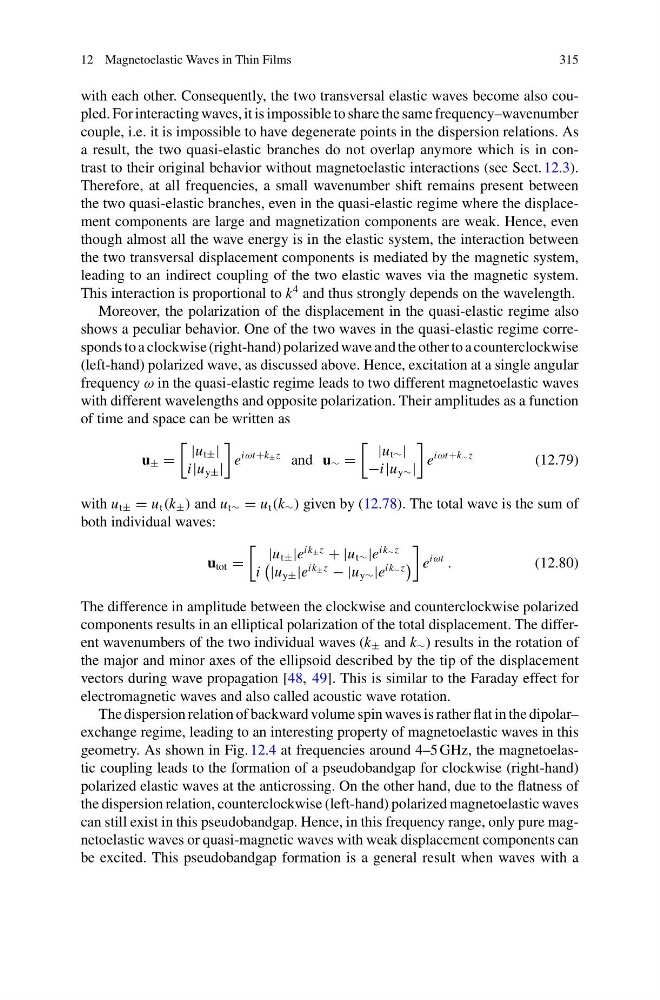
with different wavelengths and opposite polarization. Their amplitudes as a function
of time and space can be written as
u ± =
|u t± |
i|u y± |
e
iωt+k ± z and u ∼ =
|u t∼ |
−i|u y∼ |
e
iωt+k ∼ z
(12.79)
with u t± = u t (k ± ) and u t∼ = u t (k ∼ ) given by (12.78). The total wave is the sum of
both individual waves:
u tot =
|u t± |e
ik ± z
+ |u t∼ |e
ik ∼ z
i
|u y± |e
ik ± z
− |u y∼ |e
ik ∼ z
e
iωt
.
(12.80)
The difference in amplitude between the clockwise and counterclockwise polarized
components results in an elliptical polarization of the total displacement. The different wavenumbers of the two individual waves (k ± and k ∼ ) results in the rotation of
the major and minor axes of the ellipsoid described by the tip of the displacement
vectors during wave propagation [48, 49]. This is similar to the Faraday effect for
electromagnetic waves and also called acoustic wave rotation.
The dispersion relation of backward volume spin waves is rather flat in the dipolar–
exchange regime, leading to an interesting property of magnetoelastic waves in this
geometry. As shown in Fig. 12.4 at frequencies around 4–5 GHz, the magnetoelastic coupling leads to the formation of a pseudobandgap for clockwise (right-hand)
polarized elastic waves at the anticrossing. On the other hand, due to the flatness of
the dispersion relation, counterclockwise (left-hand) polarized magnetoelastic waves
can still exist in this pseudobandgap. Hence, in this frequency range, only pure magnetoelastic waves or quasi-magnetic waves with weak displacement components can
be excited. This pseudobandgap formation is a general result when waves with a
315
with each other. Consequently, the two transversal elastic waves become also coupled. For interacting waves, it is impossible to share the same frequency–wavenumber
couple, i.e. it is impossible to have degenerate points in the dispersion relations. As
a result, the two quasi-elastic branches do not overlap anymore which is in contrast to their original behavior without magnetoelastic interactions (see Sect. 12.3).
Therefore, at all frequencies, a small wavenumber shift remains present between
the two quasi-elastic branches, even in the quasi-elastic regime where the displacement components are large and magnetization components are weak. Hence, even
though almost all the wave energy is in the elastic system, the interaction between
the two transversal displacement components is mediated by the magnetic system,
leading to an indirect coupling of the two elastic waves via the magnetic system.
This interaction is proportional to k
4 and thus strongly depends on the wavelength.
Moreover, the polarization of the displacement in the quasi-elastic regime also
shows a peculiar behavior. One of the two waves in the quasi-elastic regime corresponds to a clockwise (right-hand) polarized wave and the other to a counterclockwise
(left-hand) polarized wave, as discussed above. Hence, excitation at a single angular
frequency ω in the quasi-elastic regime leads to two different magnetoelastic waves
with different wavelengths and opposite polarization. Their amplitudes as a function
of time and space can be written as
u ± =
|u t± |
i|u y± |
e
iωt+k ± z and u ∼ =
|u t∼ |
−i|u y∼ |
e
iωt+k ∼ z
(12.79)
with u t± = u t (k ± ) and u t∼ = u t (k ∼ ) given by (12.78). The total wave is the sum of
both individual waves:
u tot =
|u t± |e
ik ± z
+ |u t∼ |e
ik ∼ z
i
|u y± |e
ik ± z
− |u y∼ |e
ik ∼ z
e
iωt
.
(12.80)
The difference in amplitude between the clockwise and counterclockwise polarized
components results in an elliptical polarization of the total displacement. The different wavenumbers of the two individual waves (k ± and k ∼ ) results in the rotation of
the major and minor axes of the ellipsoid described by the tip of the displacement
vectors during wave propagation [48, 49]. This is similar to the Faraday effect for
electromagnetic waves and also called acoustic wave rotation.
The dispersion relation of backward volume spin waves is rather flat in the dipolar–
exchange regime, leading to an interesting property of magnetoelastic waves in this
geometry. As shown in Fig. 12.4 at frequencies around 4–5 GHz, the magnetoelastic coupling leads to the formation of a pseudobandgap for clockwise (right-hand)
polarized elastic waves at the anticrossing. On the other hand, due to the flatness of
the dispersion relation, counterclockwise (left-hand) polarized magnetoelastic waves
can still exist in this pseudobandgap. Hence, in this frequency range, only pure magnetoelastic waves or quasi-magnetic waves with weak displacement components can
be excited. This pseudobandgap formation is a general result when waves with a