

12 Magnetoelastic Waves in Thin Films
313
⎡
⎢
⎢
⎣
u t
u y
m x
m y
⎤
⎥
⎥
⎦ = N
⎡
⎢
⎢
⎣
−i
ω(ω 2 −ω
2
H )
(ω fy (ω
2
− ω
2
V ) + J k
2
)
1
−
ρ M s
Bkω
(ω fy (ω
2
− ω
2
V ) + J k
2
)
i
ρ M s
Bk
(ω
2
− ω
2
V )
⎤
⎥
⎥
⎦
(12.78)
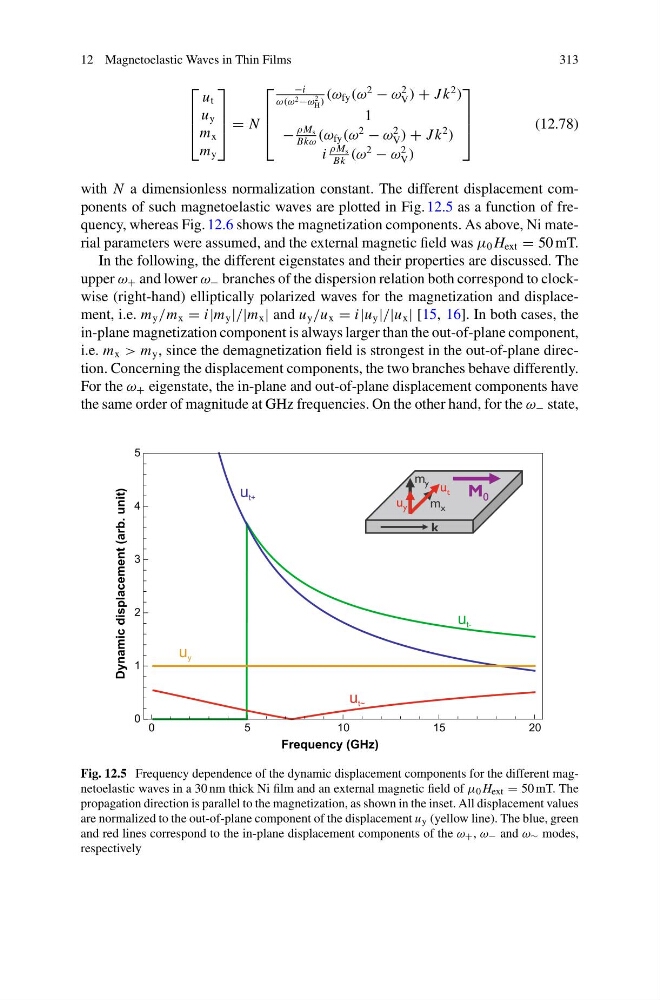
with N a dimensionless normalization constant. The different displacement components of such magnetoelastic waves are plotted in Fig. 12.5 as a function of frequency, whereas Fig. 12.6 shows the magnetization components. As above, Ni material parameters were assumed, and the external magnetic field was μ 0 H ext = 50 mT.
In the following, the different eigenstates and their properties are discussed. The
upper ω + and lower ω − branches of the dispersion relation both correspond to clockwise (right-hand) elliptically polarized waves for the magnetization and displacement, i.e. m y /m x = i|m y |/|m x | and u y /u x = i|u y |/|u x | [15, 16]. In both cases, the
in-plane magnetization component is always larger than the out-of-plane component,
i.e. m x > m y , since the demagnetization field is strongest in the out-of-plane direction. Concerning the displacement components, the two branches behave differently.
For the ω + eigenstate, the in-plane and out-of-plane displacement components have
the same order of magnitude at GHz frequencies. On the other hand, for the ω − state,
Fig. 12.5 Frequency dependence of the dynamic displacement components for the different magnetoelastic waves in a 30 nm thick Ni film and an external magnetic field of μ 0 H ext = 50 mT. The
propagation direction is parallel to the magnetization, as shown in the inset. All displacement values
are normalized to the out-of-plane component of the displacement u y (yellow line). The blue, green
and red lines correspond to the in-plane displacement components of the ω + , ω − and ω ∼ modes,
respectively
313
⎡
⎢
⎢
⎣
u t
u y
m x
m y
⎤
⎥
⎥
⎦ = N
⎡
⎢
⎢
⎣
−i
ω(ω 2 −ω
2
H )
(ω fy (ω
2
− ω
2
V ) + J k
2
)
1
−
ρ M s
Bkω
(ω fy (ω
2
− ω
2
V ) + J k
2
)
i
ρ M s
Bk
(ω
2
− ω
2
V )
⎤
⎥
⎥
⎦
(12.78)
with N a dimensionless normalization constant. The different displacement components of such magnetoelastic waves are plotted in Fig. 12.5 as a function of frequency, whereas Fig. 12.6 shows the magnetization components. As above, Ni material parameters were assumed, and the external magnetic field was μ 0 H ext = 50 mT.
In the following, the different eigenstates and their properties are discussed. The
upper ω + and lower ω − branches of the dispersion relation both correspond to clockwise (right-hand) elliptically polarized waves for the magnetization and displacement, i.e. m y /m x = i|m y |/|m x | and u y /u x = i|u y |/|u x | [15, 16]. In both cases, the
in-plane magnetization component is always larger than the out-of-plane component,
i.e. m x > m y , since the demagnetization field is strongest in the out-of-plane direction. Concerning the displacement components, the two branches behave differently.
For the ω + eigenstate, the in-plane and out-of-plane displacement components have
the same order of magnitude at GHz frequencies. On the other hand, for the ω − state,
Fig. 12.5 Frequency dependence of the dynamic displacement components for the different magnetoelastic waves in a 30 nm thick Ni film and an external magnetic field of μ 0 H ext = 50 mT. The
propagation direction is parallel to the magnetization, as shown in the inset. All displacement values
are normalized to the out-of-plane component of the displacement u y (yellow line). The blue, green
and red lines correspond to the in-plane displacement components of the ω + , ω − and ω ∼ modes,
respectively