

312
F. Vanderveken et al.
Again, the homogeneous linear system has only nontrivial solutions when its
determinant is zero. This condition leads to the dispersion relation of the resulting
magnetoelastic waves, given by
(ω 2 − ω 2
fm )(ω 2 − ω 2
H )(ω 2 − ω 2
V ) − J k 2 [ω fx (ω 2 − ω 2
H ) + ω fy (ω 2 − ω 2
V ) + J k 2 ] = 0 .
(12.77)
Three different interaction terms can be identified in this equation. The first interaction term J k
2
ω fx (ω
2
− ω
2
H ) represents the interaction between the out-of-plane
u y transversal elastic wave and the backward volume spin wave. The second term
J k
2
ω fx (ω
2
− ω
2
V ) characterizes the interaction between the in-plane u t transversal
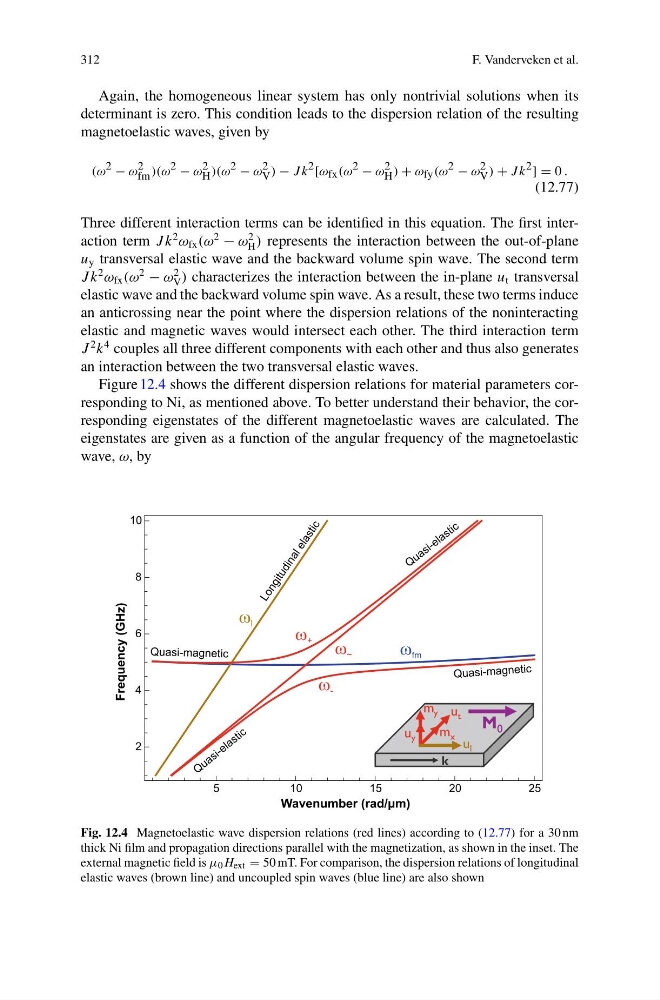
elastic wave and the backward volume spin wave. As a result, these two terms induce
an anticrossing near the point where the dispersion relations of the noninteracting
elastic and magnetic waves would intersect each other. The third interaction term
J
2 k
4 couples all three different components with each other and thus also generates
an interaction between the two transversal elastic waves.
Figure 12.4 shows the different dispersion relations for material parameters corresponding to Ni, as mentioned above. To better understand their behavior, the corresponding eigenstates of the different magnetoelastic waves are calculated. The
eigenstates are given as a function of the angular frequency of the magnetoelastic
wave, ω, by
Fig. 12.4 Magnetoelastic wave dispersion relations (red lines) according to (12.77) for a 30nm
thick Ni film and propagation directions parallel with the magnetization, as shown in the inset. The
external magnetic field is μ 0 H ext = 50 mT. For comparison, the dispersion relations of longitudinal
elastic waves (brown line) and uncoupled spin waves (blue line) are also shown
F. Vanderveken et al.
Again, the homogeneous linear system has only nontrivial solutions when its
determinant is zero. This condition leads to the dispersion relation of the resulting
magnetoelastic waves, given by
(ω 2 − ω 2
fm )(ω 2 − ω 2
H )(ω 2 − ω 2
V ) − J k 2 [ω fx (ω 2 − ω 2
H ) + ω fy (ω 2 − ω 2
V ) + J k 2 ] = 0 .
(12.77)
Three different interaction terms can be identified in this equation. The first interaction term J k
2
ω fx (ω
2
− ω
2
H ) represents the interaction between the out-of-plane
u y transversal elastic wave and the backward volume spin wave. The second term
J k
2
ω fx (ω
2
− ω
2
V ) characterizes the interaction between the in-plane u t transversal
elastic wave and the backward volume spin wave. As a result, these two terms induce
an anticrossing near the point where the dispersion relations of the noninteracting
elastic and magnetic waves would intersect each other. The third interaction term
J
2 k
4 couples all three different components with each other and thus also generates
an interaction between the two transversal elastic waves.
Figure 12.4 shows the different dispersion relations for material parameters corresponding to Ni, as mentioned above. To better understand their behavior, the corresponding eigenstates of the different magnetoelastic waves are calculated. The
eigenstates are given as a function of the angular frequency of the magnetoelastic
wave, ω, by
Fig. 12.4 Magnetoelastic wave dispersion relations (red lines) according to (12.77) for a 30nm
thick Ni film and propagation directions parallel with the magnetization, as shown in the inset. The
external magnetic field is μ 0 H ext = 50 mT. For comparison, the dispersion relations of longitudinal
elastic waves (brown line) and uncoupled spin waves (blue line) are also shown