

12 Magnetoelastic Waves in Thin Films
311
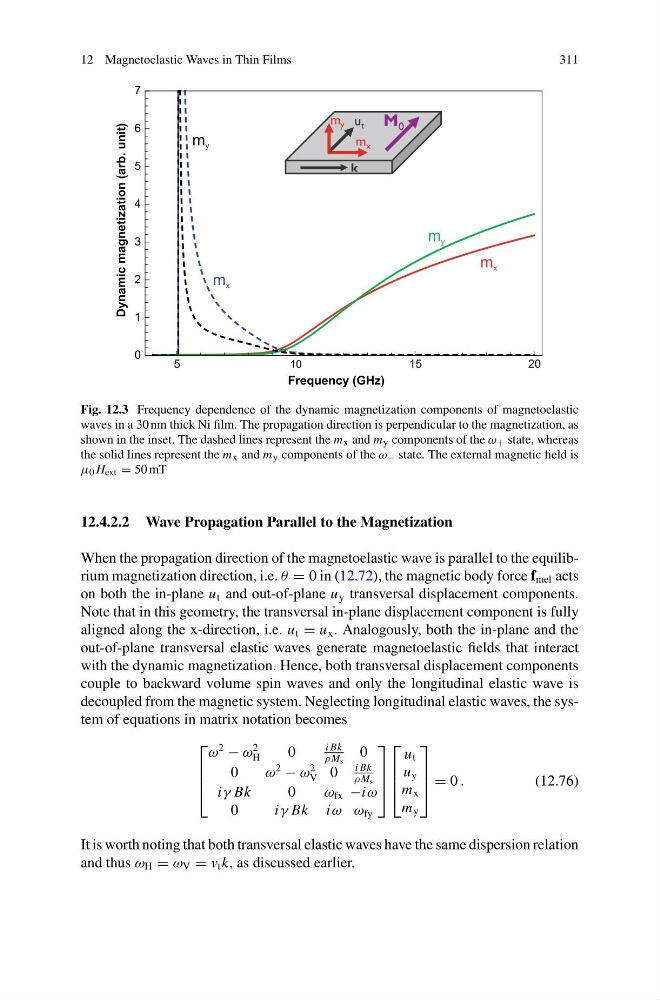
Fig. 12.3 Frequency dependence of the dynamic magnetization components of magnetoelastic
waves in a 30 nm thick Ni film. The propagation direction is perpendicular to the magnetization, as
shown in the inset. The dashed lines represent the m x and m y components of the ω + state, whereas
the solid lines represent the m x and m y components of the ω − state. The external magnetic field is
μ 0 H ext = 50 mT
12.4.2.2 Wave Propagation Parallel to the Magnetization
When the propagation direction of the magnetoelastic wave is parallel to the equilibrium magnetization direction, i.e. θ = 0 in (12.72), the magnetic body force f mel acts
on both the in-plane u t and out-of-plane u y transversal displacement components.
Note that in this geometry, the transversal in-plane displacement component is fully
aligned along the x-direction, i.e. u t = u x . Analogously, both the in-plane and the
out-of-plane transversal elastic waves generate magnetoelastic fields that interact
with the dynamic magnetization. Hence, both transversal displacement components
couple to backward volume spin waves and only the longitudinal elastic wave is
decoupled from the magnetic system. Neglecting longitudinal elastic waves, the system of equations in matrix notation becomes
⎡
⎢
⎢
⎣
ω
2
− ω
2
H
0
i Bk
ρ M s
0
0
ω
2
− ω
2
V 0
i Bk
ρ M s
iγ Bk
0
ω fx −iω
0
iγ Bk iω ω fy
⎤
⎥
⎥
⎦
⎡
⎢
⎢
⎣
u t
u y
m x
m y
⎤
⎥
⎥
⎦ = 0 .
(12.76)
It is worth noting that both transversal elastic waves have the same dispersion relation
and thus ω H = ω V = v t k, as discussed earlier.
311
Fig. 12.3 Frequency dependence of the dynamic magnetization components of magnetoelastic
waves in a 30 nm thick Ni film. The propagation direction is perpendicular to the magnetization, as
shown in the inset. The dashed lines represent the m x and m y components of the ω + state, whereas
the solid lines represent the m x and m y components of the ω − state. The external magnetic field is
μ 0 H ext = 50 mT
12.4.2.2 Wave Propagation Parallel to the Magnetization
When the propagation direction of the magnetoelastic wave is parallel to the equilibrium magnetization direction, i.e. θ = 0 in (12.72), the magnetic body force f mel acts
on both the in-plane u t and out-of-plane u y transversal displacement components.
Note that in this geometry, the transversal in-plane displacement component is fully
aligned along the x-direction, i.e. u t = u x . Analogously, both the in-plane and the
out-of-plane transversal elastic waves generate magnetoelastic fields that interact
with the dynamic magnetization. Hence, both transversal displacement components
couple to backward volume spin waves and only the longitudinal elastic wave is
decoupled from the magnetic system. Neglecting longitudinal elastic waves, the system of equations in matrix notation becomes
⎡
⎢
⎢
⎣
ω
2
− ω
2
H
0
i Bk
ρ M s
0
0
ω
2
− ω
2
V 0
i Bk
ρ M s
iγ Bk
0
ω fx −iω
0
iγ Bk iω ω fy
⎤
⎥
⎥
⎦
⎡
⎢
⎢
⎣
u t
u y
m x
m y
⎤
⎥
⎥
⎦ = 0 .
(12.76)
It is worth noting that both transversal elastic waves have the same dispersion relation
and thus ω H = ω V = v t k, as discussed earlier.