

310
F. Vanderveken et al.
spin wave dispersion relation to higher frequencies, leading to a larger value of k cross
and thus a stronger magnetoelastic coupling.
According to the dispersion relation in (12.72), two different wave-like solutions
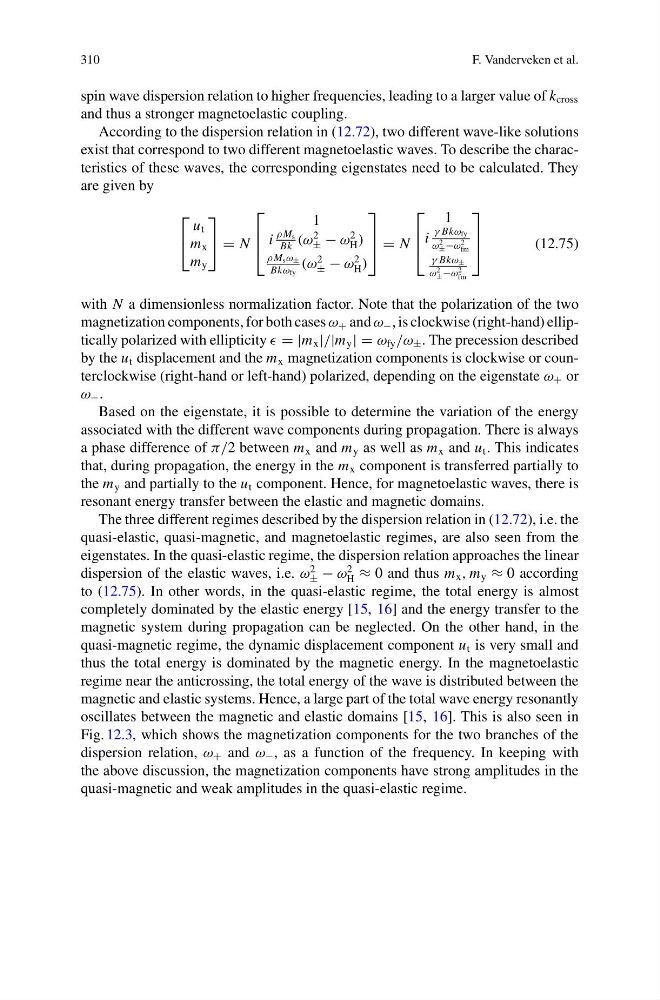
exist that correspond to two different magnetoelastic waves. To describe the characteristics of these waves, the corresponding eigenstates need to be calculated. They
are given by
⎡
⎣
u t
m x
m y
⎤
⎦ = N
⎡
⎢
⎣
1
i
ρ M s
Bk
(ω
2
± − ω
2
H )
ρ M s ω ±
Bkω fy
(ω
2
± − ω
2
H )
⎤
⎥
⎦ = N
⎡
⎢
⎣
1
i
γ Bkω fy
ω
2
± −ω
2
fm
γ Bkω ±
ω
2
± −ω
2
fm
⎤
⎥
⎦
(12.75)
with N a dimensionless normalization factor. Note that the polarization of the two
magnetization components, for both cases ω + and ω − , is clockwise (right-hand) elliptically polarized with ellipticity = |m x |/|m y | = ω fy /ω ± . The precession described
by the u t displacement and the m x magnetization components is clockwise or counterclockwise (right-hand or left-hand) polarized, depending on the eigenstate ω + or
ω − .
Based on the eigenstate, it is possible to determine the variation of the energy
associated with the different wave components during propagation. There is always
a phase difference of π/2 between m x and m y as well as m x and u t . This indicates
that, during propagation, the energy in the m x component is transferred partially to
the m y and partially to the u t component. Hence, for magnetoelastic waves, there is
resonant energy transfer between the elastic and magnetic domains.
The three different regimes described by the dispersion relation in (12.72), i.e. the
quasi-elastic, quasi-magnetic, and magnetoelastic regimes, are also seen from the
eigenstates. In the quasi-elastic regime, the dispersion relation approaches the linear
dispersion of the elastic waves, i.e. ω
2
± − ω
2
H ≈ 0 and thus m x , m y ≈ 0 according
to (12.75). In other words, in the quasi-elastic regime, the total energy is almost
completely dominated by the elastic energy [15, 16] and the energy transfer to the
magnetic system during propagation can be neglected. On the other hand, in the
quasi-magnetic regime, the dynamic displacement component u t is very small and
thus the total energy is dominated by the magnetic energy. In the magnetoelastic
regime near the anticrossing, the total energy of the wave is distributed between the
magnetic and elastic systems. Hence, a large part of the total wave energy resonantly
oscillates between the magnetic and elastic domains [15, 16]. This is also seen in
Fig. 12.3, which shows the magnetization components for the two branches of the
dispersion relation, ω + and ω − , as a function of the frequency. In keeping with
the above discussion, the magnetization components have strong amplitudes in the
quasi-magnetic and weak amplitudes in the quasi-elastic regime.
F. Vanderveken et al.
spin wave dispersion relation to higher frequencies, leading to a larger value of k cross
and thus a stronger magnetoelastic coupling.
According to the dispersion relation in (12.72), two different wave-like solutions
exist that correspond to two different magnetoelastic waves. To describe the characteristics of these waves, the corresponding eigenstates need to be calculated. They
are given by
⎡
⎣
u t
m x
m y
⎤
⎦ = N
⎡
⎢
⎣
1
i
ρ M s
Bk
(ω
2
± − ω
2
H )
ρ M s ω ±
Bkω fy
(ω
2
± − ω
2
H )
⎤
⎥
⎦ = N
⎡
⎢
⎣
1
i
γ Bkω fy
ω
2
± −ω
2
fm
γ Bkω ±
ω
2
± −ω
2
fm
⎤
⎥
⎦
(12.75)
with N a dimensionless normalization factor. Note that the polarization of the two
magnetization components, for both cases ω + and ω − , is clockwise (right-hand) elliptically polarized with ellipticity = |m x |/|m y | = ω fy /ω ± . The precession described
by the u t displacement and the m x magnetization components is clockwise or counterclockwise (right-hand or left-hand) polarized, depending on the eigenstate ω + or
ω − .
Based on the eigenstate, it is possible to determine the variation of the energy
associated with the different wave components during propagation. There is always
a phase difference of π/2 between m x and m y as well as m x and u t . This indicates
that, during propagation, the energy in the m x component is transferred partially to
the m y and partially to the u t component. Hence, for magnetoelastic waves, there is
resonant energy transfer between the elastic and magnetic domains.
The three different regimes described by the dispersion relation in (12.72), i.e. the
quasi-elastic, quasi-magnetic, and magnetoelastic regimes, are also seen from the
eigenstates. In the quasi-elastic regime, the dispersion relation approaches the linear
dispersion of the elastic waves, i.e. ω
2
± − ω
2
H ≈ 0 and thus m x , m y ≈ 0 according
to (12.75). In other words, in the quasi-elastic regime, the total energy is almost
completely dominated by the elastic energy [15, 16] and the energy transfer to the
magnetic system during propagation can be neglected. On the other hand, in the
quasi-magnetic regime, the dynamic displacement component u t is very small and
thus the total energy is dominated by the magnetic energy. In the magnetoelastic
regime near the anticrossing, the total energy of the wave is distributed between the
magnetic and elastic systems. Hence, a large part of the total wave energy resonantly
oscillates between the magnetic and elastic domains [15, 16]. This is also seen in
Fig. 12.3, which shows the magnetization components for the two branches of the
dispersion relation, ω + and ω − , as a function of the frequency. In keeping with
the above discussion, the magnetization components have strong amplitudes in the
quasi-magnetic and weak amplitudes in the quasi-elastic regime.