

12 Magnetoelastic Waves in Thin Films
307
with ω the angular frequency of the magnetoelastic wave, ω l = v l k =
C 11
ρ
k the
dispersion relation of longitudinal elastic waves, ω H = v t k =
C 44
ρ
k the dispersion
relation of horizontally-polarized (in-plane) transversal elastic waves, and ω V =
ω H the dispersion relation of vertically-polarized (out-of-plane) transversal elastic
waves. Here, the distinction between ω V and ω H is made to keep track of the origin
of different terms in the equations of motion.
Note that this set of equations describes magnetoelastic waves in thin films with
finite thickness. The finite thickness of the film changes the dipolar field according to
(12.30) and consequently also the properties of the magnetoelastic waves. The thickness influence is captured by the parameters ω fx and ω fy . In the following, different
cases and geometries of magnetoelastic wave solutions of the coupled equations of
motion are discussed.
12.4.2.1 Wave Propagation Perpendicular to the Magnetization
We first consider the case in which the wave propagation direction is perpendicular to the static equilibrium magnetization, i.e. θ = π/2. In this geometry, (12.68)
indicates that the magnetoelastic body force f mel only acts on the u t component of
the displacement. Conversely, only the displacement component u t generates a magnetoelastic field that interacts with the magnetic system. Hence, only the in-plane
transversal elastic wave couples to surface spin waves and vice versa. This means
that the longitudinal and out-of-plane transversal elastic waves are independent of the
magnetic system in a first-order approximation. As a consequence, their dispersion
relations remain unchanged, i.e. ω l = v l k and ω V = v t k, respectively, as described
in Sect. 12.3.
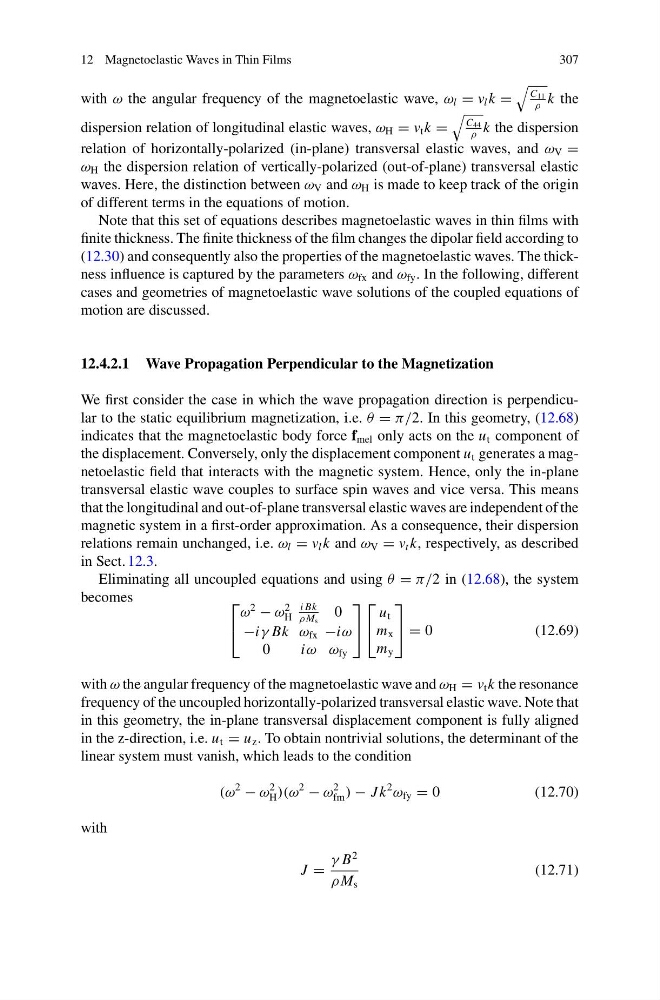
Eliminating all uncoupled equations and using θ = π/2 in (12.68), the system
becomes
⎡
⎣
ω
2
− ω
2
H
i Bk
ρ M s
0
−iγ Bk ω fx −iω
0
iω ω fy
⎤
⎦
⎡
⎣
u t
m x
m y
⎤
⎦ = 0
(12.69)
with ω the angular frequency of the magnetoelastic wave and ω H = v t k the resonance
frequency of the uncoupled horizontally-polarized transversal elastic wave. Note that
in this geometry, the in-plane transversal displacement component is fully aligned
in the z-direction, i.e. u t = u z . To obtain nontrivial solutions, the determinant of the
linear system must vanish, which leads to the condition
(ω
2
− ω
2
H )(ω
2
− ω
2
fm ) − J k
2
ω fy = 0
(12.70)
with
J =
γ B
2
ρ M s
(12.71)
307
with ω the angular frequency of the magnetoelastic wave, ω l = v l k =
C 11
ρ
k the
dispersion relation of longitudinal elastic waves, ω H = v t k =
C 44
ρ
k the dispersion
relation of horizontally-polarized (in-plane) transversal elastic waves, and ω V =
ω H the dispersion relation of vertically-polarized (out-of-plane) transversal elastic
waves. Here, the distinction between ω V and ω H is made to keep track of the origin
of different terms in the equations of motion.
Note that this set of equations describes magnetoelastic waves in thin films with
finite thickness. The finite thickness of the film changes the dipolar field according to
(12.30) and consequently also the properties of the magnetoelastic waves. The thickness influence is captured by the parameters ω fx and ω fy . In the following, different
cases and geometries of magnetoelastic wave solutions of the coupled equations of
motion are discussed.
12.4.2.1 Wave Propagation Perpendicular to the Magnetization
We first consider the case in which the wave propagation direction is perpendicular to the static equilibrium magnetization, i.e. θ = π/2. In this geometry, (12.68)
indicates that the magnetoelastic body force f mel only acts on the u t component of
the displacement. Conversely, only the displacement component u t generates a magnetoelastic field that interacts with the magnetic system. Hence, only the in-plane
transversal elastic wave couples to surface spin waves and vice versa. This means
that the longitudinal and out-of-plane transversal elastic waves are independent of the
magnetic system in a first-order approximation. As a consequence, their dispersion
relations remain unchanged, i.e. ω l = v l k and ω V = v t k, respectively, as described
in Sect. 12.3.
Eliminating all uncoupled equations and using θ = π/2 in (12.68), the system
becomes
⎡
⎣
ω
2
− ω
2
H
i Bk
ρ M s
0
−iγ Bk ω fx −iω
0
iω ω fy
⎤
⎦
⎡
⎣
u t
m x
m y
⎤
⎦ = 0
(12.69)
with ω the angular frequency of the magnetoelastic wave and ω H = v t k the resonance
frequency of the uncoupled horizontally-polarized transversal elastic wave. Note that
in this geometry, the in-plane transversal displacement component is fully aligned
in the z-direction, i.e. u t = u z . To obtain nontrivial solutions, the determinant of the
linear system must vanish, which leads to the condition
(ω
2
− ω
2
H )(ω
2
− ω
2
fm ) − J k
2
ω fy = 0
(12.70)
with
J =
γ B
2
ρ M s
(12.71)