

308
F. Vanderveken et al.
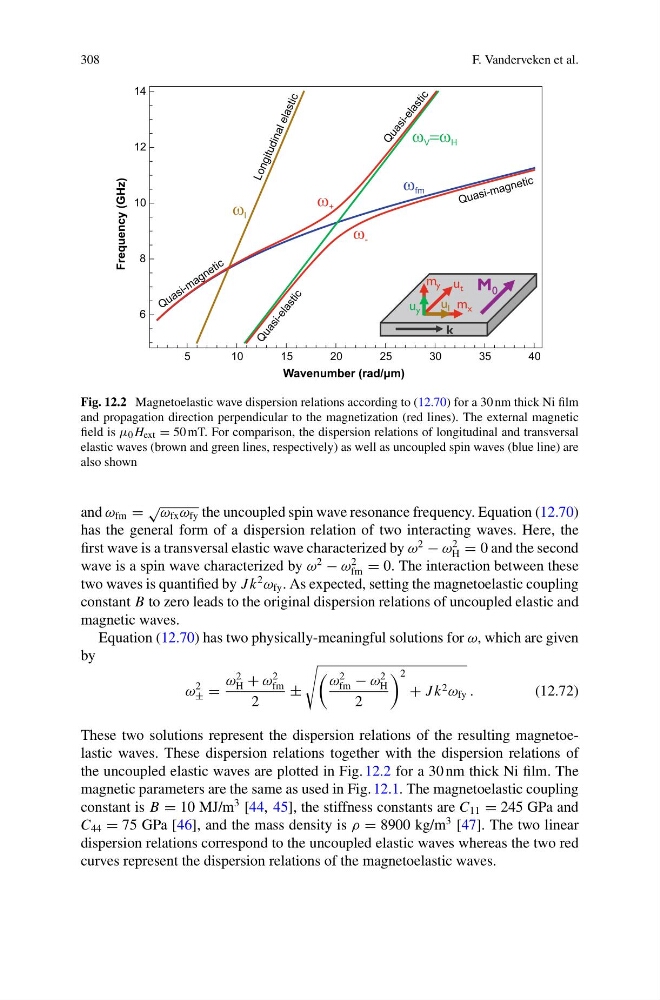
Fig. 12.2 Magnetoelastic wave dispersion relations according to (12.70) for a 30 nm thick Ni film
and propagation direction perpendicular to the magnetization (red lines). The external magnetic
field is μ 0 H ext = 50 mT. For comparison, the dispersion relations of longitudinal and transversal
elastic waves (brown and green lines, respectively) as well as uncoupled spin waves (blue line) are
also shown
and ω fm =
√
ω fx ω fy the uncoupled spin wave resonance frequency. Equation (12.70)
has the general form of a dispersion relation of two interacting waves. Here, the
first wave is a transversal elastic wave characterized by ω
2
− ω
2
H = 0 and the second
wave is a spin wave characterized by ω
2
− ω
2
fm = 0. The interaction between these
two waves is quantified by J k
2
ω fy . As expected, setting the magnetoelastic coupling
constant B to zero leads to the original dispersion relations of uncoupled elastic and
magnetic waves.
Equation (12.70) has two physically-meaningful solutions for ω, which are given
by
ω
2
± =
ω
2
H + ω
2
fm
2
±
ω
2
fm − ω
2
H
2
2
+ J k 2 ω fy .
(12.72)
These two solutions represent the dispersion relations of the resulting magnetoelastic waves. These dispersion relations together with the dispersion relations of
the uncoupled elastic waves are plotted in Fig. 12.2 for a 30 nm thick Ni film. The
magnetic parameters are the same as used in Fig. 12.1. The magnetoelastic coupling
constant is B = 10 MJ/m
3 [44, 45], the stiffness constants are C 11 = 245 GPa and
C 44 = 75 GPa [46], and the mass density is ρ = 8900 kg/m
3 [47]. The two linear
dispersion relations correspond to the uncoupled elastic waves whereas the two red
curves represent the dispersion relations of the magnetoelastic waves.
F. Vanderveken et al.
Fig. 12.2 Magnetoelastic wave dispersion relations according to (12.70) for a 30 nm thick Ni film
and propagation direction perpendicular to the magnetization (red lines). The external magnetic
field is μ 0 H ext = 50 mT. For comparison, the dispersion relations of longitudinal and transversal
elastic waves (brown and green lines, respectively) as well as uncoupled spin waves (blue line) are
also shown
and ω fm =
√
ω fx ω fy the uncoupled spin wave resonance frequency. Equation (12.70)
has the general form of a dispersion relation of two interacting waves. Here, the
first wave is a transversal elastic wave characterized by ω
2
− ω
2
H = 0 and the second
wave is a spin wave characterized by ω
2
− ω
2
fm = 0. The interaction between these
two waves is quantified by J k
2
ω fy . As expected, setting the magnetoelastic coupling
constant B to zero leads to the original dispersion relations of uncoupled elastic and
magnetic waves.
Equation (12.70) has two physically-meaningful solutions for ω, which are given
by
ω
2
± =
ω
2
H + ω
2
fm
2
±
ω
2
fm − ω
2
H
2
2
+ J k 2 ω fy .
(12.72)
These two solutions represent the dispersion relations of the resulting magnetoelastic waves. These dispersion relations together with the dispersion relations of
the uncoupled elastic waves are plotted in Fig. 12.2 for a 30 nm thick Ni film. The
magnetic parameters are the same as used in Fig. 12.1. The magnetoelastic coupling
constant is B = 10 MJ/m
3 [44, 45], the stiffness constants are C 11 = 245 GPa and
C 44 = 75 GPa [46], and the mass density is ρ = 8900 kg/m
3 [47]. The two linear
dispersion relations correspond to the uncoupled elastic waves whereas the two red
curves represent the dispersion relations of the magnetoelastic waves.