

12
T. Yu and G. E. W. Bauer
⎛
⎝
h x (r, t)
h y (r, t)
h z (r, t)
⎞
⎠ =
⎛
⎜
⎜
⎝
k + ηk y
cos (k · ρ − ωt)
k
2
y
k
+ ηk y
sin (k · ρ − ωt)
k z
k y
k
+ η
sin (k · ρ − ωt)
⎞
⎟
⎟
⎠
1
2
e
−ηkx
dx
m
k
R
x
e
ηkx
,
(1.28)
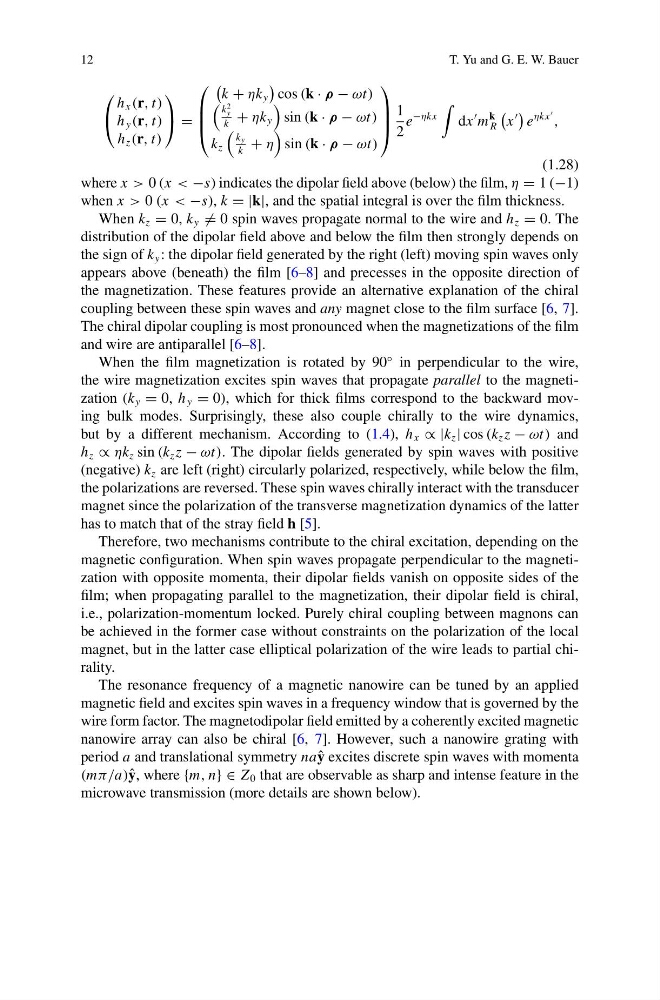
where x > 0 (x < −s) indicates the dipolar field above (below) the film, η = 1 (−1)
when x > 0 (x < −s), k = |k|, and the spatial integral is over the film thickness.
When k z = 0, k y = 0 spin waves propagate normal to the wire and h z = 0. The
distribution of the dipolar field above and below the film then strongly depends on
the sign of k y : the dipolar field generated by the right (left) moving spin waves only
appears above (beneath) the film [6–8] and precesses in the opposite direction of
the magnetization. These features provide an alternative explanation of the chiral
coupling between these spin waves and any magnet close to the film surface [6, 7].
The chiral dipolar coupling is most pronounced when the magnetizations of the film
and wire are antiparallel [6–8].
When the film magnetization is rotated by 90
◦ in perpendicular to the wire,
the wire magnetization excites spin waves that propagate parallel to the magnetization (k y = 0, h y = 0), which for thick films correspond to the backward moving bulk modes. Surprisingly, these also couple chirally to the wire dynamics,
but by a different mechanism. According to (1.4), h x ∝ |k z | cos (k z z − ωt) and
h z ∝ ηk z sin (k z z − ωt). The dipolar fields generated by spin waves with positive
(negative) k z are left (right) circularly polarized, respectively, while below the film,
the polarizations are reversed. These spin waves chirally interact with the transducer
magnet since the polarization of the transverse magnetization dynamics of the latter
has to match that of the stray field h [5].
Therefore, two mechanisms contribute to the chiral excitation, depending on the
magnetic configuration. When spin waves propagate perpendicular to the magnetization with opposite momenta, their dipolar fields vanish on opposite sides of the
film; when propagating parallel to the magnetization, their dipolar field is chiral,
i.e., polarization-momentum locked. Purely chiral coupling between magnons can
be achieved in the former case without constraints on the polarization of the local
magnet, but in the latter case elliptical polarization of the wire leads to partial chirality.
The resonance frequency of a magnetic nanowire can be tuned by an applied
magnetic field and excites spin waves in a frequency window that is governed by the
wire form factor. The magnetodipolar field emitted by a coherently excited magnetic
nanowire array can also be chiral [6, 7]. However, such a nanowire grating with
period a and translational symmetry na ˆ
y excites discrete spin waves with momenta
(mπ/a)ˆ y, where {m, n} ∈ Z 0 that are observable as sharp and intense feature in the
microwave transmission (more details are shown below).
T. Yu and G. E. W. Bauer
⎛
⎝
h x (r, t)
h y (r, t)
h z (r, t)
⎞
⎠ =
⎛
⎜
⎜
⎝
k + ηk y
cos (k · ρ − ωt)
k
2
y
k
+ ηk y
sin (k · ρ − ωt)
k z
k y
k
+ η
sin (k · ρ − ωt)
⎞
⎟
⎟
⎠
1
2
e
−ηkx
dx
m
k
R
x
e
ηkx
,
(1.28)
where x > 0 (x < −s) indicates the dipolar field above (below) the film, η = 1 (−1)
when x > 0 (x < −s), k = |k|, and the spatial integral is over the film thickness.
When k z = 0, k y = 0 spin waves propagate normal to the wire and h z = 0. The
distribution of the dipolar field above and below the film then strongly depends on
the sign of k y : the dipolar field generated by the right (left) moving spin waves only
appears above (beneath) the film [6–8] and precesses in the opposite direction of
the magnetization. These features provide an alternative explanation of the chiral
coupling between these spin waves and any magnet close to the film surface [6, 7].
The chiral dipolar coupling is most pronounced when the magnetizations of the film
and wire are antiparallel [6–8].
When the film magnetization is rotated by 90
◦ in perpendicular to the wire,
the wire magnetization excites spin waves that propagate parallel to the magnetization (k y = 0, h y = 0), which for thick films correspond to the backward moving bulk modes. Surprisingly, these also couple chirally to the wire dynamics,
but by a different mechanism. According to (1.4), h x ∝ |k z | cos (k z z − ωt) and
h z ∝ ηk z sin (k z z − ωt). The dipolar fields generated by spin waves with positive
(negative) k z are left (right) circularly polarized, respectively, while below the film,
the polarizations are reversed. These spin waves chirally interact with the transducer
magnet since the polarization of the transverse magnetization dynamics of the latter
has to match that of the stray field h [5].
Therefore, two mechanisms contribute to the chiral excitation, depending on the
magnetic configuration. When spin waves propagate perpendicular to the magnetization with opposite momenta, their dipolar fields vanish on opposite sides of the
film; when propagating parallel to the magnetization, their dipolar field is chiral,
i.e., polarization-momentum locked. Purely chiral coupling between magnons can
be achieved in the former case without constraints on the polarization of the local
magnet, but in the latter case elliptical polarization of the wire leads to partial chirality.
The resonance frequency of a magnetic nanowire can be tuned by an applied
magnetic field and excites spin waves in a frequency window that is governed by the
wire form factor. The magnetodipolar field emitted by a coherently excited magnetic
nanowire array can also be chiral [6, 7]. However, such a nanowire grating with
period a and translational symmetry na ˆ
y excites discrete spin waves with momenta
(mπ/a)ˆ y, where {m, n} ∈ Z 0 that are observable as sharp and intense feature in the
microwave transmission (more details are shown below).